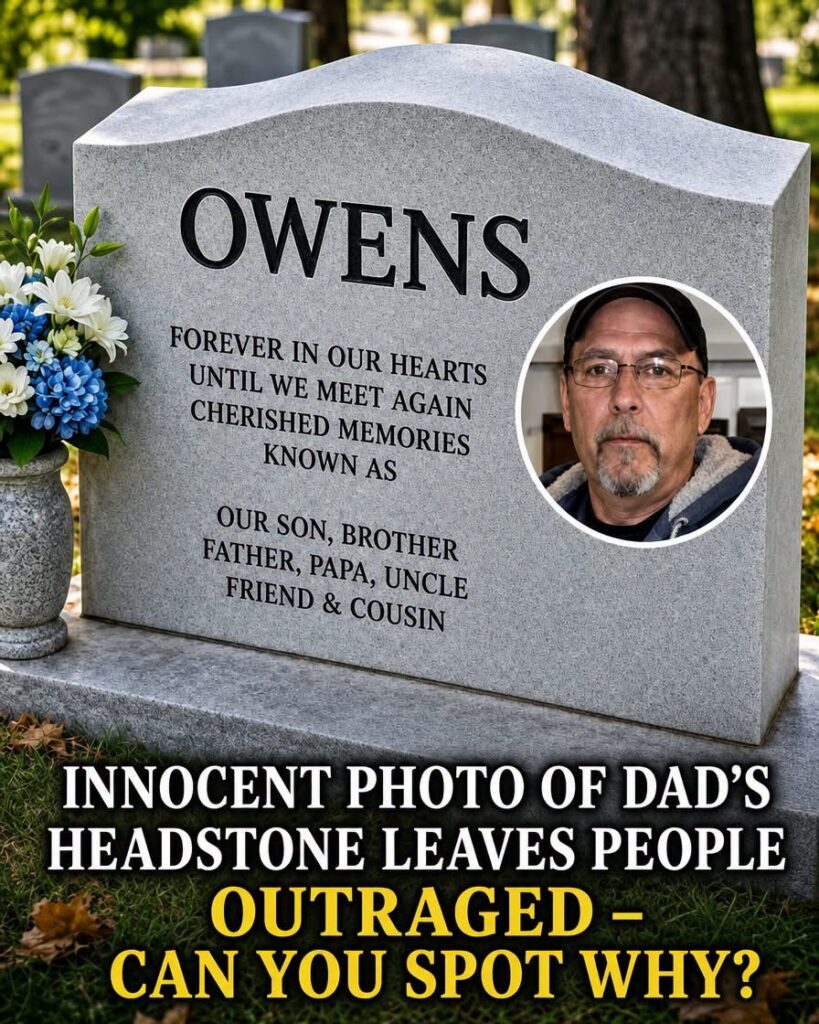
Death is traditionally framed as a great equalizer, a solemn boundary where worldly conflicts dissolve into quietude. We build cemeteries to reflect this idealized peace—rows of uniform markers, manicured lawns, and dignified epitaphs designed to offer universal comfort. Yet, the graveyard is rarely as neutral as it appears. It is a shared canvas where public regulations collide directly with private grief. When a family chooses to immortalize a loved one not with a traditional verse, but with a hidden acrostic spelling out a subtle profanity, it sparks a profound cultural clash.
The fight over this single headstone reveals how fragile the boundary truly is between private memory and public space. For the grieving family, the coded message is not a juvenile prank aimed at strangers; it is an authentic, intimate echo of the man they knew. Conversely, for the cemetery trustees, it represents a threat to the communal sanctuary of sorrow. Examining this tension exposes deeper questions about who truly owns a legacy, how we regulate grief in public, and what happens when an individual’s rebellious personality outlives their physical body.
The Anatomy of Private Grief: Honoring Authenticity Over Artifice
For the family standing behind the headstone, the hidden acrostic is an act of fierce preservation. Popular culture and societal expectations often demand that we sanitize our dead, turning complex, flawed human beings into one-dimensional paragons of virtue once they pass. We favor Latin phrases, biblical verses, and polite platitudes that soothe the living rather than accurately reflect the departed.
However, for those who knew and loved him intimately, sanitizing his headstone feels like a betrayal. The man they are mourning was likely sharp-tongued, irreverent, playful, and deeply resistant to authority. To carve a generic, pious message into his marker would be to lie in stone.
- The Refusal of Hushed Politeness: Refusing to treat death with hushed politeness is a way of keeping the deceased’s vibrant, disruptive spirit alive.
- Tactile Connection: The hidden code acts as an inside joke, a final private wink shared between the father, brother, or friend and those he left behind.
- Resistance to Erasure: Being asked by authorities to smooth out that rough edge feels less like complying with municipal code and more like sanding down his personality until only a generic, unrecognizable saint remains.
In this context, the headstone is an extension of the living room, the dinner table, and the garage where he cracked inappropriate jokes. It is a refusal to let bureaucracy dictate the terms of remembrance.
The Burden of Public Space: Guarding the Sanctuary of Shared Sorrow
Across the negotiating table sit the trustees, administrators, and community representatives. Their role is entirely divorced from the personal loss of the family, and that emotional distance shapes their perspective entirely. They are not mourning this specific man; instead, they are guarding a shared landscape meant to hold everyone’s collective sorrow.
Cemeteries operate as social contracts. They are designed to be neutral zones where people from all walks of life can bring their grief without encountering hostility, confusion, or deliberate provocation. When a family introduces a subversive element into a public graveyard, it introduces a slippery slope.
- The Slippery Slope of Taste: Trustees worry that once one sly insult or coded profanity is permanently allowed, the cemetery risks turning into a battleground of competing tastes and personal statements rather than remaining a peaceful refuge.
- The Equality of the Grounds: A public cemetery relies on a baseline of shared decorum to function. If everyone uses their loved one’s marker to make countercultural statements, the landscape loses its calming uniformity.
- Protecting the Stranger: Visitors walking through the grounds are vulnerable; they are navigating raw grief and expect the environment to hold them gently. An intercepted vulgarity, even a hidden one, can feel jarring and intrusive to a stranger seeking solace.
The trustees are not necessarily acting out of malice or a desire to censor; they are acting out of a mandate to protect the broader community’s right to a peaceful, contemplative environment.
The Philosophical Dilemma: Who Owns a Legacy?
At the heart of this standoff lies an unanswerable philosophical question: Who truly owns a legacy? Does it belong exclusively to the family who shared a life, a home, and private jokes with the deceased? Or does it belong, in part, to the public sphere where that legacy is permanently displayed?
The truth is that a legacy lives uneasily in both places at once:
- In the Hearts That Remember: In this private sphere, legacy is fluid, emotional, and specific. It thrives on inside jokes, shared memories, and the unfiltered truth of who a person was—warts, profanity, and all.
- In the Shared Ground: In this public sphere, legacy is formal, communal, and bound by civic expectations. It must coexist peacefully with the memories of hundreds of other families who have equal claim to the landscape.
When these two realms collide, compromise is agonizingly difficult. To alter the stone is to wound the family’s sense of authenticity. To leave the stone untouched is to disrupt the community’s sense of sanctuary. There is no neat legal or emotional answer that satisfies every stakeholder.
Finding the Middle Ground Between Rule and Remembrance
Resolving conflicts over unconventional memorials requires moving past rigid ultimatums and recognizing the validity of both sides. For families, acknowledging that public spaces require certain boundaries can help temper the feeling of personal persecution. For administrators, developing frameworks that allow for personalized, even unconventional expressions of individuality—without crossing into overt offensiveness in shared pathways—can prevent grief from turning into a bureaucratic war.
Ultimately, the hidden acrostic on the grave stands as a testament to human complexity. It reminds us that death does not instantly turn us into angels, and our love for one another often encompasses the very quirks and roughness that polite society tries to smooth away.
“A legacy lives uneasily in both places at once: in the hearts that remember, and in the shared ground that must carry those memories side by side.”
How do you think public spaces should balance individual freedom of expression with the collective comfort of a community?