A lesbian couple asked ChatGPT to generate an image of a family based on a photo of them together. The result, however, told a completely different story. The AI-generated image produced a heterosexual family setup, featuring a man, a woman, and two children, reinterpreting the original subjects according to a traditional scheme. The result quickly made the rounds on social media, reopening the debate on artificial intelligence biases and the representation of LGBTQIA+ families.
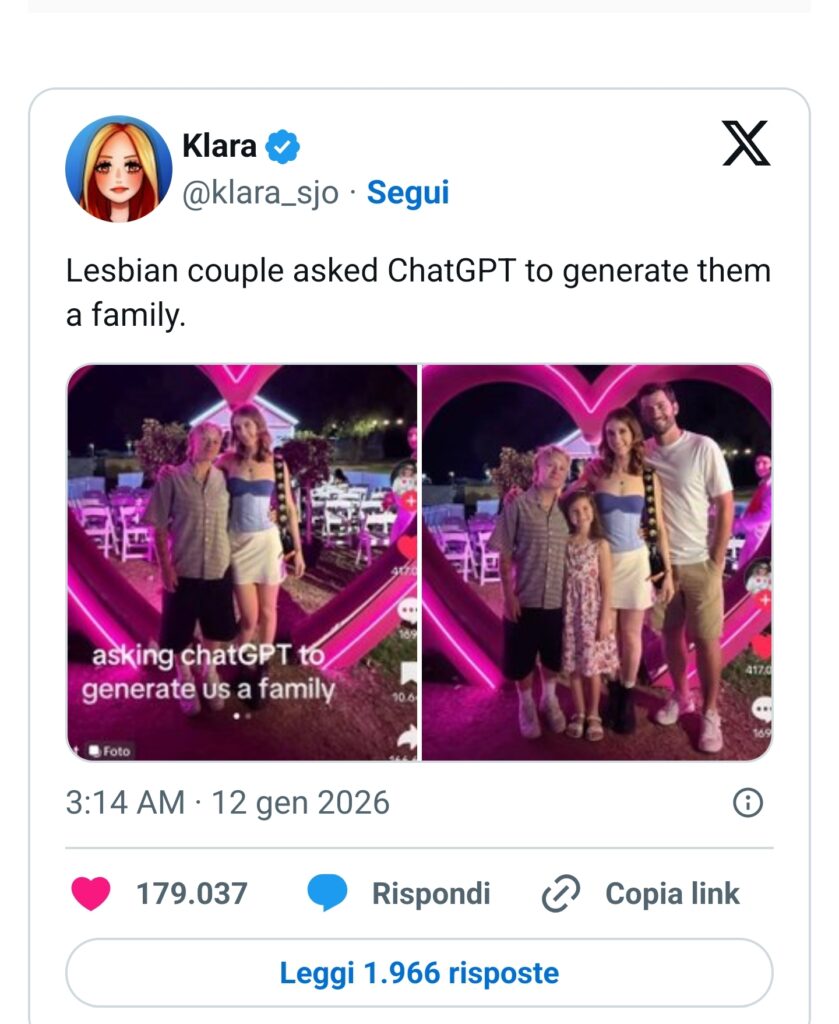
AI-generated image
ChatGPT’s generated image and heterosexual “normalization”
According to numerous online shares, ChatGPT’s output ended up depicting one of the two women—the one with short hair and clothing perceived as more masculine—as a male child, joined by a fictional little sister. Next to the other woman from the original photo appeared a man, interpreted by the system as the family’s father.
The artificial intelligence thus automatically forced the image into a heterosexual family mold, ignoring the context and the users’ explicit request. This interpretation seems to be based on two main elements: the outfit of one of the women and, above all, the cognitive biases stemming from the way artificial intelligence learns from the data it was trained on.
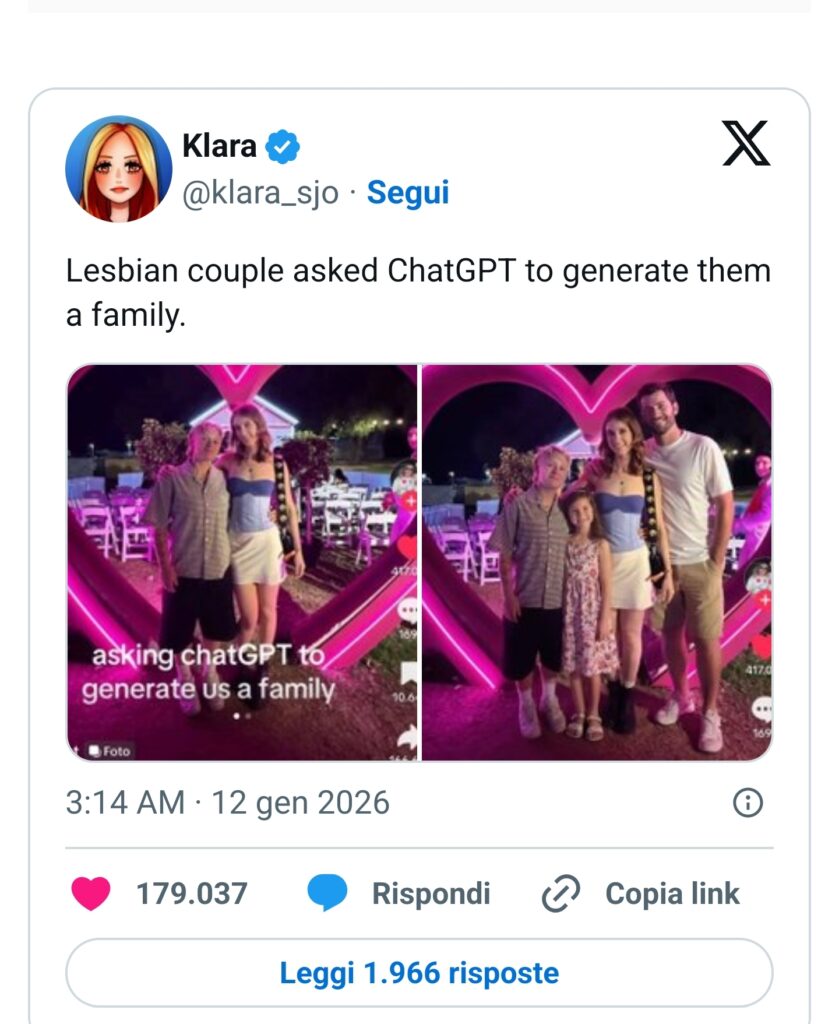
Lesbian couple asked ChatGPT to generate them a family. pic.twitter.com/0uONZUiTkX
— Klara (@klara_sjo) January 11, 2026
Why the AI “sees” a hetero family as more probable
The case quickly went viral online, becoming an emblematic example of the structural limitations of these systems. Artificial intelligence, in fact, does not understand relationships or the social meaning of images: it processes massive amounts of data and returns the statistically most probable response.
The “traditional family”—composed of a mother, father, and children—is still the dominant model in online datasets, which is why the AI tends to reproduce that template as a default. This is the direct effect of training based on unbalanced data.
A similar dynamic, as also reported on Reddit, allegedly occurred with a gay couple, to whom the system returned an image equally distant from the original request.

Gay couple asked ChatGPT to generate a family
The story, also covered by Demografica AdnKronos, sparked a broad discussion on social media. Among the comments, some tended to minimize the incident, arguing that “there is nothing strange” about the AI-generated image since—according to this reading—a same-sex couple cannot have children. This claim, however, ignores the reality of rainbow families, which are present and well-established today in many countries, including Italy.
Other users instead expressed disappointment and anger over comments deemed discriminatory, criticizing ChatGPT for reinforcing a dominant vision of the traditional family and for rendering queer families invisible.
Finally, there are those who urge toning down the accusations leveled at artificial intelligence, emphasizing the importance of the instructions provided by users: “You just had to tell the AI that you are lesbians,” writes a girl on Facebook.
This position also touches on a central node in the debate on artificial intelligence: the often poorly informed use of these tools. Generative systems, in fact, function based on the information they receive and require clear, contextualized instructions. In the absence of real digital literacy, the risk is attributing responsibilities to the AI that also stem from imprecise prompts, without losing sight of a structural element: when established cultural models come into play, artificial intelligence tends to reinforce them anyway, making the outputs problematic even beyond the individual human error.
ChatGPT’s stereotypes (and beyond)
Several studies show how ChatGPT, like other large language models, incorporates deeply rooted stereotypes. A 2025 UNESCO report analyzing the behavior of systems like Llama 2 and GPT-2 highlights how a significant share of content generated about homosexual people presents negative or stigmatizing elements: about 70% in the case of Llama 2 and 60% for GPT-2.
Representations include discriminatory language, associations with immorality or deviance, and reductive narratives of LGBTQIA+ identities. These biases also emerge when generating family images: when requests come from same-sex couples, the artificial intelligence tends to steer the scenario toward heterosexual configurations, introducing unrequested male figures or turning same-sex partners into hetero couples.
At the same time, women continue to be represented more frequently in domestic roles—up to four times more than men—reinforcing gender stereotypes linked to caregiving and parenthood.
It is important, however, to emphasize this: artificial intelligence does not deliberately choose to discriminate. Biases stem from the datasets used for training, which draw largely from the internet, where traditional representations of family still prevail.
Even in the most recent versions of the models, these asymmetries persist despite fine-tuning correction attempts. Technological neutrality in this context proves to be an illusion.
AI and LGBTQIA+ families: are there more inclusive solutions?
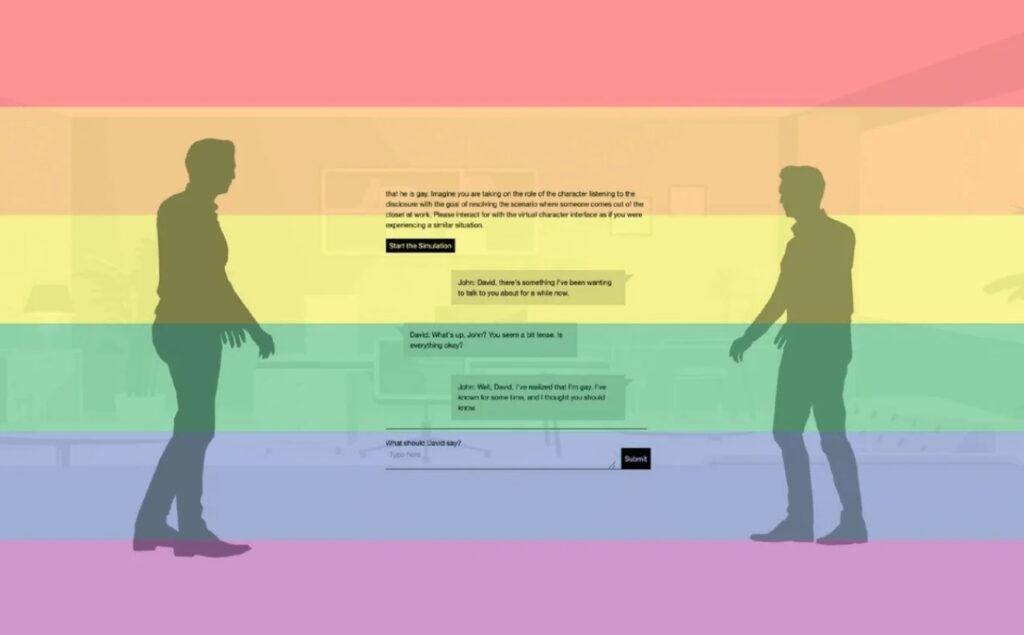
AI Comes Out of the Closet
Currently, there are no generative AI models specifically designed to systematically represent LGBTQIA+ families. However, there are interesting projects trying to reduce bias.
The MIT developed the “AI Comes Out of the Closet” simulator, designed to promote empathy and advocacy skills toward LGBTQIA+ people in workplaces through AI-mediated coming out scenarios.
In academia, some researchers are working on frameworks based on affirmative therapy principles, aiming to create chatbots capable of offering safe and validating mental health support to LGBTQIA+ individuals. Other developers are experimenting with models that ask for preferred pronouns or use neutral language, but these are still preliminary attempts.
The most effective strategy relies on the inclusion of LGBTQIA+ individuals in development teams and a critical review of the datasets used for training. Numerous studies show that the presence of diverse skills and backgrounds within technical groups helps make systems more equitable and improves the quality of generated responses.