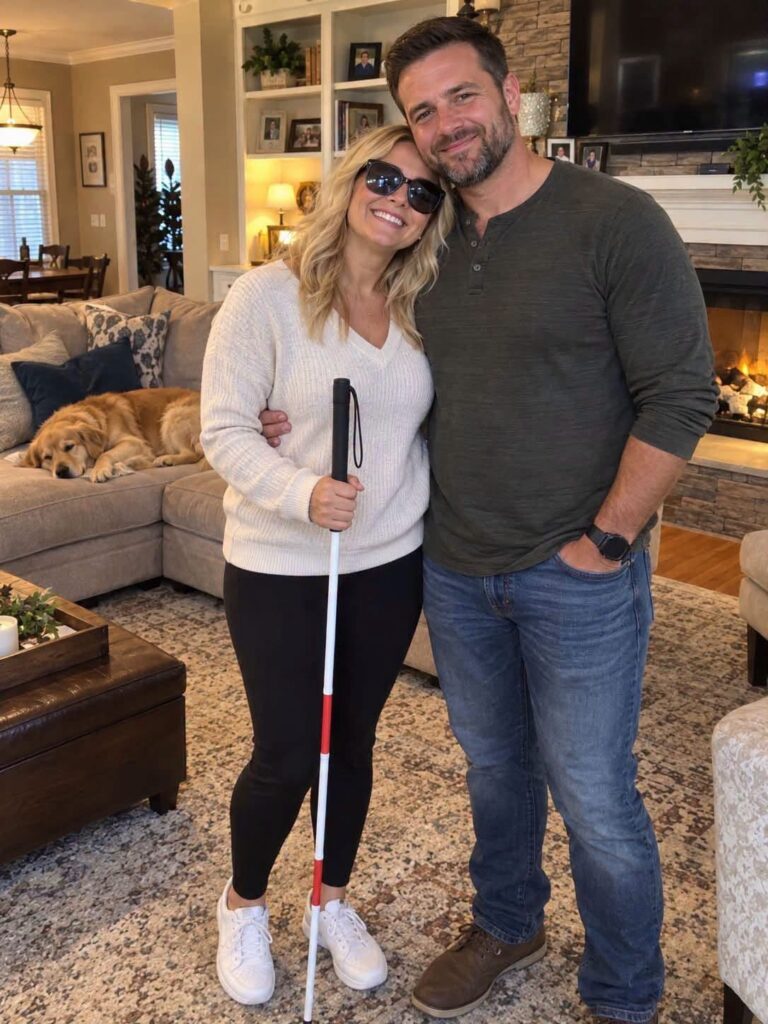
What He Kept Under the Bed
My fingers touched something hard and plastic.
I pulled it out from under the bed slowly. Carefully. The way I’d learned to do everything over the past two years. Feeling for the edges first. Listening for what might fall.
It was a storage bin. The clear kind with a blue lid. The kind we used to keep Christmas ornaments in.
I set it on the floor in front of me and knelt down beside it.
Everything was still blurry. The morning light coming through the bedroom window turned the whole room into soft shapes. The bed was a big pale rectangle. The dresser was a dark smudge. The bin in front of me was a cloudy box with something inside.
I leaned closer. Six inches from it. That’s how close I had to get to see anything clearly.
On top, right under the clear lid, was a stack of papers.
And across the top page, in big black letters, bold enough that even my broken eyes could read them, were three words.
PETITION FOR DISSOLUTION.
The second I saw it, my stomach dropped.
I sat back on my heels.
I couldn’t breathe.
Dissolution.
I know what that means. I’m not stupid. I was blind, not stupid.
Dissolution of marriage.
Divorce.
My name is Callie Reed. I’m thirty-four years old.
Two years ago, on a rainy Tuesday night in November, I was driving home from my flower shop in Tulsa when a delivery truck ran a red light at the corner of Peoria and Fifteenth.
I don’t remember it. The doctors say that’s normal. The brain protects you.
What I know, I know from the police report and the hospital records and what Ashton told me later.
The truck hit my driver’s side door at forty-one miles an hour. My little Honda Civic spun twice and hit a light pole. The firefighters had to cut me out.
I broke my left arm in three places. Four ribs. My pelvis. My left femur. My collarbone. I had a collapsed lung and a lacerated spleen.
And my head hit the driver’s side window so hard that it damaged the part of my brain that processes what I see.
They called it cortical blindness. My eyes were fine. Perfectly healthy. The light went in. But my brain couldn’t make sense of it anymore.
I woke up in the ICU at Saint Francis eleven days after the crash.
I opened my eyes.
And there was nothing.
Not black. People think blindness is black. It isn’t. It’s nothing. It’s like trying to see out of your elbow.
I screamed.
I remember that. I remember screaming and somebody grabbing my hand. A big warm hand. Calloused at the base of the fingers.
“Cal. Cal. It’s me. I’m here. I’m right here.”
Ashton.
Doctors couldn’t promise I’d ever see again.
Dr. Okonkwo, the neuro-ophthalmologist, sat on the edge of my hospital bed and explained it to me in a soft, careful voice. Some patients with cortical blindness recover partially. A few recover a lot. Most recover a little. Some never do.
Ezoic
“There’s no way to know,” he said. “The brain is remarkable. Sometimes it finds new pathways. Sometimes it takes years. I won’t lie to you, Mrs. Reed. It may not happen.”
“But there’s a chance,” Ashton said. He was holding my hand. He hadn’t let go of it since I woke up.
“There’s a chance,” Dr. Okonkwo said.
“Then that’s what we’re holding onto,” Ashton said.
God, those first months were hell.
I spent six weeks at Saint Francis. Then three months at an inpatient rehab center learning to walk again. On a broken pelvis and a rebuilt femur. With a walker. Without being able to see where I was walking.
Ezoic
Then home.
To a house I’d lived in for six years and suddenly didn’t know at all.
I walked into walls. I knocked over glasses. I fell down the two steps from the kitchen to the living room so many times that Ashton put down a rug with a different texture at the top so I’d know where the edge was.
I couldn’t cook. I couldn’t read. I couldn’t drive. I couldn’t pick out my own clothes. I couldn’t see my own face in the mirror.
Ezoic
I couldn’t run my flower shop.
The flower shop was called Bloom & Thistle. On Cherry Street. I’d opened it four years before the crash with a ten-thousand-dollar loan from my grandmother and every penny of my savings.
It was the only thing I’d ever built myself.
I sold it in March. Five months after the crash. To my assistant, Marisol. For a third of what it was worth. Because I couldn’t see the flowers anymore.
I sat in Ashton’s truck outside the shop on Marisol’s first day as owner and cried for an hour.
“You’ll have another one,” Ashton said. “When you’re better. You’ll open another one.”
“I can’t see, Ash.”
“Yet,” he said. “You can’t see yet.”
My husband, Ashton, was amazing through all of it.
I want to say that clearly. Before I tell you anything else.
He was amazing.
He took three months of unpaid leave from his job. He’s a project manager for a commercial construction company. Oakridge Builders. They build hospitals and schools and office buildings all over Oklahoma.
He slept in the chair next to my hospital bed for six weeks.
When I came home, he helped me shower. He sat on the edge of the tub with the water running and held my arm while I washed my hair. He helped me get dressed. He laid out my clothes on the bed every morning in the same order so I’d know where everything was. Underwear on the left. Then pants. Then shirt. Then socks on the right.
He labeled everything in the kitchen. He bought a label maker with raised letters. He learned which spices were which by smell so he could teach me.
He read to me. Every night. For a year. We went through all seven Harry Potter books. He did the voices. He was terrible at the voices. He did Hagrid like a pirate.
He taught me how to use my phone with my voice. He set up the screen reader. He downloaded an app that could tell me what color my shirt was.
He held my hand at every doctor’s appointment.
He told me I was beautiful. Every single day. Even when I couldn’t see myself. Even when I had scars across my collarbone and a limp from my pelvis and I hadn’t brushed my hair in three days.
Ezoic
“You’re still the most beautiful woman I’ve ever seen,” he’d say.
“How would I know?” I’d say. “I can’t see.”
“You’ll just have to trust me,” he’d say.
Seriously, I don’t know how I would have gotten through it without him.
But lately, things have been rough between us.
Really rough.
It started about six months ago. Maybe seven.
Ashton started coming home late. Later than usual. Ten o’clock. Eleven sometimes. He said it was overtime. A big project. A new wing at the children’s hospital in Oklahoma City.
Ezoic
He was tired. All the time. He’d come home and fall asleep on the couch in his clothes.
And he got irritated.
Over the smallest things.
If I knocked over a glass, he’d sigh. Loud. Not the old sigh. Not it’s okay, babe, I’ve got it. A different sigh. Tired. Sharp.
If I asked him to read the mail to me, he’d say, “Can it wait?”
Ezoic
If I asked what was wrong, he’d say, “Nothing.”
If I asked again, he’d say, “I said nothing, Callie.”
We argued way more than we used to.
About stupid things. The dishes. The thermostat. Whether I’d taken my medication. Whether he’d called my mom back.
He snapped at me. I snapped back. He’d leave the room. I’d sit there in the dark, which was always, and cry.
Ezoic
We’d never argued like that. Not in nine years of marriage. Not even in the hospital.
Honestly, I’d started wondering if he was just tired of taking care of me.
I didn’t blame him. I really didn’t.
He’d married a woman who could see. Who ran her own business. Who cooked dinner and drove herself to the grocery store and picked out her own clothes.
Ezoic
And now he was married to someone who couldn’t find the bathroom in a strange restaurant. Who needed help cutting her steak. Who couldn’t see his face.
Two years is a long time.
People get tired.
I lay in bed some nights next to him and listened to him breathe and thought, He’s going to leave. Someday soon. He’s going to wake up one morning and realize he’s thirty-six years old and he’s spent two years being a nurse instead of a husband. And he’s going to leave.
I thought about it every night.
I didn’t say anything.
I was too scared.
Then, a couple of weeks ago, something happened.
I was sitting at the kitchen table in the morning. Drinking coffee. The sun was coming through the window over the sink.
Ezoic
And I saw it.
Not saw it, exactly. Not like seeing. More like a feeling in my eyes. A change. A brightness. A smudge of something lighter in the nothing.
I held very still.
I turned my head.
It moved.
The light moved when I moved my head.
I turned back.
It was still there.
A window.
I was looking at a window.
I didn’t say anything to Ashton.
I was scared.
Scared it wasn’t real. Scared it was my brain playing tricks on me. Scared I’d tell him and get his hopes up and then wake up the next day and it would be gone.
I’d seen it happen to other people. In my support group. A man named Dennis who thought his sight was coming back. Who told his whole family. Who threw a party.
Ezoic
Then it went away. In three days. Like it was never there.
He stopped coming to group after that.
So I kept it to myself.
But it didn’t go away.
The next day, I could see the window again. And a dark shape that was the refrigerator.
The day after that, I could see the edge of the kitchen table. And my own hand when I held it up in front of my face.
Ezoic
My hand.
I cried for twenty minutes.
I made an appointment with Dr. Okonkwo.
I went alone. I took an Uber. I told Ashton I was going to my support group.
I sat in the exam chair in the dark room while Dr. Okonkwo shined lights in my eyes and held up cards and asked me what I could see.
“Shapes,” I said. “Light and dark. Movement. I can see your hand. Is that your hand? Is it moving?”
Ezoic
“It’s moving,” Dr. Okonkwo said.
His voice sounded strange. Like he was smiling.
He ran more tests. He put me in a big machine. He did a visual field test where I pressed a button every time I saw a flash of light.
Then he sat down across from me.
“Mrs. Reed,” he said. “Your brain is rewiring. The visual cortex is finding new pathways. Your vision is improving. Significantly.”
I couldn’t breathe.
“How much will come back?”
“I don’t know,” he said honestly. “But based on what I’m seeing, a lot. Maybe most of it. It could keep coming back over the next few weeks or months. It won’t be perfect. You’ll probably have some blind spots. Some blurriness. But…” He paused. “I think you’re going to see again, Callie.”
Ezoic
Y’all, I nearly cried right there in his office.
No.
I did cry. Right there in his office. In the exam chair. With my face in my hands.
Dr. Okonkwo handed me a box of tissues.
“Where’s your husband?” he asked gently. “He’s usually here. He never misses an appointment.”
“I didn’t tell him,” I said.
Dr. Okonkwo looked surprised.
“I want to surprise him,” I said. “When I can really see. When I can see his face. I want the first thing I tell him to be, I can see you.”
Ezoic
Dr. Okonkwo smiled.
“That,” he said, “is going to be a very good day.”
I wanted to tell Ashton so badly.
Every night. When he came home late and fell asleep on the couch. When he snapped at me about the dishes. When I lay in bed next to him.
I wanted to grab his face in my hands and say, Ash, I can see light. I can see shapes. I can see the window. I can see my hand.
Ezoic
But I didn’t.
I figured I’d wait.
And surprise him when I could actually see his face again.
So I pretended.
For two weeks. I pretended I was still completely blind.
It was harder than you’d think. When you can see a glass, you reach for it differently. You don’t feel for it. Your hand just goes there. I had to stop myself. I had to feel for things on purpose.
Ezoic
I had to pretend not to notice when the light changed. When someone walked in front of the window. When Ashton turned on the bedroom lamp.
I had to look at the wrong spot when he talked to me. The way I’d learned to do. Somewhere near his voice. Not at his face.
I don’t know if he noticed anything.
I don’t think he did.
He was so tired.
Well, yesterday, I could finally make out furniture.
And movement around me.
Everything was still blurry. Like looking through a shower door. Soft edges. Colors that bled into each other.
Ezoic
But I could see.
I could see the couch. Navy blue. I’d forgotten it was navy blue.
I could see the coffee table. Dark wood.
I could see a lamp. A rug. A doorway.
I could see the kitchen. The white cabinets. The window over the sink. A blur of green outside that was the backyard.
I stood in the middle of my living room and turned in a slow circle and cried.
Ezoic
I could see.
That evening, Ashton came home in a bad mood.
Worse than usual.
It was nine-forty-five. I was sitting on the couch. I’d been sitting there since five, waiting for him. Pretending to listen to an audiobook. Actually watching the front door.
I’d planned it all out. I was going to wait until he came in. I was going to look straight at him. Right at his face. And say, Hi, Ash. You look tired.
I wanted to see his reaction.
I wanted to see his face when he realized I could see it.
Ezoic
The front door opened.
A blurry shape came through it. Tall. Broad. Dark hair. Wearing something gray.
Ashton.
My husband.
I could see him.
Not clearly. A shape. A blur. A man-shaped smudge in the doorway.
But I could see him.
My heart was pounding so hard I thought he’d hear it.
Ezoic
He dropped his keys on the table by the door. Hard. They clattered.
He didn’t say hello.
He walked past me into the kitchen. I watched him go. A gray shape moving across the room.
I heard the refrigerator open. A bottle cap. He was drinking a beer.
Ezoic
“Ash?” I said.
“What.”
Not hey, babe. Not how was your day.
What.
“Is everything okay?” I asked.
“It’s fine.”
“You seem upset.”
“I said it’s fine, Callie.”
I could see him now. Leaning against the kitchen counter. His head down. One hand pressed against his forehead.
I stood up.
I walked toward the kitchen. Slowly. I almost walked right to him. Then I remembered. I had to pretend. I had to put my hand out. Feel for the doorframe. Feel for the counter.
“Did something happen at work?”
“Can you just—” He stopped. He took a breath. “Can you just leave it? Please? For one night? I don’t want to talk about it.”
Ezoic
“I’m your wife, Ash. If something’s wrong, I want to know.”
“Nothing’s wrong!” he said.
He said it loud. Almost a shout.
He’d never shouted at me. Not once in nine years.
We ended up arguing again.
I don’t even remember about what. Something about the electric bill. He said I’d left the space heater on in the spare room again. I said I hadn’t. He said I had. He said it was costing us money we didn’t have.
Ezoic
“What do you mean, money we don’t have?”
“Nothing,” he said. “Forget it.”
“Ash, what do you mean?”
“I mean forget it, Callie. Jesus. Can I just have one night