My husband left me for a younger woman, tookour children and the rest of the family overseas tocelebrate his new marriage, and sent me amessage telling me to disappear before theyreturned.
“Be gone before we return. I hate old things. Iwork hard, so I deserve a fresh start.”
He seemed convinced that I would simply accepthis decision and leave everything behind.
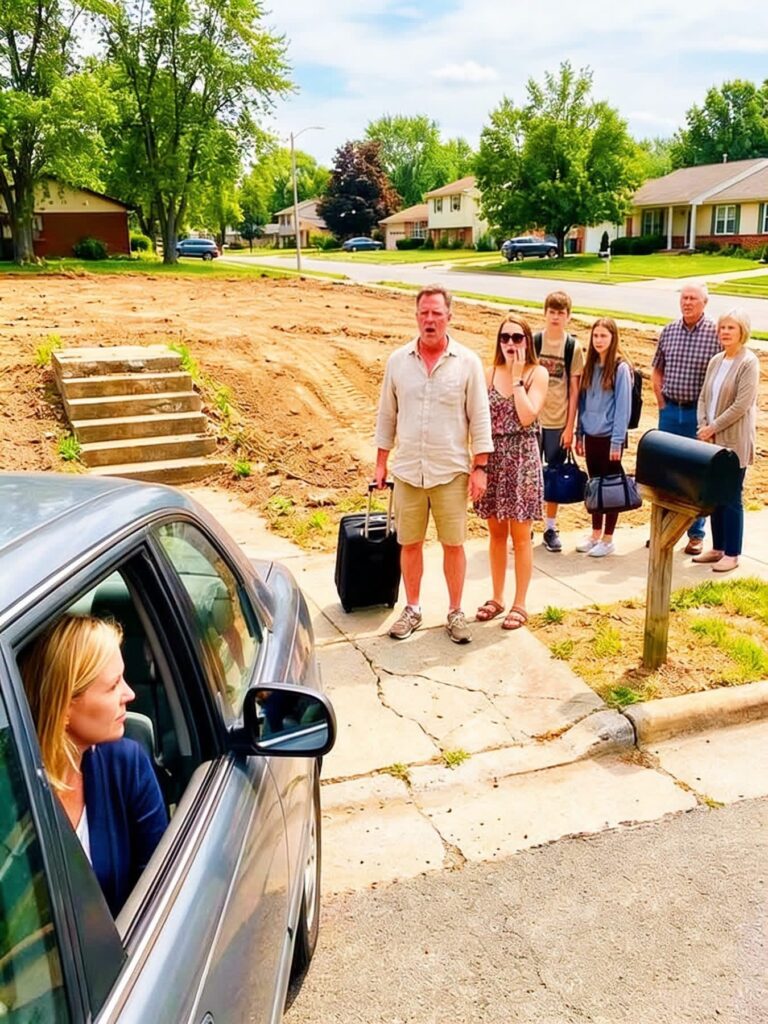
But when he returned from his luxurious trip,laughing with his new wife and carrying hisluggage, he discovered that the house he hadtaken for granted was no longer standing wherehe had left it.
There was nothing but bare land.
I watched from my parked car down the road, andI couldn’t stop smiling.
My name is Natalie Caldwell, and until thatmorning, I had spent most of my adult lifebelieving that keeping a family together wasworth almost any sacrifice.
I was wrong.
The message arrived at 2:13 in the morning.
My phone lit up the nightstand, pulling me out of arestless sleep.
I reached for it, expecting something unimportant.
Instead, I saw a message from my husband,Ethan.
“Be gone before we return. I hate old things. Iwork hard, so I deserve a fresh start.”
I stared at the screen.
Before I could even process what he had written,another message appeared.
“Don’t make this embarrassing. The kids arecoming with us.”
I felt something tighten in my chest.
There was no apology, no explanation, andcertainly no concern about what I might befeeling.
Ethan had already made his decision. Apparently,he believed he could simply announce it andexpect everyone else to rearrange their livesaround him.
That was how he had always operated.
My husband had a particular talent for makingselfish decisions sound like reasonable businessarrangements. He used short sentences, spokewith confidence, and rarely left room for anyoneto disagree.
For years, I had mistaken that confidence forstrength.
Now I understood that it was often just arrogance.
Three weeks earlier, Ethan had told me he wasleaving our marriage.
We had been standing in the kitchen, beside theisland where I had prepared thousands of mealsfor our family. My coffee was sitting untouched,growing cold while he explained that he wantedsomething different.
He said he had met someone.
Her name was Sienna.
She was twenty-six years old, had beautiful hair, aperfect smile, and the kind of confidence thatcomes from never having to worry about wherethe next mortgage payment will come from.
Ethan spoke about her as though she representedeverything he had been missing.
He said he wanted excitement.
He wanted freedom.
He wanted to feel young again.
I listened without interrupting.
Then he announced that he had already arrangeda wedding overseas.
Not only had he planned to marry Sienna, but hehad also invited almost everyone in the family.
His parents were going.
Our two teenage children were going.
Several relatives and family friends had alsoreceived invitations.
Apparently, he had decided that leaving mebehind was simply another detail to organize.
I remember looking at him and asking onequestion.
“What did you tell the children?”
He shrugged.
“They know we’re having problems. They’llunderstand.”
I wanted to ask how he could possibly expectthem to understand something he hadn’t evenproperly explained.
But I remained silent.
I didn’t cry in front of him.
I didn’t beg him to reconsider.
I didn’t ask what Sienna had that I didn’t.
I simply sat there while he described his plans asthough he were discussing a business trip.
For years, I had supported Ethan through difficultperiods. I had helped when his businessstruggled, managed the household, raised ourchildren, and taken care of countlessresponsibilities that he rarely noticed.
I had believed we were building a life together.
Now he was telling me that he deserved a freshstart.
And somehow, in his mind, I was the old thing thatneeded to be removed.
The morning after his message, somethingunexpected happened.
Ethan accidentally emailed the flight itinerary toour shared email account.
He had probably intended to send it to someoneelse.
I opened the message and found the completetravel schedule.
Departure date.
Return date.
Hotel reservations.
Flight information.
Everything was there.
I looked at the dates and realized that Ethan hadgiven me something valuable without intending to.
Time.
I knew exactly how long he would be away.
That afternoon, I sat at the dining table andopened the county property records website.
I had looked at those documents many timesbefore, but this time I wanted to remind myself ofsomething important.
The deed.
I entered the property details and waited for theinformation to appear.
When the ownership record loaded, I read itcarefully.
Owner: Natalie Caldwell.
Not Ethan Caldwell.
Not Ethan and Natalie.
Just me.
The land had originally belonged to my father.
Before he passed away, he had transferredownership to me. He had always been protectiveof his property and believed that important legaldecisions should be handled carefully.
Ethan had never liked that arrangement.
He used to joke about it, calling it my father’s littleobsession with paperwork.
He never bothered to challenge it or understandwhat it meant.
He simply assumed that because we weremarried and living in the house, he had the samecontrol over everything.
But ownership and marital rights are not alwaysthe same thing, and I knew I needed proper legaladvice before making any decisions.
Two days later, I found myself sitting across froma real estate attorney named Gloria Mendez.
Her office was in a small shopping center. Theroom smelled faintly of printer toner andpeppermint gum.
I handed her a folder containing Ethan’smessages, the property documents, and thetravel itinerary.
She read everything carefully.
Then she looked up.
“You want him removed from the property?” sheasked.
“I want to know what rights I have and what I canlegally do.”
Gloria nodded.
“That’s the right place to start.”
I explained everything.
The affair.
The sudden wedding.
The message ordering me to leave.
The fact that Ethan had taken our childrenoverseas without properly discussing the situationwith me.
She listened patiently.
When I finished, she placed the papers on herdesk.
“First, we need to establish exactly how theproperty is titled, whether there are any maritalclaims or other interests, and whether anyone hasoccupancy rights. Your father’s transfer isimportant, but we cannot assume that it answersevery legal question.”
I appreciated her honesty.
I didn’t want revenge badly enough to make amistake that could cost me everything.
“What happens if he returns and tries to force hisway into the house?” I asked.
“We can examine the available legal protectionsand seek appropriate orders if the circumstancessupport them. We also need to address thedivorce and your financial situation.”
She paused.
“One thing is certain, Natalie. You need to stopmaking decisions based on what Ethan mightthink. We need to make them based on whatprotects you.”
For the first time in weeks, I felt that someone wastaking my situation seriously.
We began organizing the evidence.
I filed for divorce.
I froze my credit and opened a separate bankaccount at another financial institution.
I saved every message Ethan had sent me.
His insults.
His demands.
His instructions to disappear.
I also kept copies of the documents relating to theproperty.
Gloria explained that Ethan’s written messagescould become relevant to the proceedings,particularly when considered alongside thecircumstances surrounding his departure.
She also helped me understand the differencebetween owning the property, having the right tooccupy it, and having the authority to removesomeone else’s belongings.
Nothing would be done without reviewing thelegal requirements.
Then came the question of the house itself.
It wasn’t just a building.
It was the place where I had raised our children.
It was where I had prepared birthday cakes,decorated the Christmas tree, and stayed awakeduring countless nights when one of the childrenhad a fever.
It was where Ethan and I had once promised eachother that we would grow old together.
I had spent decades making that house feel like ahome.
But now, every room reminded me of how easilyEthan had decided that my life could bediscarded.
One afternoon, Gloria introduced me to a licensedand insured modular-home relocation company.
The owner came to inspect the property.
He walked through the house carefully, examiningthe structure and discussing what would beinvolved in moving it.
He explained that not every house could berelocated. The foundation, construction, accessroads, utility connections, permits, and conditionof the building all mattered.
He took measurements and made notes.
Finally, he turned toward me.
“Depending on the structural assessment andapprovals, this house may be movable. We wouldneed to finalize the engineering plan andpermissions first.”
I looked around the living room.
The family photographs were still hanging on thewalls.
The dining table was where we had celebratedbirthdays.
The kitchen was where I had spent so manyevenings preparing meals for people who barelynoticed the effort.
I felt tears gathering in my eyes.
“Can you do it without damaging the structure?”
He explained what would be required and told methat the final decision would depend on theengineering assessment.
I nodded.
“Then let’s see what can be done.”
Over the following days, the legal and technicalwork continued.
Gloria handled the property questions, while therelocation company prepared its plans andreviewed the necessary approvals.
I didn’t tell Ethan what I was considering.
He hadn’t asked how I was doing.
He hadn’t asked whether I had somewhere to go.
He had simply instructed me to disappear.
And I had finally stopped treating his demands asinstructions I was required to follow.
The week Ethan departed overseas, I receivedanother message.
It was a photograph of the family at the airport.
Sienna stood beside him, smiling brightly.
Our children were standing nearby, looking lessenthusiastic than the adults.
Ethan had written:
“Enjoy your quiet time. We’ll be back soon.”
I stared at the photograph for a long time.
I wanted to call the children.
I wanted to ask whether they were comfortableand whether they understood what washappening.
But I also knew that they were caught in themiddle of a situation they hadn’t created.
So I sent them a separate message.
“I love you both. Whatever happens between yourfather and me, that will never change.”
Neither responded immediately.
That night, I sat alone in the house.
The silence was overwhelming.
But instead of crying, I began making a list ofeverything I needed to organize.
My personal documents.
My father’s belongings.
The family photographs.
The furniture that belonged to me.
The items I wanted to preserve.
For the first time, I was thinking about my futurewithout automatically placing Ethan’s wishes atthe center of every decision.
The relocation company eventually confirmed thatthe structure could be moved, subject to theagreed plans and final permissions.
The work was carefully scheduled.
The appropriate legal arrangements werereviewed, and the necessary preparations werecompleted.
I also made arrangements for the personalbelongings and property matters that needed tobe resolved separately.
I knew the house couldn’t simply be treated asthough it had no history or legal significance.
There were children involved, and there was amarriage that still had to be formally dissolved.
But I also knew that I had a right to protect myinterests.
As the days passed, I became calmer.
I stopped checking Ethan’s social media.
I stopped wondering whether Sienna wasenjoying the holiday.
I stopped imagining the conversations they mightbe having about me.
Instead, I focused on the things I could control.
And then, on the morning Ethan was scheduled toreturn, I received confirmation that the relocationwork had been completed.
The house had been moved to a new location.
The original lot had been cleared according to theapproved plan.
I looked at the photographs the contractor hadsent me.
The familiar house was no longer standing there.
The land looked strangely empty.
There were marks from the equipment, patches ofdisturbed soil, and a wide stretch of open spacewhere the house had once stood.
I stared at the photographs for several minutes.
It was difficult to believe that the place where Ihad spent so much of my life was no longer there.
But I also knew that the house itself had notdisappeared.
It had simply begun another chapter somewhereelse.
I was still sitting in my car when I received theflight notification.
Ethan’s plane had landed.
I checked the time.
Then I drove to a spot down the road where Icould see the property without being directly infront of it.
I parked and waited.
A little while later, I saw their vehicle approaching.
Ethan was driving.
Sienna sat beside him, wearing sunglasses andsmiling as she spoke.
The children were in the back.
His parents followed in another car.
They looked relaxed.
They were laughing, carrying luggage, and talkingabout their holiday.
Everything appeared normal.
Until Ethan turned into the property.
His smile disappeared.
He slowed down.
Then he stopped.
For several seconds, he remained behind thesteering wheel, staring through the windshield.
Sienna leaned forward.
“What happened?”
He didn’t answer.
She looked out of her window.
Then she turned toward him.
“Where’s the house?”
The children had gone completely quiet.
Ethan opened his door and stepped out.
He looked toward the empty land, then walkedseveral steps forward.
His parents got out of their vehicle.
His mother placed one hand over her mouth.
His father looked around as though expecting thebuilding to appear somewhere behind the trees.
But there was nothing.
No porch.
No front door.
No garage.
No windows.
Only open land.
Ethan turned in a circle.
“What the hell happened here?”
His voice carried down the road.
Sienna stepped out of the vehicle.
“Did someone demolish it?”
Ethan shook his head.
“That’s impossible.”
He pulled out his phone and began callingsomeone.
I watched from my parked car.
I could see his movements becoming increasinglyfrantic.
He called again.
Then he looked toward the road, apparently tryingto understand whether someone had made amistake.
Finally, he noticed my car.
He recognized it immediately.
He began walking toward me.
I lowered the window.
“Natalie!” he shouted.
I didn’t move.
He approached the driver’s side, his face pale andhis expression filled with disbelief.
“What did you do?”
I looked at him calmly.
“Good afternoon, Ethan.”
“Where’s the house?”
I paused.
“Not here.”
He stared at me.
“Don’t play games. Where is it?”
“Exactly where the relocation company deliveredit.”
His mouth opened slightly.
For a moment, he didn’t seem capable ofanswering.
Then he stepped closer.
“You moved our house?”
I corrected him gently.
“Let’s be careful with that word. The propertyrecords and legal arrangements are beinghandled through my attorney.”
He looked furious.
“You can’t do this!”
“Gloria Mendez can explain the legal position toyou.”
“You’re destroying my life!”
I almost laughed.
The man who had sent me a message orderingme to disappear was now standing in front of me,complaining that his life had been disrupted.
I looked past him.
Our children were still standing beside thevehicle.
They looked confused and frightened.
That was the moment I realized somethingimportant.
Whatever had happened between Ethan and me, Ididn’t want them to believe that their childhoodhome had been a weapon in a fight between theirparents.
I stepped out of the car.
“Ethan, you told me to be gone before youreturned.”
He looked at me.
“I didn’t mean this!”
“You told me you hated old things. You said youdeserved a fresh start.”
He shook his head.
“That was an argument!”
“No. You sent it in writing. Twice.”
Sienna approached us.
“Can someone explain what’s going on?”
Ethan turned toward her.
“Stay out of this.”
She looked shocked.
I spoke calmly.
“The property was originally transferred to me bymy father. I obtained legal advice, and thearrangements involving the house were reviewedbefore anything happened. If you have questionsabout ownership or occupancy, my attorney canaddress them.”
Sienna looked at Ethan.
“You told me the house was yours.”
He didn’t answer.
That silence seemed to tell her more than anyexplanation could.
His mother finally approached.
“Natalie, please. We need to talk about thechildren.”
I nodded.
“I agree. But that conversation needs to beseparate from whatever Ethan and I are resolvinglegally.”
I turned toward my son and daughter.
“I love you both. I haven’t forgotten you, and Ihaven’t stopped being your mother.”
My daughter looked down.
My son seemed to want to say something butcouldn’t find the words.
I didn’t force them.
Then I turned back toward Ethan.
“Gloria has the documents. You can contact her.”
He stared at me.
“You planned all this while we were away?”
“I planned how to protect myself after you told meto leave.”
“You’re going to regret this.”
I looked at him for a long moment.
“Perhaps. But I already regret spending so manyyears believing that your decisions mattered morethan my dignity.”
I got back into my car.
Ethan remained standing beside the emptyproperty.
I started the engine and slowly drove away.
For the first time in years, I wasn’t drivingsomewhere because Ethan needed something.
I wasn’t going to buy groceries for a family dinner.
I wasn’t heading home to prepare a meal while herelaxed.
I was driving toward a future that I had finallystarted choosing for myself.
And the story didn’t end there.
Over the following weeks, the legal consequencesof Ethan’s assumptions became increasinglyclear.
He discovered that being married to someone didnot automatically make every asset theirs tocontrol.
The property questions were handled through thedivorce process, and both sides had to providethe necessary financial information.
Ethan’s attempts to claim that he had beenentitled to make decisions about the land wereexamined alongside the original deed and thecircumstances surrounding its transfer.
Gloria made sure that everything wasdocumented.
I also learned that Ethan had been telling relativesa very different version of events.
He claimed I had acted out of jealousy.
He said I had deliberately destroyed the familyhome because I couldn’t accept his relationshipwith Sienna.
Some relatives believed him.
Others contacted me privately to ask what hadreally happened.
I didn’t spend my time trying to convinceeveryone.
I simply kept the documents and allowed the legalprocess to address the facts.
Meanwhile, the children began reaching out moreoften.
My daughter called one evening.
“Mom?”
“Hello, sweetheart.”
She hesitated.
“Are you really okay?”
I sat down on the sofa.
“I’m getting there.”
“Why didn’t you tell us what Dad was doing?”
I took a breath.
“Because I didn’t want to put you in the middle.Your father made his choices, and I had to makemine.”
She was quiet.
Then she asked whether I was angry with her.
I told her the truth.
“I was hurt when you left without asking how Iwas doing. But I know you were in a difficultsituation too. I don’t want us to spend the rest ofour lives blaming each other.”
She began crying.
I let her speak.
For the first time in a long while, we had aconversation that wasn’t about Ethan, money, orarguments.
We talked about her schoolwork, her friends, andthe things she had been thinking about during thetrip.
It wasn’t perfect.
But it was a beginning.
A few weeks later, I visited the new locationwhere the house had been delivered.
I stood outside for a long time.
The building looked familiar, but somehowdifferent.
The porch was still there.
The windows were the same.
The front door was still the one I had chosenmany years earlier.
I walked inside and opened the curtains.
Sunlight filled the living room.
I ran my hand along the kitchen counter andremembered the birthday cakes, family dinners,and countless ordinary evenings.
For a moment, I felt sad.
Not because I wanted Ethan back.
But because I was mourning the life I had believedwe were building together.
I had loved that man.
I had loved the family we created.
And I had loved the home where our childrengrew up.
But none of those things meant I had to acceptbeing treated as disposable.
I placed a photograph of my parents on themantel and sat down.
Then I did something I hadn’t done in years.
I invited a friend over for dinner.
We cooked together, laughed, and talked until latein the evening.
Nobody complained that I was taking too long.
Nobody told me I was getting in the way.
Nobody treated my presence like aninconvenience.
It was a small evening, but it felt like the beginningof a much bigger change.
Ethan eventually learned that the life he hadimagined after returning from overseas would notsimply fall into place.
He had to deal with the divorce, the propertyarrangements, and the consequences of thedecisions he had made.
Sienna, meanwhile, began asking questions heapparently hadn’t expected.
She had believed she was marrying a man whohad everything under control.
Now she was discovering that the situation wasmuch more complicated.
I didn’t celebrate their problems.
I didn’t need to.
I had something more valuable to concentrate on.
My own life.
One evening, as I stood on the porch of myrelocated home, I looked at the sky and thoughtabout my father.
He had always told me that property was morethan land and buildings.
It represented responsibility, security, and thefreedom to make decisions about your ownfuture.
I finally understood what he meant.
Ethan had believed that because he worked hard,he deserved whatever he wanted.
But working hard doesn’t give someone the rightto erase another person’s contributions.
And being younger doesn’t make someone moredeserving of love, respect, or a future.
I was no longer interested in competing withSienna.
I wasn’t trying to prove that I was younger,prettier, or more exciting.
I didn’t need to.
I was Natalie Caldwell.
I had survived the end of a marriage, the betrayalof someone I trusted, and the painful realizationthat the family I had worked so hard to protectwasn’t what I thought it was.
But I was still standing.
And I still had the right to build a life that belongedto me.
Sometimes, a fresh start doesn’t mean finding anew husband, buying expensive things, orpretending the past never happened.
Sometimes, it simply means refusing to letsomeone else decide that your life is over.
Ethan wanted me gone before he returned. Whathe never considered was that I could leave behindthe life he had taken for granted and finally buildone on my own terms.