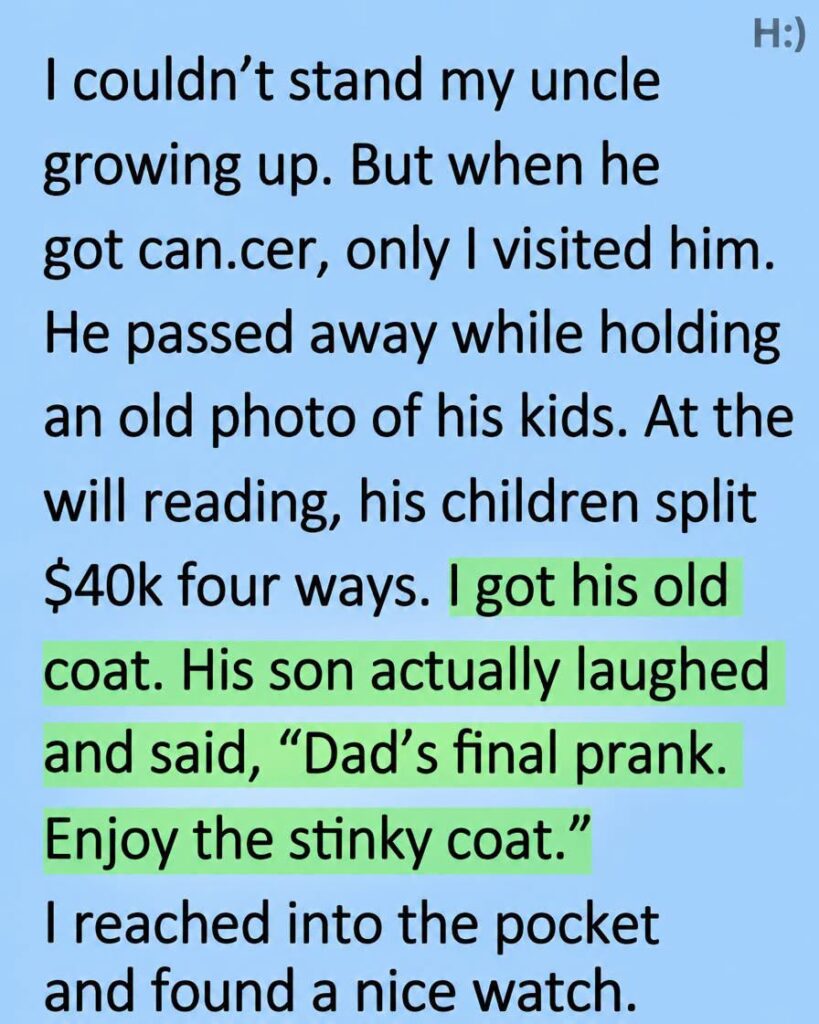
Uncle Richard had never been an easy person to get along with. He was known throughout our family for his sharp comments, constant criticism, and distant personality. He rarely showed affection, even toward his own children, and seemed to prefer keeping everyone at arm’s length. So when my mother called to tell me that his health was deteriorating and he might not have much time left, I wasn’t sure whether I should visit him.
However, after thinking about it for a while, I decided to go to the hospital.
When I finally walked into his room, I barely recognized the man lying in the bed. He looked weak, tired, and considerably older than I remembered. But something else had changed, too. His usual harsh expression had disappeared, and when he greeted me, his voice sounded surprisingly warm.
We began talking about ordinary things, including family memories, old neighbors, and the years that had passed. What I expected to be a brief visit turned into almost an hour of conversation. Before leaving, I promised him I would come back soon.
Over the following weeks, I kept that promise. I visited whenever I could, sometimes bringing him something to eat or simply sitting beside his bed. Our conversations gradually became more personal. He told me stories about his childhood, the difficult jobs he had worked, and the sacrifices he had made throughout his life.
On a few occasions, he even admitted that he hadn’t always treated his family fairly. He said he had spent too many years believing that being strict was the same as being strong. He had expected everyone around him to be tough, but rarely considered how much a little kindness could mean.
Those conversations changed the way I saw him.
For years, I had thought of Richard as an unpleasant man who simply didn’t care about other people’s feelings. Now I was beginning to understand that there was more to his personality than the difficult exterior he had shown everyone.
Then, one morning, my mother called with devastating news.
Uncle Richard had passed away.
Although we had never shared a particularly close relationship, I felt a genuine sense of loss. I kept remembering those final hospital visits and wondering whether he had finally found some peace after so many difficult years.
A few days later, our family gathered at his attorney’s office to hear the reading of his will.
Richard’s children each received $40,000, along with several personal belongings. Other relatives were mentioned, and various items were distributed according to his instructions.
Then the attorney reached my name.
He paused briefly before announcing that Uncle Richard had left me one specific possession: his old brown coat.
The room became strangely quiet.
I looked at the attorney, wondering whether he had made a mistake.
A coat?
That was all?
My cousins immediately began laughing. One of them joked that Richard had managed to criticize me one final time, even after his death. Another suggested that I should be grateful he hadn’t left me one of his broken tools instead.
I didn’t argue.
I simply accepted the coat, which looked old, worn, and smelled as though it had been stored in a damp basement for years.
At the time, I couldn’t understand why Richard had chosen such an unusual inheritance. If he wanted to leave me something meaningful, why hadn’t he selected an ordinary personal item?
I took the coat home and hung it near the entrance.
For a while, I considered donating it or throwing it away. But something about the attorney’s announcement kept bothering me. Richard had been very specific about leaving it to me. Surely there had to be a reason.
Later that evening, I decided to examine it more carefully.
I checked the pockets first. They contained a few old receipts, a small button, and some loose threads. Nothing seemed particularly valuable.
Then I noticed something unusual.
The coat felt considerably heavier than it looked.
I turned it inside out and began examining the lining. Near the lower section, my fingers came across a part of the fabric that felt thicker than the surrounding material.
There was a small opening hidden beneath a folded section of the lining.
Carefully pulling it apart, I discovered a narrow compartment that had clearly been sewn into the coat intentionally.
Inside was a sealed envelope.
My name was written across the front in Richard’s unmistakable handwriting.
I immediately sat down.
For several seconds, I simply stared at it.
Then I carefully opened the envelope.
The first thing I noticed was a handwritten letter. It began with a sentence that made my eyes fill with tears.
If you’re reading this, then you finally found the reason I wanted you to have this coat.
Richard explained that my visits to the hospital had meant more to him than he had ever been able to express.
He wrote that, during the final months of his life, he had spent a great deal of time thinking about the people who had been part of his journey. He regretted many of the things he had said and done, especially the moments when he had pushed away people who genuinely cared about him.
He also explained that he had noticed something about me.
I had never visited him because I expected money, recognition, or a place in his will. I had simply shown up when he was sick and lonely.
According to his letter, that meant everything.
But the next paragraph completely changed my understanding of the inheritance.
Richard revealed that the coat contained more than just a personal message. He had arranged for me to receive something he had kept hidden from the rest of the family for years.
There were additional documents inside the compartment.
One was a certificate relating to an investment account. Another was a letter from his financial adviser, explaining that the account had been established many years earlier and had grown considerably in value.
The amount mentioned in the documents was approximately $600,000.
I read the figure several times.
Six hundred thousand dollars.
I couldn’t believe what I was seeing.
The man whose children had received $40,000 each had apparently left me an inheritance worth fifteen times that amount.
But Richard’s letter made it clear that the money was not the only reason he had chosen me.
He wanted me to understand that he had spent years making decisions based on pride, fear, and the mistaken belief that affection was a weakness.
He had been unable to say those things while he was alive.
So he had placed his final message somewhere he knew I would eventually look.
I sat at the kitchen table for a long time, holding the letter and trying to process everything.
The old brown coat that everyone had laughed at was suddenly the most meaningful possession I had ever received.
The Secret Behind Richard’s Final Gift
The following morning, I contacted the attorney who had handled the estate.
I explained what I had discovered and asked whether he knew anything about the documents hidden inside the coat.
At first, he seemed surprised.
Then he became very serious.
He explained that Richard had specifically instructed him to leave the coat with me and had mentioned that certain private financial documents would be found inside it.
However, the attorney had not been given permission to disclose the details before I discovered them myself.
He asked me to bring the documents to his office so that he could verify everything.
I spent the next few days arranging the paperwork and reviewing the information with him.
Eventually, he confirmed that the investment account was legitimate and that Richard had made arrangements for the funds to be transferred according to his wishes.
The estimated value was close to $600,000, although the final amount would depend on the account’s valuation and the completion of the required legal procedures.
I was overwhelmed.
I had gone from believing I had inherited a smelly old coat to discovering that my uncle had left me a substantial financial gift.
But there was something else I couldn’t stop thinking about.
Why hadn’t he told me about it while he was alive?
Why had he allowed the family to believe that I had received nothing of value?
The attorney explained that Richard had wanted the decision to remain private until after his death. He believed that revealing the arrangement beforehand might create arguments, pressure, and unnecessary conflict.
That explanation sounded exactly like something Richard would have done.
Even in his final days, he had preferred silence over confrontation.
When My Family Discovered the Truth
I initially decided not to tell anyone about the documents.
I needed time to understand the situation and didn’t want the inheritance to become the subject of another family argument.
However, secrets rarely remain hidden forever.
About a week later, one of my cousins called and asked whether I had finally thrown away Richard’s old coat.
I told him I was keeping it.
He laughed and said I should have donated it to someone who needed winter clothing.
I almost laughed myself.
Then he asked whether I had found anything interesting inside it.
I paused before answering.
I wasn’t ready to explain everything.
A few days later, I received another call. This time, my aunt wanted to know whether Richard had left any additional instructions concerning the coat.
I realized that the family had begun wondering why he had singled me out.
Eventually, I decided to arrange a conversation with the attorney present.
I explained that I had discovered a sealed envelope containing personal documents and that Richard had made a separate financial arrangement for me.
When I mentioned the approximate value, nobody spoke.
My cousins looked at one another.
One of them asked how that could possibly be fair when Richard’s own children had received considerably less.
I understood why they were upset.
But the attorney calmly explained that Richard had made his estate decisions according to his own wishes and that the documents would need to be handled through the appropriate legal procedures.
I didn’t argue with anyone.
I didn’t ask them to agree with his decision.
I simply explained that I had never expected an inheritance and had no intention of turning his final gift into a family dispute.
What mattered most to me was understanding why he had chosen to leave it.
What the Letter Taught Me
I reread Richard’s letter several times during the following weeks.
Each time, I noticed something different.
He wrote about how lonely he had become during the final years of his life. He admitted that he had often mistaken people’s patience for weakness and had pushed away those who tried to get close to him.
He also mentioned that he had watched me visit him without expecting anything in return.
That was apparently what had convinced him to make the decision.
He wanted to leave something to someone who had shown him kindness when there was nothing to gain from doing so.
The money was substantial, but the message behind it was even more meaningful.
I began thinking about all the years when our family had judged Richard based on his difficult personality.
Perhaps we had never really understood what was happening inside him. That didn’t excuse the hurtful things he had done, but it reminded me that people can carry regrets they never know how to express.
Sometimes, the people who appear the most distant are also the ones who struggle the most to communicate their feelings.
Richard had waited until the end of his life to acknowledge his mistakes.
I wished he had done it sooner.
I wished we had enjoyed more conversations, shared more memories, and had the opportunity to build a closer relationship while he was still here.
But I was grateful that those final weeks had happened.
They had given me the chance to see a different side of him.
A Decision About the Unexpected Inheritance
After the legal arrangements were completed, I began thinking carefully about what I wanted to do with the money.
I didn’t want to make emotional decisions simply because the amount was larger than anything I had expected to receive.
Instead, I spoke with a financial adviser and considered how the inheritance could be managed responsibly.
Part of me wanted to use it to improve my family’s financial security. Another part wanted to do something that would honor Richard’s memory.
I remembered how he had spent so many years working hard, often sacrificing his personal happiness because he believed financial security was the most important thing he could provide.
Perhaps the best way to respect his final gift was to use it wisely.
I also decided to keep the coat.
Not because it was valuable or particularly attractive, but because it reminded me of the conversations we had shared in the hospital.
I had originally thought it was an insult.
Now I understood that it was his way of saying something he had struggled to say throughout his life.
Thank you for coming.
Thank you for listening.
And I’m sorry I didn’t show you this side of me sooner.
Final Thoughts
Uncle Richard’s old brown coat turned out to be much more than an unusual inheritance.
Hidden inside it was an unexpected financial gift worth approximately $600,000, but the real surprise was the message he had left behind.
For years, Richard had been known as the difficult member of the family, someone who rarely expressed affection and often pushed people away. Yet during his final weeks, he allowed himself to become more open, revealing regrets and feelings that had remained hidden for decades.
My hospital visits had given us something neither of us had expected: an opportunity to reconnect.
His final gift taught me that kindness can matter far more than we realize, especially when someone is facing the end of their life.
I will never forget the moment I discovered the envelope inside that old coat. But I will remember even more clearly the man I came to know during those final hospital visits.
Sometimes, the most meaningful inheritance isn’t simply the money someone leaves behind.
It’s the apology they never managed to say, the gratitude they finally find the courage to express, and the reminder that even the most difficult relationships can still have room for understanding and forgiveness.