My father sat quietly in the passenger seat of my log truck, holding a check with both hands. He had barely spoken since we left the sawmill yard.
The check was for $600.
It had been issued by Lindholm Lumber Company, the business run by my cousin Lyle. On the memo line was one word: Pallet.
I looked at Dad. He was eighty years old, and I could tell the experience had hurt him more than he wanted to admit.
Those twenty-two black cherry logs on our trailer represented months of hard work. They had grown on the family farm for generations, and Dad had personally cut and prepared them. Yet my cousin had classified every single one as low-grade wood.
I knew something wasn’t right.
Instead of arguing, I decided we needed another opinion.
A Family Legacy Growing on the Hillside
My cousin Lyle had inherited the family sawmill from his father, Walt, who established the business in 1961.
Walt had spent decades earning a reputation for treating loggers and farmers fairly. He understood hardwood grading and believed that a sawmill’s reputation depended on honesty.
After his death, Lyle took over the operation.
A few months before our visit, Lyle had come to my parents’ farmhouse to inspect the cherry trees growing behind their barn. He walked the property with my father and examined the trees carefully.
At the end of the visit, he offered Dad $4,000 for the standing timber.
Dad politely declined.
Although he was eighty, he wanted to harvest the trees himself. He had watched them grow throughout his life and wanted to handle the work personally.
For most of October, he worked on the hillside with his old chainsaw and tractor. My son Mason helped whenever he could, especially on weekends.
The work was difficult, but Dad was determined.
There was another reason for his decision. My mother needed extensive dental treatment that would cost more than their insurance covered. Dad wanted to help pay for it and also set aside a little money for his grandchildren.
The trees had become his way of providing for the people he loved.
The Sawmill Offered Only $600
When we finally delivered the logs to Lyle’s mill, I expected a reasonable evaluation.
Instead, Lyle walked down the grading deck and marked each log with a large letter P.
Every log received the same classification.
In the hardwood business, pallet-grade timber is generally among the lower-value categories. Such logs are often used for basic industrial products rather than quality furniture or cabinetry.
Lyle calculated approximately 4,300 board feet and offered fourteen cents per foot.
The total came to around $600.
I was stunned.
I had worked in the logging business for twenty-six years. I knew what quality black cherry looked like, and these logs appeared far better than the classification suggested.
I approached Lyle and told him we would not accept the offer.
He simply said that nobody in the area would pay more.
I decided not to argue.
My son Mason climbed into the loader and carefully transferred all twenty-two logs back onto our trailer. Once everything was secured, we prepared to leave.
Dad was still holding the check when I returned to the cab.
He folded it carefully and placed it inside his coat pocket.
He never deposited it.
Looking for Someone Who Would Examine the Wood
Back at the farm, my mother was waiting.
She noticed that the logs had returned with us, but she didn’t ask many questions. Instead, she prepared coffee, and we gathered around the kitchen table.
My father explained what had happened.
Mom was disappointed. She knew how much effort he had put into preparing the timber.
That afternoon, I remembered another sawmill I had visited during my years in the logging business.
It belonged to an Amish craftsman named Levi Yoder, who operated a traditional sawmill near Smicksburg, Pennsylvania.
I had delivered timber to his operation before and remembered that he took considerable care when evaluating logs.
I contacted him and explained our situation.
He asked several questions about the trees, including their dimensions, growing conditions, and location.
After listening, he gave me a simple answer.
“Bring them Saturday morning,” he said. “And bring your father.”
The Amish Sawmill Gives the Logs a Fair Examination
We left early Saturday morning.
Dad insisted on riding in the log truck with me. Mason followed in his pickup, and Mom packed sandwiches, coffee, and a homemade pie for the journey.
The drive through the Pennsylvania hills was beautiful. Dad spent much of the trip looking out the window.
At one point, he began telling me about his father, Nils.
Nils had immigrated from Sweden and eventually purchased the family farm. According to Dad, his grandfather had planted one particular cherry tree around the time Dad was born.
The tree had become a family landmark.
Dad explained that his father believed planting a tree for a newborn child was a way of giving something to future generations.
That particular tree was among the largest logs on our trailer.
It was also the one Lyle had classified as pallet-grade.
When we arrived at Levi’s farm, he was waiting beside his sawmill.
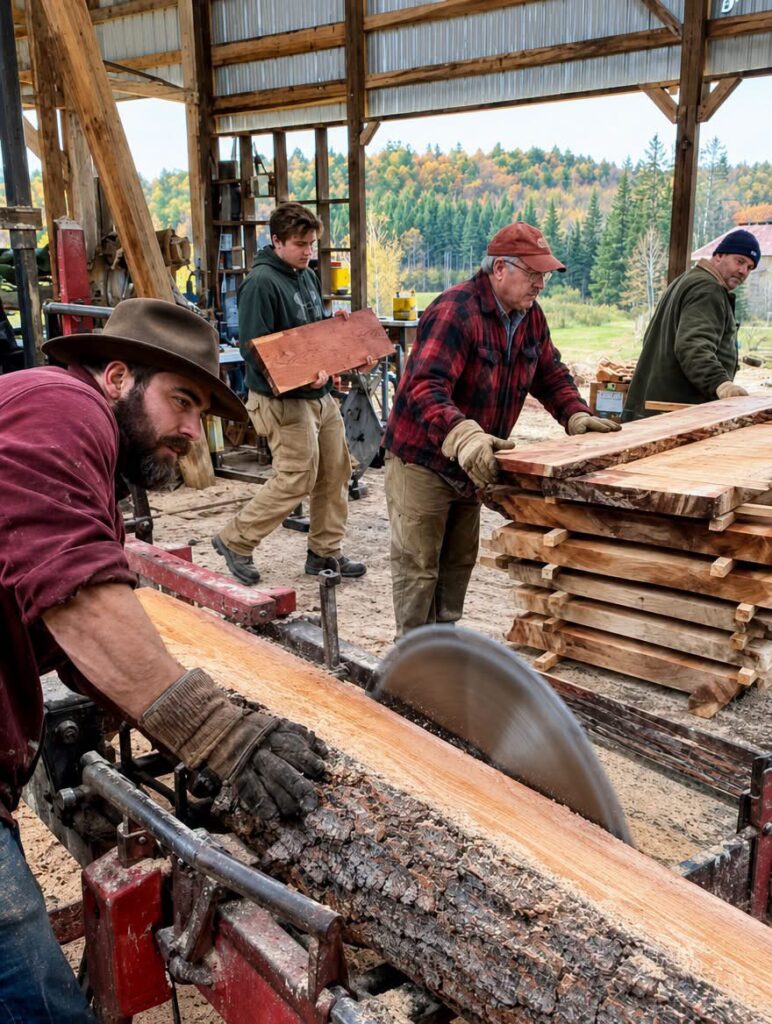
The operation was simple and traditional, powered by a diesel engine. Levi worked alongside his sons, using a large circular saw to turn logs into lumber.
He inspected every log on our trailer.
He examined the ends, studied the bark, and checked the overall shape and condition. When he reached the largest cherry log, he spent several minutes looking it over.
Then he turned toward Dad and nodded.
Mason unloaded the logs, and Levi prepared the first one for sawing.
The Wood Revealed Its Quality
Levi selected the largest log for the initial cut.
After securing it to the saw carriage, he started the engine. The blade began turning, and the first rough slabs came away.
Then the first finished board emerged.
Its surface was a beautiful reddish color, with a remarkably clean grain.
There were no significant defects in that section.
My father slowly approached the stack of freshly cut boards. He placed his hand on the top one and studied it quietly.
I noticed his eyes filling with emotion.
For him, this was much more than a valuable piece of lumber. It was a piece of the hillside where he had grown up, and a connection to his father.
Mason began carrying the finished boards to a nearby stack while Levi continued working.
The men processed all twenty-two logs throughout the morning.
Not every board was perfect. Some contained knots, natural imperfections, or small internal defects. Levi separated the lumber according to its quality.
However, a substantial portion was exceptionally good black cherry.
He eventually classified much of the best material as FAS, meaning Firsts and Seconds, a premium hardwood grade commonly used for quality furniture and cabinetry.
By early afternoon, the sawing was complete.
Levi took out a small notebook and began measuring the boards individually.
He recorded their lengths and widths, carefully separating the premium material from the lower grades.
Dad watched the entire process.
The True Value Was Finally Revealed
After finishing his calculations, Levi approached my father.
He explained that the twenty-two logs had produced approximately 4,600 board feet of lumber.
Of that amount:
- 3,100 board feet were premium-quality cherry.
- 1,500 board feet were Number One Common, a useful grade with some natural imperfections.
Levi explained that his cabinet-making customers purchased high-quality cherry lumber regularly.
He offered Dad $2.80 per board foot for the premium material and $1.40 for the common lumber.
The total offer came to $10,980.
We were all surprised.
The logs that had been valued at approximately $600 at the first mill had produced an entirely different result when properly examined and sawn.
Dad listened quietly.
Then he mentioned that the amount was even greater than the original offer for the standing trees.
Levi explained that standing timber and processed lumber were different products. The additional work involved harvesting, hauling, and sawing had also contributed to the final value.
But he wasn’t finished.
He suggested that Dad keep seven particularly beautiful boards from the largest cherry log.
That tree, Levi understood, had special meaning because Dad’s father had planted it.
Levi offered to dry those seven boards in his kiln without charging for the service.
He would purchase the remaining lumber for $9,400.
Dad agreed.
A Lesson About Honesty
Before we left, Dad asked Levi a question that had been bothering him.
He wanted to understand why his own nephew had graded the logs so poorly.
Levi listened carefully.
He explained that financial difficulties could sometimes lead people to make decisions they would never have considered under different circumstances.
He also made an important observation: the quality of a log becomes much easier to judge once the wood is opened and examined.
A person could describe a log in many different ways, but the finished boards provided tangible evidence.
Levi paid Dad $9,400 in cash.
We loaded the seven special boards for drying and headed home.
For the first time in weeks, Dad seemed relaxed.
During the drive, he began discussing what he planned to do with the money.
First, he would pay for Mom’s dental treatment. Then he wanted to give each grandchild a Christmas gift and put some money aside for Mason’s education.
Mason had apparently told his grandfather that he was interested in studying forestry at Penn State DuBois.
I hadn’t even known about that conversation.
Dad smiled when he mentioned it.
He said he hoped Mason would learn enough about forestry and timber management to recognize quality wood and understand its value.
My Cousin Finally Admitted What He Had Done
Two weeks before Christmas, Lyle came to the farm.
He arrived during a snowfall and spent several minutes near the barn before approaching Dad.
He had heard about the sale at Levi’s sawmill.
Lyle admitted that his business had been struggling financially. He had borrowed heavily to purchase new equipment, and the bank was preparing to take possession of the mill.
He also confessed that he had been deliberately grading logs too low to purchase them cheaply and resell the processed lumber at a higher price.
He acknowledged that he had known our cherry logs were valuable.
He had inspected the trees in August and had offered Dad $4,000 for them.
By November, however, he had allowed his financial problems to influence his judgment.
He apologized to Dad.
My father listened without interrupting.
Then he reached into his coat and took out the original $600 check.
He had kept it all that time.
Dad handed it to Lyle and reminded him of the principles his father had established when the sawmill first opened.
He explained that a business was built on trust, and that a person’s reputation was worth more than any piece of equipment.
He asked Lyle to contact everyone he had treated unfairly and make things right.
His advice was simple:
If the mill had to close, Lyle should at least leave with his honesty intact.
A Difficult Road Toward Making Things Right
Lyle followed his uncle’s advice.
He contacted eleven farmers and timber owners who had received unfair evaluations during the previous months.
He visited their homes, admitted what he had done, and apologized.
Some people were understandably upset. Others listened and gave him an opportunity to explain.
He sold personal belongings, including his pickup truck and a hunting property, to help repay the money he owed.
He also arranged installment payments for the remaining amounts.
Despite his efforts, the bank eventually took possession of the sawmill.
The equipment was sold, and the family business that Walt had built decades earlier came to an end.
However, Lyle did not give up on the logging industry.
In April, he traveled to Levi’s sawmill near Smicksburg.
He explained his circumstances and asked whether Levi might have work for him.
He wasn’t looking for a management position. He was willing to start with basic tasks, including moving logs, carrying boards, and cleaning the sawmill.
Levi considered his request.
Then he offered him a job.
He told Lyle that he could begin working as a laborer and learn the proper way to grade timber.
Lyle accepted.
He now worked three days a week at Levi’s operation, earning an hourly wage and rebuilding his knowledge of the trade.
He later told me that it was some of the most meaningful work he had ever done.
A Special Gift Made From a Family Tree
While these events were unfolding, Dad was working on something of his own.
In January, he brought the seven special cherry boards home after Levi finished drying them.
He placed them on sawhorses in his workshop and began working on them with hand tools.
He didn’t tell anyone what he was making.
Mason helped him on Saturdays, learning how to measure, cut, shape, and join the wood.
I occasionally stopped by to watch.
My father worked slowly, but his attention to detail was remarkable.
After several months, he finally revealed what he had created.
It was a beautiful piano bench for Mom’s old Baldwin piano.
The bench had a wide seat and a hinged lid where she could store her hymnbooks.
The cherry wood had developed a rich reddish-brown color, and its grain was visible across the finished surface.
Inside the lid, Dad had carefully burned a message into the wood:
Planted in 1945 by Nils for his son’s old age. Cut in 2025 by Arvid for his wife.
He also included a line connected to the family’s beloved Swedish hymn.
On Easter Sunday, Dad and Mason carried the bench into the house.
Mom ran her hands across the polished wood and immediately understood its significance.
She sat down and began playing the old hymn on her piano.
Dad stood behind her with one hand resting on her shoulder.
The wood from his father’s tree had become something that would remain in the family for generations.
Twenty-Two New Trees for the Future
In May, Dad invited Mason and me to the farm early one Saturday morning.
He had prepared a cardboard box containing twenty-two young black cherry seedlings.
He explained that he had purchased them from a state nursery.
There was one seedling for every tree he had harvested.
We walked together up the hillside behind the barn.
The old trees were gone, leaving open spaces where sunlight now reached the ground. Their stumps remained, reminding us of the forest that had once stood there.
We spent the morning planting the seedlings.
Mason dug the holes, Dad positioned each tree, and I installed protective wire cages to help keep deer away.
For the final seedling, Dad chose the spot beside the stump of the largest cherry tree.
He called Mason over.
Then he handed him the young tree.
Dad explained that his own father had planted the original tree around the time he was born.
He knew he probably wouldn’t live long enough to see the new tree reach maturity, but Mason might.
He wanted his grandson to understand that planting a tree was an investment in a future that might belong to someone else.
Mason carefully planted the seedling.
Dad placed a hand on his shoulder and reminded him of the lesson they had learned from the experience.
Never accept someone else’s description of something without understanding its real value. Seek honest advice, examine the evidence, and remember that integrity matters.
The three of us sat on the old stone wall overlooking the hillside.
Below us stood twenty-two young cherry trees, each one protected in its own small enclosure.
From the farmhouse, we could hear Mom playing the piano.
She was playing the Swedish hymn that had been part of the family for generations.
Dad began humming along.
A little later, a pickup truck appeared on the gravel road.
It was Lyle.
He had driven up from Levi’s sawmill on his day off. Beside him was a beautiful cherry board wrapped in a blanket.
It was one of the first boards he had graded himself since beginning his new job.
He stepped out, looked up the hillside, and saw the three of us sitting together.
Dad recognized him and raised his hand.
“Come on up, Lyle,” he called. “We saved you a seat.”
And as Lyle started walking toward us, I realized that the story had never really been about the money.
It had been about family, responsibility, honesty, and the things we leave behind.
The original trees had provided for Mom, helped Mason pursue his dreams, and given Dad a way to honor his own father.
Now twenty-two new trees were growing on that same hillside.
Their shade would belong to another generation.
And perhaps, many decades from now, someone in our family would stand beneath those trees and remember why they were planted in the first place.