If you have ever visited an Aldi store, you may have noticed a small but unusual feature at the entrance that immediately stands out to many first-time customers before they even begin shopping.
To use a shopping cart at Aldi, customers are required to insert a small coin, typically a quarter in the United States, into a built-in locking mechanism attached directly to the cart handle system.
At first glance, this setup can confuse new shoppers, and some people mistakenly believe it is a fee or extra charge added before they can begin their grocery shopping experience.
In reality, the system is not a payment or rental fee, but instead a simple deposit mechanism designed to be fully refunded when the shopping cart is returned properly after use.

The main purpose of this system is to encourage customers to return carts to their designated storage area instead of leaving them scattered in parking lots or other inconvenient locations.
When a shopper finishes loading groceries into their vehicle, they are expected to return the cart to the designated cart corral or reconnect it to a chain of other carts near the store entrance.
Once the cart is securely locked into place with another cart, the mechanism releases the inserted coin, returning it to the customer as a small financial incentive.
This simple refund process encourages most shoppers to complete the return step, because they naturally prefer not to lose their coin after finishing their shopping trip.
As a result, Aldi stores often experience significantly fewer abandoned shopping carts in parking areas compared to many other grocery retailers that do not use a similar system.
This contributes to cleaner parking environments, reduces clutter, and helps prevent carts from rolling into vehicles, sidewalks, or pedestrian pathways where they could create safety risks.

From an operational perspective, the system also reduces the workload for employees, who would otherwise need to spend time collecting and organizing carts throughout the day.
Instead, staff members are able to focus more on tasks such as stocking shelves, assisting customers inside the store, and maintaining overall store organization and efficiency.
This approach is part of Aldi’s broader business model, which is centered around cost efficiency, simplicity, and minimizing unnecessary operational expenses wherever possible.
By reducing labor costs associated with cart collection and maintenance, the company is able to allocate resources more effectively across other essential areas of store operation.
These savings ultimately contribute to Aldi’s ability to offer lower grocery prices compared to many traditional supermarkets, making it a popular choice for budget-conscious shoppers.
The shopping cart deposit system also reflects a wider philosophy that encourages customers to take responsibility for small actions that help maintain order in shared spaces.
In addition to cart returns, Aldi also promotes other simple habits such as bringing reusable shopping bags instead of relying on single-use plastic or store-provided bags.

Although the system may seem unusual or inconvenient at first, especially for visitors unfamiliar with it, most customers quickly understand its purpose after a few shopping experiences.
Once shoppers become familiar with the process, it becomes a routine part of their visit, and many even appreciate how it contributes to a more organized shopping environment.
The design of the system is intentionally simple and mechanical, relying on physical connection rather than electronic systems, which helps reduce maintenance and technical issues.
This mechanical approach also ensures that the system works reliably across different store locations without requiring complex technology or frequent repairs.
Another important aspect of the system is its behavioral design, which uses a small financial incentive to encourage responsible customer actions in a consistent and predictable way.
Because customers want their coin back, they are naturally motivated to return the cart instead of leaving it in parking areas after finishing their shopping.
This self-regulating behavior reduces the need for staff intervention and creates a smoother flow of operations both inside and outside the store environment.
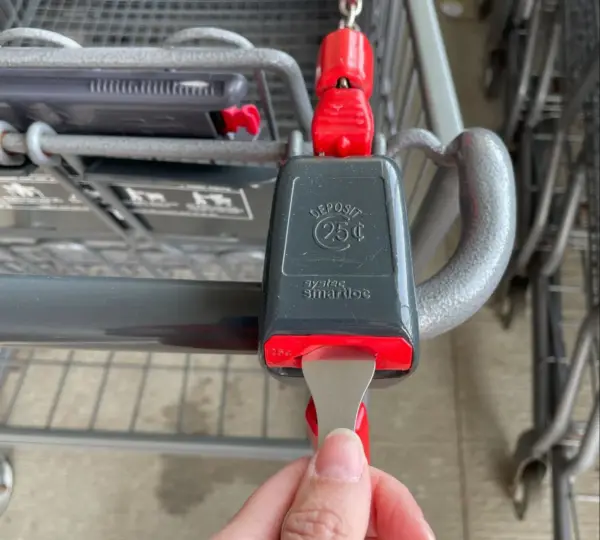
Unlike many supermarkets where carts may be left scattered across parking lots, Aldi locations typically maintain more organized and structured cart storage areas.
This contributes not only to convenience but also to safety, as properly returned carts reduce the risk of accidents involving vehicles or pedestrians in busy parking areas.
Over time, the system also helps reduce the number of damaged or lost carts, since proper handling and return behavior naturally minimizes unnecessary wear and misuse.
Lower damage rates mean fewer replacement costs, which further supports Aldi’s goal of maintaining a low-cost, efficient retail operation focused on essential services.
Many retail analysts view this system as a simple yet effective example of how small design choices can significantly influence customer behavior and operational efficiency.
Even though it involves only a small coin, the system plays an important role in shaping how customers interact with store equipment and shared public spaces.
The Aldi cart system has become one of the most recognizable features of the brand, often surprising new customers but quickly becoming an accepted part of the experience.
It demonstrates how a simple idea can combine customer motivation, cost savings, and operational efficiency into one practical solution that benefits both the store and its shoppers.
In the end, the small coin used for a shopping cart is not just a deposit, but part of a larger system designed to promote order, responsibility, and efficiency.
This approach reflects Aldi’s overall philosophy of simplicity, value, and practicality, which continues to define its identity in the global grocery retail industry.