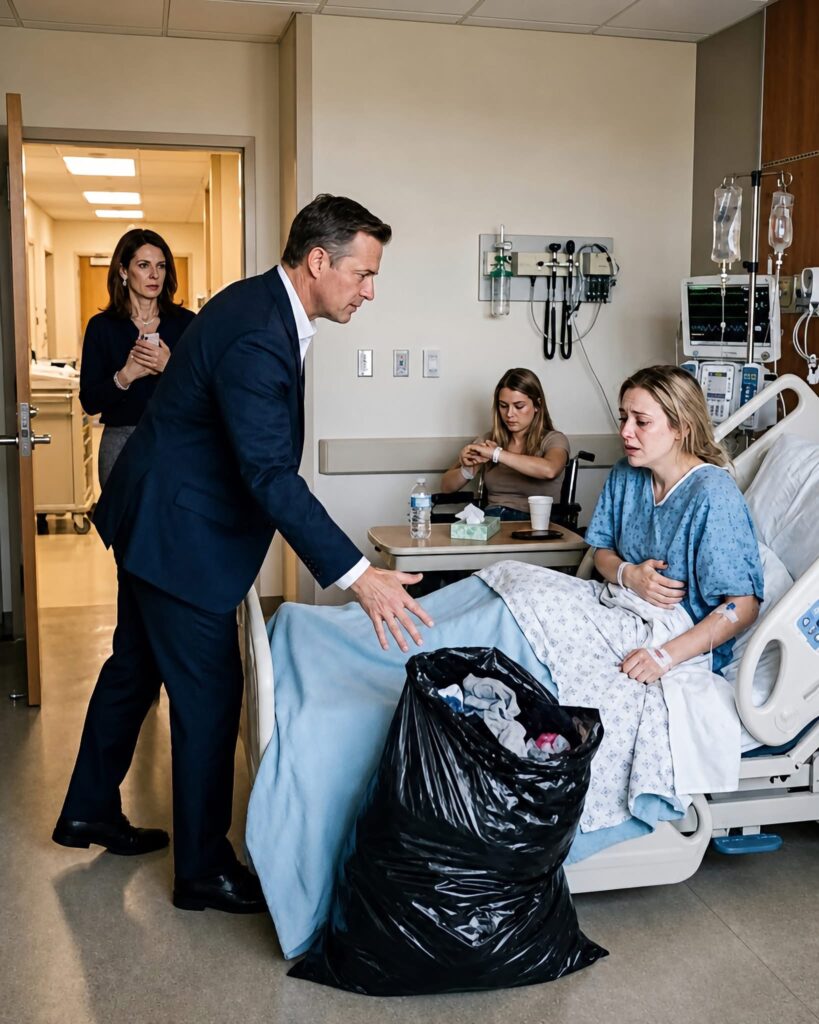
The Chair Kept Changing Meaning Every Time He Told the Story
The latch slid shut precisely as I tucked the folded hospital printout underneath the extra shirt inside my tote. I pulled the zipper across before my husband walked back into the room.
He returned holding two paper cups, though nobody had asked for any, and thrust mine toward me as if we had merely taken a wrong turn on a routine Tuesday afternoon.
I left my hands motionless in my lap.
“What did they say?” he inquired. The representative from the child-welfare unit flipped her identification badge around correctly this time. Her printed name read Mara Chen.
She informed him that our little girl was being admitted for evaluation and that the clinical staff still required clarification regarding when her symptoms had first manifested. He glanced at me first. Then toward the attending physician. Then back at Mara. “I told you already,” he insisted. “She took a tumble around four o’clock.” I watched the surface of the coffee quiver once against the cardboard insulation.
The doctor inquired whether she had seemed uncommonly drowsy earlier in the day. My husband offered a casual shrug. “She’s nearly three. She gets worn out.” I remained silent.
That required a conscious effort. I wanted to inform him that I was well aware of every conflicting version inscribed on the paper resting inside my bag. I wanted to demand why he had altered “coloring” to “playing,” why daycare had supposedly never happened, and why he had tried to frame my anxiety as the central issue instead of our daughter resting underneath glaring fluorescent panels with medical leads taped to her skin. Instead, I allowed him to keep talking. He stated that she had eaten lunch. He claimed she had watched cartoons. He insisted she had been entirely fine right up until the accident. The physician jotted down every assertion. No one challenged him. That appeared to soothe him more than any confrontation would have. Mara asked if I wished to sit beside our daughter while they finalized the next round of checks. I stood up before my husband could answer on my behalf. As I brushed past him, his fingers grazed my elbow lightly. “Don’t let them rattle you,” he murmured. “They’re required to ask these things.” I pulled my arm away from his grip. The corridor felt noticeably colder than the family-room waiting area.
A custodial trolley had been parked against the wall, and someone had left a single yellow rubber glove resting on top of it. I stared at that glove far longer than necessary because it was infinitely easier than looking through the glass panels up ahead.
Our daughter was awake when I reached her bedside. Scarcely. Yet conscious. Her gaze followed my movements as I stepped up to the rail. I pressed two fingers gently against her shin instead of scooping her up, mindful of the nurse’s strict instruction to keep her completely still. “Mommy’s here,” I whispered. Her lips parted. I leaned in closer. “Blue cup.” Just two words. I let out a single, sharp breath through my nose and pressed my lips together tightly. Of course. The blue cup. “I know,” I murmured back. A nurse was adjusting one of the monitoring leads across her chest. Her name tag identified her as Tessa. “You probably haven’t eaten since midday,” she noted, setting a packet of crackers and a small bottle of water on the sill.
I opened the crackers regardless. I consumed one. Then another. They tasted faintly of cardboard and salt. Sometime later, Mara returned by herself and pulled a chair up next to mine. I posed the question before she had the chance to speak. “Do you believe he hurt her?” Mara did not answer in the manner I hoped for. She explained that the hospital did not rely on speculation when dealing with facts they could document. They were already aware that the timeline he provided failed to align with what the medical team was observing. They knew he had shifted various details. They knew our daughter had never actually attended daycare as planned. What they still needed to determine was precisely what had transpired inside our apartment or why he had delayed contacting me. I checked the screen of my phone. Daycare. “I need to call them.”
Mara gave a nod of assent. So I dialed. The receptionist recognized my phone number, and when I inquired whether my daughter had been signed in that morning, the woman hesitated before replying. “No. She wasn’t here today.” I asked if my husband had placed a call. Another brief pause. “Yes.” My fingers tightened around the casing of the phone. “At what time?” “A little past eight.” I waited while she verified the entry in their records. Then she stated, “Eight-twenty-six. He informed us she had picked up a stomach bug and wouldn’t be attending.” I stopped chewing. My daughter had been standing in dinosaur pajamas at 7:12, arguing over the hue of a plastic cup. By 8:26, less than ninety minutes afterward, my husband had canceled her daycare attendance without my knowledge. I asked the woman to restate the timestamp.
She repeated it. I scribbled it down on the back of a pharmacy receipt pulled from my bag. 8:26. Mara watched as I underlined the numbers once. I called my husband back into the room only after I had finished speaking with the doctor. Not a moment before. He walked in with his phone clutched in one hand and asked if our daughter had uttered anything. I kept my tone perfectly even. “Why did you call daycare at eight-twenty-six?” His expression barely flickered. Hardly at all. “She wasn’t feeling well.” “You told me you were going to drop her off.” “I intended to.” “You told the hospital staff she ate lunch and acted fine.” “She was fine.”
“You canceled her daycare before nine o’clock.” “Because she looked tired out.” I stared right at him. I glanced down at his phone. Then I looked back up into his eyes. “Was she already injured?” “No.” Instantaneous. Far too instantaneous. He leaned closer to the mattress and dropped his voice to a softer register. “Can we please not argue while she’s right here?” I shifted my position to stand squarely between him and the bed rail. “We aren’t arguing.” He exhaled a long breath as though I had deeply disappointed him. Then he turned his attention toward Mara. “This is precisely what I was trying to point out. She fixation-locks on things whenever she gets frightened.”
Mara requested that he step back out into the hallway. He complied. Before departing, he set my untouched cup of coffee down beside the blue plastic pitcher near the sink. It remained there until the liquid turned entirely cold. The physician entered not long afterward. He offered no dramatic speeches or grand declarations. He simply stated that the scans revealed trauma severe enough to warrant keeping her under strict observation, and that the medical presentation did not permit them to accept a four o’clock timeline without substantial further explanation. I asked if she was going to pull through. He replied that they were encouraged by her responsiveness, though they were not yet prepared to make any absolute promises. I repeated my question about whether a fall from a chair could have caused such damage. He noted that the specific mechanism mattered less at this stage than establishing when she had stopped behaving normally and why professional care had been withheld. Withheld. I latched onto that specific word. My husband had reached out to me at 4:18. He had canceled daycare at 8:26. Sandwiched between those two timestamps was nearly an entire day about which I knew nothing.
I opened my bag and retrieved the folded sheet Mara had provided earlier. For the very first time, I penned an addition of my own. 8:26 — daycare canceled, citing “stomach bug.” My handwriting looked foreign to my own eyes. Moments later, my phone buzzed against my palm. It was his mother. I nearly swiped to ignore it. He had spent years treating every marital disagreement as something his mother could eventually patch over with a casserole and a cliché beginning with, “You both just need to remember you’re a team.” I had no appetite for another iteration of that conversation. I opened the notification anyway. She inquired how our little girl was doing. Then a second text popped up. I read through the words twice. She wrote that my husband had startled her earlier when he called to say the little one had taken a fall and refused to stay awake. Earlier. I tapped out a reply using both thumbs.
“What time did he call you?” The three animated typing dots appeared on screen. Vanished. Reappeared. At last, she sent her answer. 12:47. I froze completely. I could hear the hum of the air vent directly above the bed. I could hear Tessa rustling packaging at the nurses’ station down the hall. I could hear the steady rhythm of our daughter’s breathing. 12:47. More than three hours prior to when he had finally notified me. I asked his mother to recount precisely what he had told her. Her reply arrived in fragments. He claimed our daughter had climbed up near the kitchen counter. He mentioned an accidental fall.
He stated she had cried briefly and then drifted into a heavy sleep. His mother had instructed him to ring me up and bring her in if she proved difficult to rouse. He had assured her he was monitoring her closely. Then she appended one final message. “I thought you already knew.” I captured screenshots of the screen. I presented them to Mara. She did not celebrate the breakthrough. Instead, she simply asked if I could forward the text logs to the secure digital address the hospital was utilizing for their official file. I did so immediately. Then I refolded the timeline document. The paper no longer felt like a mere handout given to me by strangers. It felt like something I was actively constructing. When my husband reappeared, I deferred to Mara to pose the opening query. “Did you speak with your mother today?” He looked straight at me.
“Yes.” “At what time?” “I don’t recall. Sometime in the afternoon.” “Before you contacted your wife?” He rubbed the back of his neck once more. “Maybe.” Mara pressed him on what he had shared with his mother. “That she wasn’t feeling well.” “Did you mention that a fall had occurred?” He stared at the floor tiles for a solid second. Then his entire narrative shifted. He claimed there had actually been two separate incidents. A minor tumble sometime before lunch that had appeared entirely harmless. Followed later by the fall from the chair at four o’clock. He argued that this was the reason everyone seemed so confused. He explained that he had omitted the first fall simply because it had seemed insignificant at the time.
I almost admired how smoothly the fabricated story rolled off his tongue. Almost. “Where did this first fall take place?” I demanded. He flicked a glance in my direction. “In the kitchen.” “What was she doing?” “Climbing.” “On what object?” He hesitated. “The chair.” “The exact same chair?” His jaw tightened noticeably. “I don’t remember.” I certainly did. All four dining chairs had been neatly tucked beneath the table at 7:12. One had been resting on its side near the counter when I first walked through the door.
The chair he had previously designated as proof of an afternoon accident was now being retrofitted into a morning mishap before lunch. Same piece of furniture. New timeframe. Entirely new story. I asked him point-blank whether there had been one fall or two. He retorted that I was completely missing the larger point. I told him to give me a straight answer. He snapped, “I was here. You weren’t.” That statement struck me harder than anything else he had uttered all day. Not because it established his innocence. Because for nearly nine consecutive hours, that grim reality had been true. I had been away at work. He held absolute control over the apartment. He controlled the outgoing phone calls. He controlled what the daycare facility was told. He controlled what his own mother was told.
He controlled the precise moment I finally received the emergency call. Right up until the hospital began pinning hard timestamps alongside his shifting statements. Mara instructed him to leave the quarters once again. This time, he dug his heels in. Speaking in a low, stubborn tone, he said, “I’m her father. I’m not walking away from my daughter just because my wife is having a breakdown.” Mara clarified that nobody had used the term abandonment. She then informed him that the facility was instituting temporary safety protocols while the case underwent formal review and processing. He would no longer be permitted unsupervised access to our child on the premises. His eyebrows arched upward in disbelief. He looked toward me as though expecting me to intervene and fix it. I remained entirely still. He spoke my name once in warning. I reached out and pulled the door open. Hospital security was already stationed quietly in the hallway.
He departed without raising his voice a single octave. That somehow made it feel much worse. As he brushed past my shoulder, he murmured, “When you’ve calmed down, give me a call.” I clicked the door shut behind him. For perhaps twenty minutes, I labored under the delusion that I had finally regained some measure of control. Then Mara settled into the seat beside me and explained that the hospital could not simply release our daughter back into the exact same residence under identical conditions without a documented safety protocol in place. My stomach plummeted into freefall. I had assumed the restrictions were solely targeted at him. Now I realized they encompassed me as well. I asked if they intended to take my child away from me. “No,” Mara answered firmly. Just that single word. Then she outlined what they required on my end. I needed to demonstrate that he would not be providing unsupervised custody while the official evaluation remained ongoing. I had to present a realistic, actionable plan—not merely a reassuring promise uttered within the sterile confines of a hospital room. I had to determine where he would reside, or alternatively, where my daughter and I would live following her discharge.
I stared down at the lukewarm cup of coffee sitting beside the sink. Then I dialed his mother’s number. I bypassed any demand that she choose sides between us. I kept it strictly practical. “Can he stay with you?” There was a heavy silence for a few seconds on the other end. “Yes.” I relayed the confirmation to Mara. Then I texted my husband to inform him that he could not return to our apartment while our daughter was being discharged under the hospital’s mandatory safety plan. His incoming call flashed on my screen instantly. I declined it. He dialed again. I declined it a second time. When a third call came through, I flipped the phone face-down against the table. Sometime that evening, a lengthy text message arrived from him.
He accused me of allowing total strangers to tear our family apart. He claimed the medical staff were simply covering themselves legally. He insisted his mother had completely misunderstood his earlier words. He argued that he had only been trying to shield me from panicking while I was stuck at work. That final sentence lingered stubbornly on my screen. Trying to keep me from panicking. I re-read the earlier text log from his mother once more. 12:47. Our daughter would not stay awake. I tapped out a single, concise response. “You knew the truth long before you ever called me.” He failed to reply for nearly an hour. At last, he typed back, “I thought she would just sleep it off.” I took yet another screenshot. Nothing inside me required any further confession to understand the reality.
The following morning, our daughter appeared noticeably more alert. She asked for a carton of juice. She shoved a cup of applesauce away with an irritable sweep of her hand. She grew genuinely furious when Tessa attempted to smooth down a hospital sticker that had peeled halfway off the metal bed rail. I let her be furious. It was easily the most reassuring sound I had heard in over twenty-four hours. By sometime that afternoon, she was able to sit upright with minimal assistance. The physician still weighed his words carefully, but his demeanor had visibly shifted when he stepped into the room. They felt encouraged by her trajectory. They still required ongoing observation. They anticipated that full recovery would be a gradual process. I meticulously jotted down every care instruction because I no longer trusted my own brain to retain spoken directives accurately. For a few hours, the hours dissolved into mundane hospital routines. Scheduled medications. A lunch tray she refused to touch. A cartoon blaring too loudly from the wall-mounted television overhead. I scrubbed grape jelly stains from the shirt I had carried her in and draped it over the back of a plastic chair to dry. I finally located a pair of shoes inside the small bag my mother-in-law had dropped off at the front desk. I managed thirty-seven minutes of shallow sleep with my forehead pressed against the edge of the mattress. When I blinked awake, our daughter was staring straight into my face. “Blue cup,” she repeated softly. I managed a tired smile. “We’ll find it as soon as we go home.” For a fleeting second, that felt like a complete conclusion. She was conscious. She recognized me. She was fixating on her ridiculous blue cup. I could have stopped right there and persuaded myself that everything else was merely bureaucratic paperwork. I chose not to. Later that day, Mara dropped by to hand me the revised timeline document. My husband had undergone a separate, secondary interview.
His newest version of events no longer referenced a four o’clock fall whatsoever. He now asserted that the sole mishap had occurred prior to midday. He claimed he had merely guessed around four when he finally phoned me because that was the moment he realized our daughter remained excessively drowsy. I read through the sentence twice. He had spent nearly an entire day shifting the accident around to whatever temporal slot his latest excuse required. Yet the hard timestamps surrounding his story refused to budge. 7:12 — I witnessed her acting completely normally. 8:26 — he terminated her daycare enrollment. 12:47 — he informed his mother a fall had happened and the child wouldn’t stay awake. 4:18 — he finally placed a call to me. I asked Mara if I was permitted to retain a duplicate copy. She nodded affirmatively. I slipped the paper into my bag right beside the first one. Then I dialed my husband’s number one more time. I dispensed with asking what had happened. I posed a single, direct question. “Why did you wait?” He remained silent. In the background, I could hear the drone of a television playing in his mother’s living room. Eventually, he muttered that he had assumed the hospital staff would blow everything out of proportion. He claimed he hadn’t wanted me rushing back in a panic. He insisted our daughter’s breathing had seemed normal to him. He argued that toddlers naturally sleep heavily after a crying spell. He protested that he was simply trying to manage the situation. I listened quietly until he exhausted every available excuse. Then I told him plainly that our daughter had needed him to secure medical help, not curate a convenient narrative. He began repeating my name in a pleading tone. I terminated the call. The hospital filed its mandatory report. The protective safety plan remained firmly in place through her eventual discharge, and he continued staying at his mother’s residence while the subsequent legal and administrative steps unfolded outside those hospital walls. Nobody offered me any ironclad guarantees regarding what would become of our marriage, the formal investigation, or the lingering medical questions concerning the older bruises. I stopped searching for guarantees.
I held onto the saved text logs. I kept the accumulated timelines. I retained the daycare cancellation record. Above all, I stopped allowing him to translate events for me before I had witnessed them with my own eyes. When our daughter was finally cleared for release, I carried her out through the exact same glass entrance where I had rushed in barefoot days earlier. This time, I was wearing shoes. She possessed a hospital wristband, a stuffed bear gifted by a nurse, and a pocketful of strict clinical guidelines folded neatly inside my bag. Upon arrival, our kitchen looked almost precisely as I had left it. The breakfast plate still sat unwashed in the basin. A hardened slice of banana remained glued to one rim. The blue cup rested plainly on the counter. And the chair was still lying on its side beside it. I stood in the doorway for several long seconds. Then I reached down and set the chair upright. Not because it served as absolute proof of anything. The hospital records already preserved the facts that mattered.
I slid it neatly beneath the table and positioned the blue cup where our daughter could easily spot it. Weeks later, when she had grown steady enough to roam the kitchen freely once more, I heard the grating sound of wood scraping across the linoleum while I was busy putting away groceries. I spun around. She had dragged one dining chair outward. Then another. And another still. She arranged them in a crooked, uneven train across the kitchen floor and hoisted herself onto the leading seat with both small hands gripping the backrest tightly. “Train,” she announced proudly. I cleared the sharp utensils away from the counter edge and lowered myself onto the floor directly beside her. The chair belonged entirely to her game once more. I left the crooked line of furniture right where she put it until dinnertime.