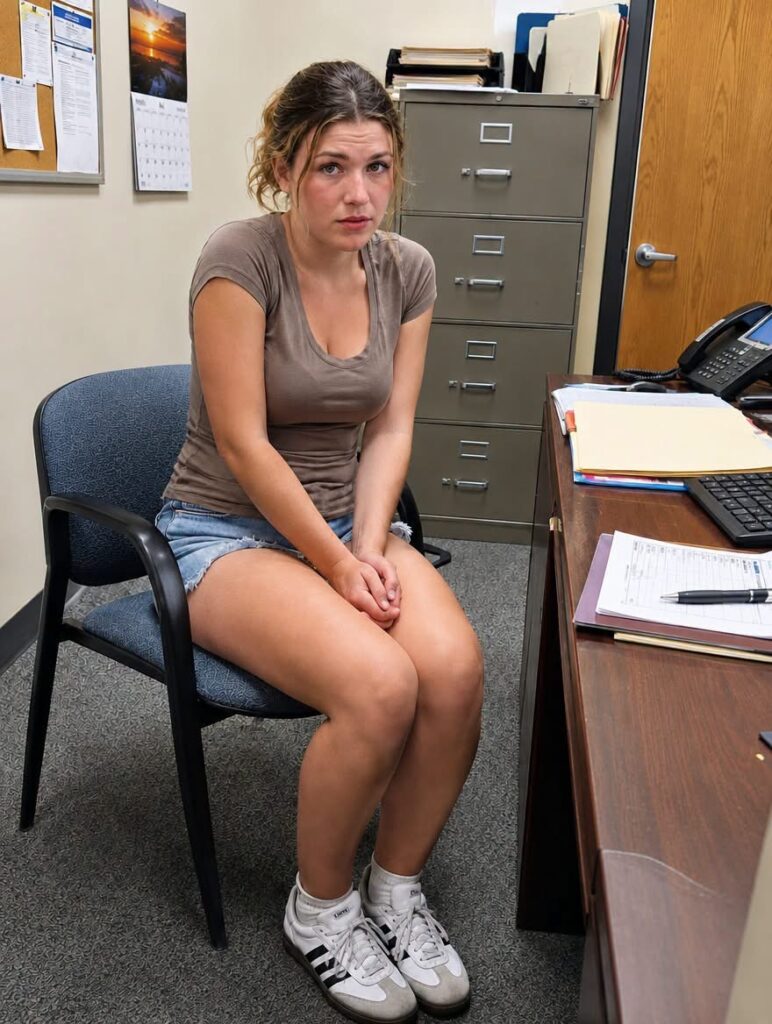
“Mom, please don’t make me get up. I can’t leave this chair.”
Those were the first words my fourteen-year-old daughter, Emily, said when I entered the principal’s office.
She was sitting in a corner, holding a pale blue dress tightly across her knees. Her eyes were swollen from crying, and she looked more upset than I had ever seen her.
I knew immediately that something serious had happened.
Just twenty-five minutes earlier, I had been at work when the school called.
“Mrs. Wilson, this is Principal Harris. Emily is safe, but something happened during history class. She is very upset, and we think you should come in.”
I left my office without hesitation.
During the drive, my mind raced through countless possibilities. Had someone bullied her? Had she argued with another student? Was something happening that she was afraid to tell me?
I never imagined the real reason.
When I entered the principal’s office, I noticed her history teacher, Mr. Bennett, standing beside the window.
I approached Emily and gently knelt beside her.
“Sweetheart, what happened?”
She looked toward her teacher and pointed at him.
“I don’t want to talk while he’s here. Please ask him to leave.”
Her voice was trembling, but she sounded determined.
Mr. Bennett approached me.
“Mrs. Wilson, perhaps we should discuss this privately first. I want to explain what happened before you make any decisions.”
I looked at my daughter.
“I’ll be just outside, honey. You’re not alone.”
Then I followed him into the hallway.
He explained that Emily had been participating in a family-history assignment. Each student was supposed to bring something meaningful from their family’s past and share its story with the class.
Emily had brought an old blue dress decorated with tiny embroidered flowers.
Unfortunately, one of the students made an unkind comment about her clothing. A few classmates laughed.
Emily tried to continue her presentation, but she became increasingly uncomfortable.
When she sat down to organize her notes, the dress caught on a damaged section of her chair. As she stood, the fabric tore badly.
She immediately became distressed.
According to Mr. Bennett, he had initially assumed she was upset because of the teasing.
He told her that accidents happened and encouraged her to stop worrying.
But that only made things worse.
“She wouldn’t continue the presentation,” he explained. “She kept saying the dress was ruined.”
I asked why nobody had contacted me immediately.
He admitted that they had brought her to the principal’s office, hoping she would settle down.
I looked through the small window in the office door. Emily was still sitting in exactly the same position.
“There’s more to this than a damaged dress,” I said.
Mr. Bennett lowered his eyes.
He agreed to give us some privacy.
When I returned, I sat beside my daughter.
“Sweetheart, I heard about what happened to your dress. We’ll find a solution.”
She shook her head.
“You don’t understand, Mom. It’s Grandma’s dress.”
My heart sank.
My mother, Evelyn, had passed away two years earlier. She was seventy-three, and her sudden departure had left a tremendous emptiness in our family.
Emily had been especially close to her grandmother.
They baked together, planted flowers, and spent countless afternoons making little crafts from leftover pieces of fabric.
After Grandma died, Emily rarely talked about her.
I assumed she was slowly learning to live with the loss.
But I was about to discover that she had been keeping many feelings to herself.
The dress that carried years of memories
Emily explained that she had discovered the dress inside Grandma’s old cedar chest in our attic.
It had been stored there with my mother’s other belongings after her funeral.
She had secretly taken it out several weeks earlier.
The dress had several small holes and a loose hem, so Emily decided to repair it herself.
Grandma had taught her a few basic sewing techniques when she was younger.
Emily had spent several evenings practicing stitches and watching sewing tutorials to remember what her grandmother had shown her.
She carefully pointed out the repairs.
There were tiny blue stitches along the hem and a small patch covering an old hole.
The work wasn’t flawless, but it was thoughtful and remarkably careful.
I was amazed.
My daughter had spent weeks restoring something precious, and I hadn’t even noticed.
“Why didn’t you tell me?” I asked gently.
She looked down.
“Because whenever I talk about Grandma, you get sad.”
I didn’t know what to say.
Emily continued.
“I wanted to wear her dress for the presentation. I thought you might smile when you saw it. But you always change the subject when I mention her.”
Her words brought back memories I had tried to avoid.
After my mother’s death, I had struggled to look at her photographs or revisit familiar places.
When Emily suggested baking Grandma’s famous cookies for her birthday, I suggested buying a cake instead.
When she wanted to talk about old family memories, I quickly redirected the conversation.
I thought I was protecting her from sadness.
I hadn’t realized that my silence was making her feel alone.
“I’m sorry, sweetheart,” I whispered. “I never wanted you to feel that way.”
She looked at the damaged dress.
“Now it’s ruined.”
I gently examined the tear. A large section of fabric had separated along the back seam.
I finally understood why she had refused to stand. She was embarrassed and frightened that moving might damage the dress even further.
“Let’s get you something comfortable to wear first,” I told her. “Then we’ll work out how to repair it.”
The school provided a loose sweatshirt and a pair of athletic pants.
Once Emily had changed, she carefully folded the dress and held it against her chest.
She didn’t want to leave it behind.
The principal apologized for not arranging assistance sooner. He also assured us that the school would address the teasing and inspect the damaged classroom furniture.
Before we left, Mr. Bennett asked whether he could speak to Emily.
I told her she didn’t have to agree.
After thinking for a moment, she nodded.
The teacher remained near the doorway.
“Emily, I owe you an apology,” he said. “I should have taken your feelings seriously instead of assuming you were overreacting.”
Emily looked at him.
“I wasn’t trying to cause trouble. Tyler laughed at me before the dress even tore.”
Mr. Bennett acknowledged that he should have addressed the comment immediately.
He also promised that she could complete the assignment in another way whenever she felt comfortable.
Then we went home.
A message hidden inside the dress
During the drive, Emily kept running her fingers over the embroidered flowers.
I asked what she had planned to tell her classmates.
She explained that her grandmother had made the dress when she was nineteen, while working at a small tailor shop.
She had also planned to share the story of how Grandma met Grandpa at the county fair.
Apparently, Grandpa had been so nervous that he accidentally spilled lemonade on himself while trying to impress her.
I laughed when Emily repeated the story.
It was one of my mother’s favorite memories.
Then Emily turned the dress inside out.
“Mom, look at this.”
Inside the waistband was a small piece of white fabric with a message embroidered in blue thread.
For Emily, who makes every ordinary day beautiful.
I immediately recognized my mother’s handwriting.
My hands began to tremble.
Years earlier, Mom had told me that she was saving the dress for Emily. She wanted to give it to her when she became old enough to appreciate its history.
She had even sewn a special message inside.
I had completely forgotten.
Emily stared at the words.
“Grandma made this for me?”
I nodded.
“She wanted you to have it when you were older.”
Emily’s eyes filled with tears.
“I didn’t know. I thought I had found something she used to wear.”
I explained that her grandmother had deliberately saved it for her.
She looked at the damaged fabric.
“But I tore something she kept for me.”
I held her hand.
“The dress has been damaged, but the message is still there. And the love behind it hasn’t changed.”
We sat in the car for several minutes, remembering my mother.
For the first time in a long while, we talked openly about how much we missed her.
Grandma’s old friend had an idea
That evening, I placed the dress carefully on our dining table.
I knew very little about sewing, so I couldn’t promise Emily that I could repair it.
But I remembered someone who could help.
Her name was June Pettersen, my mother’s closest friend for decades.
The two women had worked together at the same tailor shop when they were young. They had shared countless memories, and June had helped my mother with many sewing projects over the years.
I hadn’t spoken to her properly in months.
After Mom’s funeral, even hearing June’s voice reminded me too much of the past.
The next morning, I finally called.
When she answered, I explained everything about the dress.
She listened quietly.
Then she said something simple.
“Bring it over, dear. We’ll see what we can do.”
That afternoon, Emily and I visited her little yellow cottage.
June welcomed us warmly and immediately hugged Emily.
She examined the dress under a bright sewing lamp, carefully inspecting the damaged seam and the delicate embroidery.
When she discovered the message inside the waistband, she became emotional.
“Oh, Evelyn,” she whispered.
Then she looked at Emily.
“Your grandmother made this before you were born. I remember watching her work on it.”
Emily’s eyes widened.
June explained that her friend had spent much of one summer embroidering hundreds of tiny flowers by hand.
“She was so particular about every detail,” June recalled. “She wanted this dress to be special.”
Emily apologized for damaging it.
June gently shook her head.
“Your grandmother made clothes to be worn and enjoyed, not locked away forever. She would have been delighted to see you wearing something she created.”
Those words seemed to comfort Emily.
June then examined the tear more closely.
She believed it could be repaired, although the stitching might remain visible.
She also suggested that Emily help with the restoration.
“You already have some lovely sewing skills,” she said. “Let’s work on it together.”
For the next hour, June patiently showed Emily how to strengthen the damaged fabric and carefully secure the loose seam.
I watched my daughter become more confident with every stitch.
June shared funny stories about my mother, including one occasion when Evelyn accidentally attached a sleeve backward while working on a wedding dress.
Emily laughed.
I laughed too.
And something unexpected happened.
Talking about my mother no longer felt like reopening a painful wound.
It felt like welcoming her memories back into our lives.
A new beginning for mother and daughter
Over the following week, Emily and June continued repairing the dress.
I joined them whenever I could.
June even insisted that I learn a few basic sewing techniques.
My attempts were far from impressive, but Emily found them hilarious.
One afternoon, June told me something I hadn’t expected.
Emily had secretly contacted her several weeks earlier to ask for advice about repairing the dress.
She had found June’s telephone number in my mother’s old address book.
Emily had explained that she didn’t want me to know because she was afraid it would make me sad.
Hearing that broke my heart.
My daughter had been trying to protect my feelings while quietly dealing with her own.
I realized that I needed to make a change.
I couldn’t bring my mother back, but I could stop treating every memory of her as something we had to avoid.
Meanwhile, the school arranged a meeting with me.
The principal confirmed that the damaged chair had been replaced and that other classroom furniture had been inspected.
The student responsible for the hurtful comment had also been spoken to, along with his parents.
Mr. Bennett explained that he had apologized to the class for not addressing the teasing immediately.
He wanted Emily to feel comfortable returning to his classroom.
He offered her several ways to complete the family-history assignment.
She could submit a written report, present privately, or speak to the class whenever she felt ready.
I left the decision entirely up to her.
After thinking about it, Emily made her choice.
“I want to show them the dress when it’s fixed,” she said.
“Are you sure?”
She nodded.
“Grandma would have wanted people to hear its story.”
The presentation that changed everything
A few days later, Emily returned to history class.
She didn’t wear the blue dress. Instead, she carried it carefully inside a cloth bag.
She had decided that she wasn’t ready to wear it to school again, and I respected that.
Her teacher arranged for her to give the presentation at the beginning of class.
I waited in the school parking lot while she went inside.
When she returned, she was smiling.
She told me that she had stood at the front of the classroom and explained how her grandmother had made the dress decades earlier.
She talked about the tailor shop, the hundreds of embroidered flowers, and the afternoon her grandparents met at the county fair.
She also explained how the dress had been damaged and how her grandmother’s closest friend had helped her restore it.
Then she showed everyone the repaired seam.
It wasn’t invisible.
The new stitches were slightly different from the original ones, but they were strong and carefully placed.
“This dress has two stories now,” Emily told the class. “My grandmother’s story and the story of how we repaired it.”
Finally, she showed them the embroidered message inside.
The classroom became quiet.
Several students asked questions about the sewing process. One girl even asked whether Emily could teach her how to repair a button.
Emily answered every question.
Nobody made fun of her.
After class, the boy who had made the original comment approached her.
He apologized for laughing at her clothing and admitted that he hadn’t considered how much the dress meant to her.
Emily listened.
She didn’t pretend that everything was suddenly forgotten, but she accepted his apology and made it clear that she expected him to treat her respectfully in the future.
When she told me about the conversation, I could see how proud she was of herself.
She had stood up for something important without allowing the experience to define her.
The memories we finally learned to share
That evening, Emily asked me a question.
“Mom, do you think Grandma would have liked my presentation?”
I sat beside her on the bed.
“She would have been incredibly proud,” I answered. “She would probably have cried happy tears.”
Emily smiled.
Then she asked whether we could talk about Grandma more often.
“Even if it makes us sad?”
I took her hand.
“Especially then.”
We spent the evening looking through old photographs from the cedar chest.
We remembered Grandma’s enormous glasses, her garden full of sunflowers, and her habit of singing while she cooked.
I shared stories about my childhood that I hadn’t talked about in years.
Some memories made us laugh.
Others brought tears.
But this time, I didn’t change the subject.
A few days later, Emily hung the repaired dress in the front of her closet instead of hiding it beneath her winter coat.
She liked being able to see it whenever she opened the door.
The repaired seam remained visible, and she didn’t mind.
“It reminds me that June and I worked on it together,” she explained.
That weekend, I finally brought my mother’s photograph out of my bedroom.
For two years, I had kept it facing the wall because seeing her smile was too painful.
I turned it around and placed it back in the hallway.
Emily noticed immediately.
She stopped in front of it, smiled, and gently touched the frame.
In the spring, the three of us began visiting June regularly.
She continued teaching Emily to sew, and I slowly learned too.
On what would have been my mother’s birthday, we visited her grave and planted sunflower seeds nearby.
Emily wore the blue dress.
It was the first time she had worn it since the incident at school.
The repaired seam was visible, and the little embroidered flowers moved gently in the breeze.
Standing beside her grandmother’s resting place, Emily shared stories about her presentation, the sewing lessons, and everything she had learned.
June and I stood nearby, listening.
Later, Emily showed me the report her history teacher had graded.
She had received an excellent mark.
At the bottom of the page, she had written one final sentence:
The most meaningful things we inherit aren’t always the things that remain perfect.
I read those words several times.
They reminded me of something I had nearly forgotten.
When Principal Harris called that morning, I thought my responsibility was simply to protect my daughter and bring her home.
But the experience taught me something much deeper.
Emily didn’t only need help repairing an old dress.
She needed someone willing to listen to her feelings, share her memories, and understand why something that seemed ordinary to others meant so much to her.
The dress was repaired, and Emily returned to school.
But the most important change happened inside our home.
We began sharing stories about Grandma again. We brought her photographs back into view, baked her favorite recipes, and made room for both laughter and tears.
I finally understood that remembering someone we love doesn’t mean we must avoid sadness.
Sometimes, the best way to keep their memory alive is to talk about them, learn from them, and pass their stories to the next generation.
And every time I see that pale blue dress hanging in Emily’s closet, I remember the lesson my daughter taught me:
Some of the most precious things in life aren’t valuable because they remain untouched. They’re valuable because of the love, memories, and people connected to them.