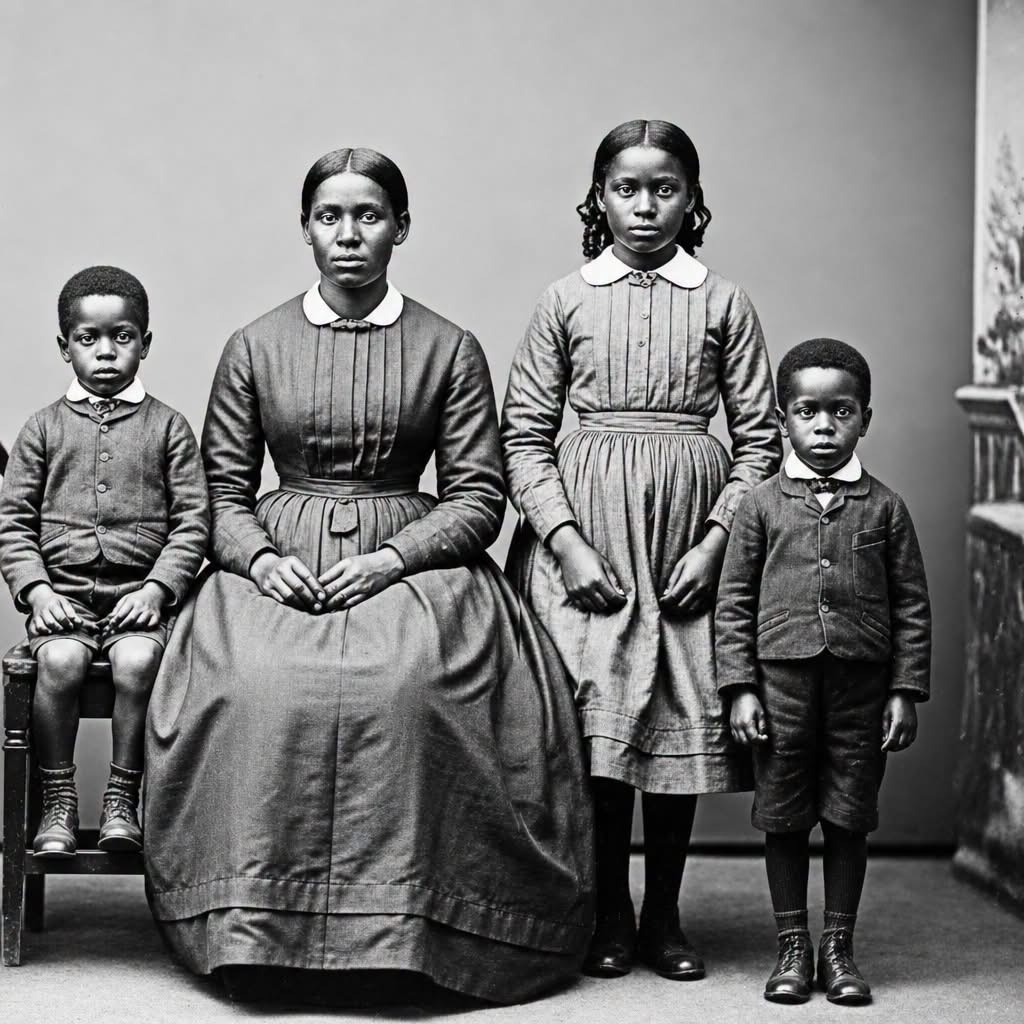
At first glance, a family portrait from 1872 appears completely ordinary.
A mother and her children sit carefully in the formal style typical of the Victorian era, posing for a photograph that was probably meant to preserve a simple family memory.
But look a little closer at the older daughter’s hand.
Beside it appears to be another hand.
That tiny, unexplained detail has transformed an otherwise ordinary family photograph into a mystery that continues to attract attention generations later.
People have examined enlarged versions of the image, tracing the visible arms and trying to determine exactly where the mysterious hand could have come from.
Some viewers believe there is something genuinely disturbing about the photograph.
Others think the explanation is much more ordinary and may have something to do with the limitations of nineteenth-century photography.
Taking a photograph in 1872 was nothing like taking a picture with a smartphone today.
Exposure times could be lengthy, which meant subjects often had to remain completely still for extended periods.
Photographers sometimes relied on posing stands, braces, and other hidden supports to help people maintain their positions.
If one of those supports was partially concealed by clothing or furniture, it could potentially create an unusual shape in the finished photograph.
Another possibility is a double exposure.
If a photographic plate was exposed more than once, two images could overlap and produce strange-looking forms.
Movement during a long exposure could also result in blurred or duplicated shapes.
Hands are especially easy for the human brain to recognize, so even a partial or distorted outline can look surprisingly convincing.
Clothing and shadows may provide another explanation.
Victorian clothing often included large sleeves and layers of fabric, while closely positioned arms could easily overlap.
When combined with shadows and highlights, those elements can create shapes that appear almost impossible from a modern perspective.
There is also a psychological factor involved.
Once someone points out an “extra hand,” the brain begins looking for that specific shape.
This tendency is known as pareidolia—our natural tendency to recognize familiar objects or patterns in unclear visual information.
It’s the same phenomenon that makes people see faces in clouds, buildings, or shadows.
Old photographs can be especially vulnerable to this effect because fading, scratches, blur, and imperfect reproductions may remove details that would otherwise make the image easier to understand.
Unfortunately, the surviving photograph may not contain enough information to establish a definite answer.
Without access to the original photographic plate, the photographer’s records, or additional pictures taken during the same session, it may be impossible to determine whether the mysterious shape came from clothing, movement, a hidden support, or a photographic error.
And that uncertainty is precisely what makes the portrait so intriguing.
The family who originally owned the photograph probably saw it as nothing more than a cherished record of their lives.
Generations later, however, one unexplained detail has turned that ordinary family portrait into a historical curiosity.
The “extra hand” may never receive a completely certain explanation.
But there is little reason to assume something supernatural when ordinary photographic techniques provide several plausible possibilities.