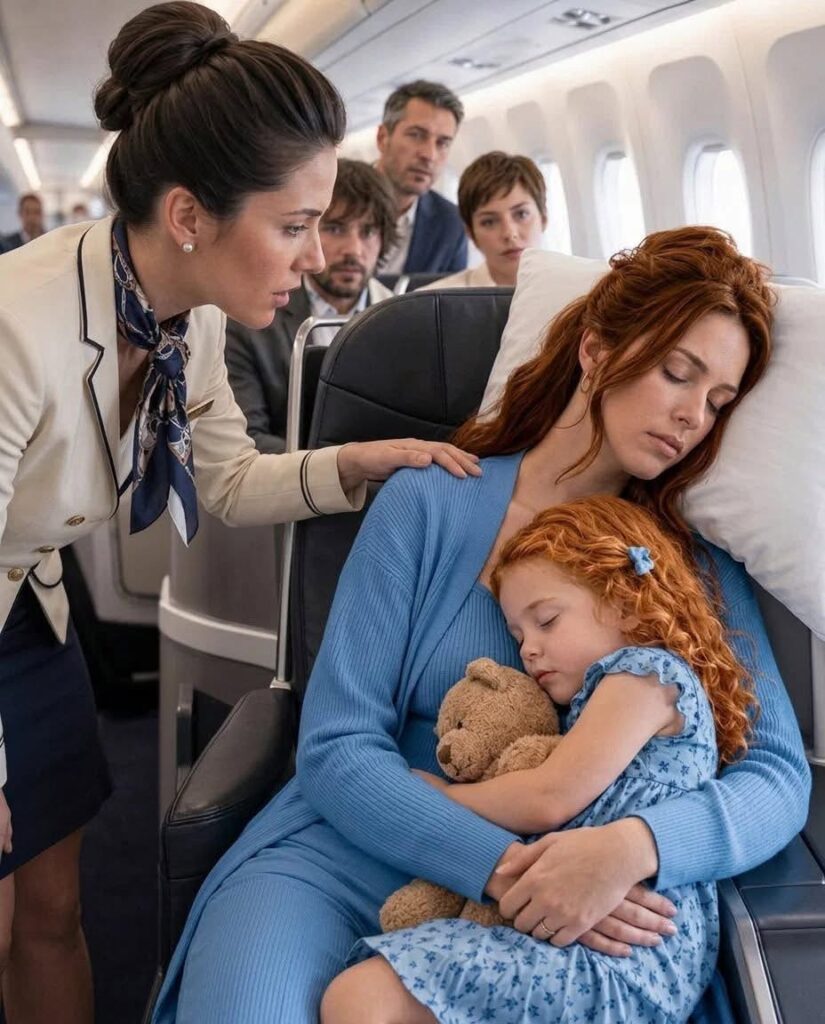
Maya Bennett had spent years learning how to stay calm when everyone else was afraid.
She had learned it in places where mistakes could cost lives, where alarms sounded without warning and where every decision had to be made before there was time to question it.
But that part of her life was over.
At least, that was what Maya had convinced herself.
She had left military aviation two years earlier and deliberately built a quiet life far away from aircraft, uniforms, and emergency briefings. She rarely talked about her past. Even close friends knew very little about what she had done before.
So when she boarded a late-night flight from Boston to Lisbon, she expected nothing more than a long, uncomfortable journey.
She was wrong.
Maya had been reading a paperback near the window when the cabin lights suddenly brightened.
A moment later, the captain’s voice came over the speakers.
“Ladies and gentlemen, please remain calm. We are dealing with an unexpected technical issue. If any passenger has professional aviation or military flight experience, please notify a member of the cabin crew.”
The cabin became strangely quiet.
People looked at one another.
A few passengers laughed nervously, assuming the announcement was some unusual precaution.
Maya didn’t laugh.
She knew what fear sounded like when a trained pilot was trying desperately not to let passengers hear it.
She closed her book.
For several seconds, she remained completely still.
She had promised herself she would never sit inside a cockpit again.
Then she looked around the cabin.
A father was holding his young daughter’s hand.
An elderly couple sat frozen in their seats.
A flight attendant was walking rapidly down the aisle, asking passengers whether anyone could help.
Maya knew she couldn’t simply pretend she hadn’t heard.
She raised her hand.
“I have flight experience.”
The attendant stopped.
“Commercial?”
“No.”
“What kind?”
Maya hesitated.
“Military.”
The attendant’s eyes widened.
“Please come with me.”
Maya followed her toward the cockpit.
Every step brought back memories she had worked hard to bury.
When the cockpit door opened, she immediately saw that something was seriously wrong.
The captain was fighting to keep the aircraft stable.
The co-pilot was receiving medical attention from another crew member.
Several warning indicators were flashing across the instrument panel.
The captain looked at Maya skeptically.
“You’re military?”
“Yes.”
“What did you fly?”
“Fast jets.”
He studied her for a moment.
“I need someone who understands emergency flight systems.”
“I’ll help however I can.”
Maya took the empty seat beside the captain and began observing the instruments.
She didn’t touch anything at first.
She watched.
The aircraft was responding strangely to the controls.
Something wasn’t behaving the way it should.
“Don’t make another correction,” Maya said.
The captain glanced at her.
“Why?”
“Because the aircraft is already correcting itself. You’re giving it conflicting commands.”
He paused.
Then he followed her suggestion.
The aircraft immediately became steadier.
The captain stared at the instruments.
“You saw that?”
“I’ve seen something similar before.”
Before he could ask another question, the cabin crew reported that the co-pilot’s condition had worsened.
A doctor traveling as a passenger entered the cockpit.
“He’s breathing, but he needs medical attention as soon as we land,” the doctor said.
The captain looked at Maya.
“How far to the nearest suitable airport?”
“Not far enough,” she answered after looking at the navigation display.
The aircraft was approaching a severe weather system.
Rain covered the windshield.
Lightning flashed in the distance.
Then another warning appeared.
The landing system was reporting an irregularity.
The captain exhaled slowly.
“We’re going to have to land through this.”
Maya looked at the runway information.
“Then let’s make sure we do it properly.”
For the next several minutes, the cockpit became a place of absolute concentration.
No one shouted.
No one panicked.
Everyone had one job.
The captain focused on flying.
The doctor monitored the injured crew member.
Maya watched the aircraft’s behavior and helped the captain interpret the unusual responses.
The passengers knew almost nothing about what was happening.
All they could feel was the turbulence.
Some prayed.
Some cried quietly.
Others held hands.
Maya could almost feel their fear from the cockpit.
Then the runway appeared through the clouds.
They were close.
But the aircraft still wasn’t behaving normally.
“Keep it centered,” Maya said.
“I’ve got it.”
“Don’t rush the landing.”
The captain nodded.
The plane descended.
The runway grew larger.
Then the wheels touched the ground.
For a brief moment, the aircraft moved slightly toward one side.
Maya immediately called out the correction.
The captain responded.
The aircraft straightened.
The brakes engaged.
The engines roared.
Then, finally, the aircraft stopped.
For several seconds, nobody in the cockpit spoke.
Then the cabin erupted in applause.
Maya closed her eyes.
They had made it.
But the story didn’t end on the runway.
After the passengers were safely evacuated, investigators began examining the aircraft.
The problem wasn’t as simple as mechanical failure.
Several maintenance records appeared inconsistent.
A component that should have been recently inspected showed signs of poor servicing.
The authorities also discovered that someone had accessed restricted maintenance information shortly before the flight.
The investigation expanded quickly.
Maya was interviewed because of the role she had played during the emergency.
During one interview, an investigator placed a folder in front of her.
“We found something you may want to see.”
Maya opened it.
Inside were records from an aviation accident that had happened years earlier.
Her hands became cold.
She recognized the aircraft number.
She recognized the mission.
And she recognized the name of the pilot who had died.
Daniel Reyes.
Her closest friend.
For years, Maya had believed she had failed him.
She had been the last person to speak with him before the accident.
Afterward, she had replayed the event in her mind hundreds of times.
What if she had reacted sooner?
What if she had warned him differently?
What if she had made one better decision?
Those questions had eventually convinced her to leave aviation.
The investigator turned another page.
“We found evidence that the accident was caused by a faulty component.”
Maya stared at him.
“That isn’t what I was told.”
“I know.”
He slid another document across the table.
The component had been supplied through a company later investigated for falsifying inspection records.
The same company had recently appeared in the maintenance records of the aircraft Maya had just helped land.
For years, Maya had carried a burden that had never belonged to her.
She had walked away from a career because she believed she had failed someone.
Now she was learning that the truth had been hidden from her.
That evening, she sat alone in her hotel room.
For the first time in years, she allowed herself to cry.
Not because Daniel was suddenly coming back.
He wasn’t.
She cried because she finally understood that his death had never been her fault.
A few weeks later, Maya visited Daniel’s parents.
She almost turned around before knocking.
Daniel’s mother opened the door.
For a moment, neither woman said anything.
Then Maya whispered,
“I spent years believing I should have saved him.”
Daniel’s mother reached for her hand.
“You loved him,” she said. “You don’t honor someone by destroying your own life because they are gone.”
Maya looked down.
“I don’t know how to move forward.”
“You don’t have to forget him,” the older woman replied. “Just don’t let your grief decide what the rest of your life will be.”
Those words stayed with Maya.
Months later, she made a decision.
She wasn’t going back to military service.
She didn’t want medals or recognition.
Instead, she began teaching aviation safety at a small training academy.
On her first day, a group of young students gathered around her.
They expected stories about military aircraft.
Instead, Maya wrote one sentence on the classroom board:
“Stay calm. Understand the problem. Trust your training.”
Then she turned toward her students.
“Flying isn’t about being fearless,” she told them. “It’s about knowing what to do when fear appears.”
The students listened carefully.
Maya smiled.
For years, she had believed her aviation career ended with the worst day of her life.
Now she understood something different.
Sometimes a painful chapter doesn’t have to become the end of the story.
Sometimes it becomes the reason you help someone else.
That night, Maya stood outside the academy and watched a training aircraft disappear into the evening sky.
The sound of the engine no longer reminded her only of loss.
It reminded her of possibility.
She thought about Daniel.
She thought about the passengers whose lives had briefly depended on her experience.
And she finally allowed herself to imagine a future that wasn’t defined by guilt.
Maya smiled.
She had spent years trying to escape her past.
Now she understood that she didn’t need to run from it.
She simply needed to stop letting it control where she was going.
And for the first time in a very long time, she looked toward the sky without fear.