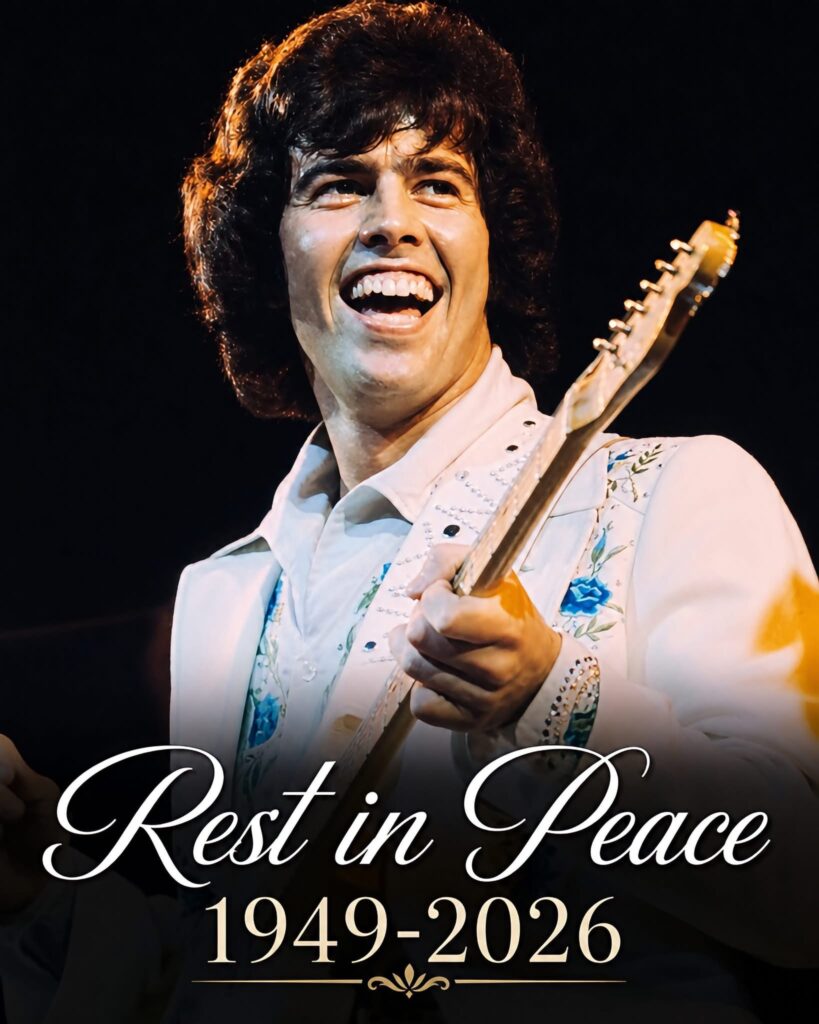
Alan Osmond, the eldest performing member of the legendary Osmond family, has died at the age of 76. The musician, songwriter, producer, husband, father, and longtime leader of the Osmond Brothers passed away on April 20, 2026, at his home in Utah, surrounded by his wife, Suzanne, and their eight sons.
News of Alan’s death marked the end of an important chapter in the story of one of America’s most recognizable musical families. For decades, the Osmonds entertained audiences around the world, first as a wholesome family singing group and later as a successful pop, rock, country, and television act. While younger siblings Donny and Marie eventually became household names in their own right, Alan played an important role in building the foundation that made the family’s success possible.
He was 76.
A Life Built Around Family and Music
Alan Ralph Osmond was born on June 22, 1949, in Ogden, Utah. He was the third of nine children born to George and Olive Osmond.
Music became part of the Osmond household at an early age. The family was deeply religious, and singing was an important part of their lives. Alan and his brothers learned to perform and harmonize together, eventually turning their musical abilities into a career.
The beginning of the Osmonds’ professional story was not simply about fame or fortune. The brothers originally performed in part to help their older brothers, Virl and Tom, who were hearing impaired. Money earned from performances helped with hearing aids and other family needs.
Alan became the eldest member of the performing group, joining brothers Wayne, Merrill, and Jay in the original Osmond Brothers quartet. Their early performances took them to fairs and events throughout Utah before an important opportunity changed the direction of their lives.
A trip to California eventually led the young musicians to Disneyland, where their performances attracted attention. That exposure helped open the door to television and ultimately to one of the most important opportunities of their early careers: an appearance on “The Andy Williams Show.”
The Osmond Brothers Become Television Favorites
The Osmond Brothers became regular performers on “The Andy Williams Show” during the 1960s. Their clean-cut appearance, polished harmonies, energetic performances, and family-friendly image made them popular with viewers.
The exposure was enormous for a young family act.
The brothers were not simply appearing on television as occasional guests. They became familiar faces to millions of Americans and developed the professional discipline that would serve them throughout their careers.
Their younger brother Donny eventually joined them on the program, becoming an important part of the family act. As the years passed, other members of the family also became involved in entertainment.
The Osmonds’ ability to perform together as a family became one of their greatest strengths.
Behind the scenes, Alan was increasingly important to the group’s musical direction. Although audiences often focused on the singers in front of the microphone, Alan was also developing his skills as a musician, songwriter, arranger, and producer.
That behind-the-scenes work would become a major part of his legacy.
The Rise of Osmondmania
The early 1970s brought the Osmonds an extraordinary level of popularity.
The family moved from their television roots into the world of pop music and quickly became one of the biggest acts of the era. Their youthful appearance and energetic performances appealed particularly strongly to younger audiences.
Their breakthrough included the enormous success of “One Bad Apple,” which became a No. 1 hit for the group in 1971.
The Osmonds followed that success with a series of recordings that demonstrated they were capable of more than simply performing cheerful pop songs.
Alan and his brothers became increasingly involved in writing and producing their own material. Alan’s work with brother Merrill was particularly important to the group’s evolution.
Songs such as “Down by the Lazy River,” “Hold Her Tight,” and “Crazy Horses” showed a different side of the family.
“Crazy Horses,” in particular, became one of the most memorable Osmonds recordings. With its harder rock sound and unusual subject matter, the song surprised listeners who knew the family primarily for their clean-cut television image.
Alan helped write some of the group’s most enduring material and played an important role in shaping their musical identity.
Alan Osmond Was More Than a Performer
It can be easy to remember the Osmonds primarily through their television appearances, matching outfits, dance routines, and pop hits.
Alan’s contribution was considerably broader.
He was a musician, songwriter, producer, and organizer who frequently worked behind the scenes. His leadership helped the family navigate an entertainment business that was changing rapidly.
He played instruments including guitar and piano and worked closely with his brothers on the group’s recordings.
Alan was also involved in production for “The Donny & Marie Show,” the television program that starred his younger brother and sister. The show ran from 1976 through 1979 and became another major part of the Osmond family’s entertainment legacy.
The program demonstrated just how large the family’s presence had become. The Osmonds were no longer simply a singing group. They were a television family, recording artists, performers, producers, and entertainers whose careers extended across multiple areas of the industry.
Alan’s ability to work behind the scenes was especially valuable during this period.
“The Plan” and a More Personal Side of the Osmonds
One of Alan’s most ambitious projects with his brothers was the 1973 album “The Plan.”
The album was deeply connected to the family’s religious beliefs and attempted to explore spiritual themes through music. It represented a significant creative departure from the straightforward pop material that had made the Osmonds famous.
Alan considered the project particularly important.
The album incorporated more ambitious musical arrangements and explored themes that were personal to the brothers. Although it did not achieve the same commercial success as some of their earlier releases, it became an important part of the Osmonds’ artistic story.
For Alan, music was not simply entertainment. It was also a way of expressing his beliefs, values, and experiences.
That combination of music and faith remained an important part of his life throughout his career.
The Family Faces Major Challenges
Like many enormously successful entertainers, the Osmonds experienced difficulties behind their public success.
By the late 1970s, the family’s financial situation had become complicated. Despite having earned substantial sums during the height of their popularity, poor business decisions, financial problems, and fraud contributed to serious losses.
The family was reportedly left with enormous debts.
Rather than simply walking away, the Osmonds worked to recover financially through continued performances and other projects.
The experience tested the family’s unity and determination.
Alan’s role as one of the family’s leaders became particularly significant during difficult periods. The Osmonds had spent their lives working together, and their commitment to one another helped them navigate challenges that could have ended many entertainment careers.
A Return to Country Music
In the early 1980s, Alan reunited with brothers Wayne, Merrill, and Jay as the original Osmond Brothers.
This time, however, the group explored country music.
The move allowed the brothers to reinvent themselves after the height of their pop success. They recorded and performed as a country group and achieved success on the country charts.
Songs including “I Think About Your Lovin’” helped establish the group’s new direction.
The transition was significant because it demonstrated that the Osmonds were not interested in being permanently defined by their early teen-idol image.
They were musicians who wanted to continue performing and evolving.
Alan remained a central part of that effort.
Alan Osmond’s Multiple Sclerosis Diagnosis
In 1987, Alan’s life changed dramatically when he was diagnosed with multiple sclerosis.
The condition eventually affected his mobility and made performing increasingly difficult.
Alan eventually stepped away from regular public performance, but he refused to allow the disease to become the defining story of his life.
A phrase associated with Alan’s approach to the illness became particularly meaningful: “I might have MS, but MS doesn’t have me.”
That attitude reflected the determination that had characterized his life and career.
Although he could no longer perform in the same way he had during the Osmonds’ most active years, Alan remained connected to his family, his faith, and the entertainment world.
His experience with multiple sclerosis also gave him an opportunity to become an advocate for perseverance and optimism.
Family Came Before Fame
Away from the stage, Alan was devoted to his family.
He married Suzanne Pinegar in 1974, and the couple built a family of their own. They had eight sons: Michael, Nathan, Doug, David, Alex, Jon, Scott, and Tyler.
Alan and Suzanne eventually became grandparents to 30 grandchildren and great-grandparents to five great-grandchildren.
For Alan, family was not simply part of his public image. It was central to his identity.
In his later years, he often emphasized the importance of family over show business. His career had provided extraordinary experiences, but his relationships with his wife, children, grandchildren, siblings, and extended family remained his greatest source of meaning.
That perspective also helps explain why his brothers and children have spoken so warmly about him following his death.
A Final Public Appearance
Although Alan largely withdrew from the spotlight after his diagnosis, he occasionally returned for special occasions.
One of his most memorable later appearances came in 2019, when he reunited with brothers Wayne, Merrill, and Jay on the daytime television program “The Talk.”
The appearance was connected to sister Marie Osmond’s birthday.
The original four Osmond Brothers performed together, giving longtime fans an emotional opportunity to see the siblings reunited.
For many viewers, the appearance was more than a nostalgic television moment. It was a reminder of how far the family had traveled together since their childhood performances.
Alan’s health had changed, but his connection to his brothers remained strong.
Alan’s Final Years
In the years before his death, Alan’s health continued to decline as he lived with multiple sclerosis.
His family remained closely involved in his care.
According to reports, Alan died at approximately 8:30 p.m. on April 20, 2026, with Suzanne and his eight sons by his side. He was at his Utah home at the time.
The family did not initially announce a separate cause of death, although his decades-long battle with multiple sclerosis was an important part of his later life.
His death brought an outpouring of tributes from his siblings, fans, musicians, and people who had followed the Osmond family for generations.
Donny Osmond Remembers His Brother
Donny Osmond paid an emotional tribute to Alan following his death.
He remembered his older brother as a protector and guide and emphasized how much responsibility Alan had carried while helping the family build its career.
That description captures an important part of Alan’s place within the Osmond family.
Alan was not necessarily the sibling most frequently in the spotlight. Donny became the breakout teen idol. Marie developed her own successful career. Other brothers continued performing and working in entertainment.
But Alan’s influence was often felt behind the scenes.
He helped create opportunities for his siblings, contributed to the group’s music, worked in television production, and helped guide the family through periods of extraordinary success and difficult setbacks.
His leadership was not always flashy.
It was foundational.
Merrill Osmond’s Final Conversation With Alan
Brother Merrill Osmond also shared memories of his final days with Alan.
Merrill said the brothers had a heart-to-heart conversation shortly before Alan died. Even though Alan was physically struggling, the two were able to laugh together and reflect on their lives.
During that conversation, Alan reportedly spoke about “The Plan,” the ambitious spiritual project the brothers had created decades earlier.
He asked Merrill to continue sharing the message behind the work.
For Merrill, the conversation became one of his final memories of his brother.
It also illustrated something that remained consistent throughout Alan’s life: his belief that music could carry a message beyond entertainment.
A Lasting Legacy
Alan Osmond’s legacy extends far beyond a list of hit songs.
He helped establish the Osmonds as one of the most successful family entertainment acts of the 20th century. He contributed as a singer, instrumentalist, songwriter, composer, and producer.
He helped write songs that remain associated with the Osmonds decades later.
He also helped produce television projects and played a role in the family’s continued professional development.
Beyond music, Alan was involved with the creation of Stadium of Fire, the major Fourth of July celebration in Provo, Utah. The event grew into a significant annual Independence Day celebration and became another part of Alan’s contribution to his home state.
His influence therefore reached beyond recordings and television screens.
Remembering the Eldest Osmond Brother
The story of the Osmonds is often remembered through images of young brothers singing together on television, screaming fans, chart-topping records, and the enormous popularity of Donny and Marie.
But behind those familiar images was Alan Osmond.
He was the oldest performing brother, a leader, a songwriter, a producer, and a person who spent much of his life helping his family succeed.
His career was marked by remarkable highs and difficult challenges. He experienced the extraordinary success of Osmondmania, the pressures of the entertainment business, major financial setbacks, a dramatic shift into country music, and a life-changing diagnosis of multiple sclerosis.
Through it all, his family remained at the center of his life.
Alan died surrounded by the people he loved most.
He is survived by his wife, Suzanne, their eight sons, 30 grandchildren, five great-grandchildren, and several siblings, including Merrill, Jay, Donny, Marie, Jimmy, Virl, and Tom.
For generations of fans, Alan Osmond will remain part of the soundtrack of American popular culture.
For his family, however, his legacy is likely to be much more personal.
He was a brother who helped lead the way, a husband and father who placed family above fame, and a musician whose work helped shape one of America’s most famous entertainment families.
Alan Osmond may no longer be on stage, but the music he helped create—and the family legacy he helped build—will continue to be remembered.