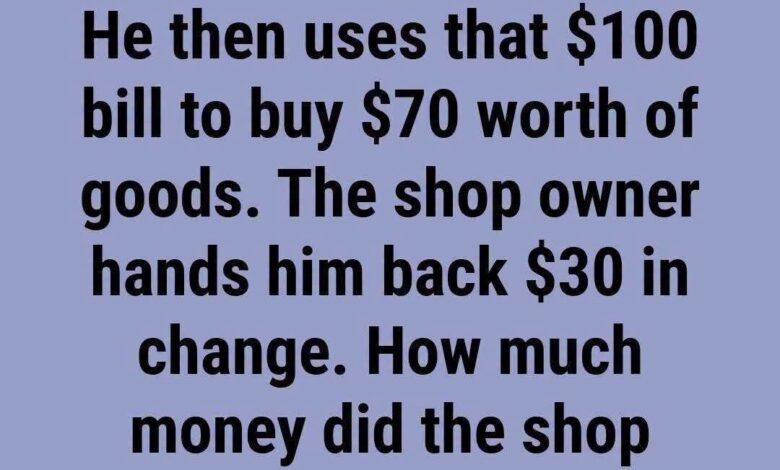
Imagine you own a small shop and are helping customers throughout the day. Everything seems normal until a customer secretly takes $100 from your cash register. A short time later, the same person returns to the counter, selects $70 worth of merchandise, and pays for it using the very same $100 bill. You accept the payment without realizing what happened and give the customer $30 in change. After the customer leaves, an important question arises: How much money has the shopkeeper actually lost?
At first, this puzzle can seem more complicated than it really is. Some people believe the answer is $200 because they add the stolen $100, the $70 in merchandise, and the $30 in change. Others suggest that the loss is $170 or another amount. However, the key to solving this brain teaser is to follow the money carefully and avoid counting the same bill twice.
Let’s examine what happens from beginning to end.
First, the customer secretly takes $100 from the cash register. At this moment, the shopkeeper is missing $100 in cash. The customer has the money, while the shopkeeper’s register has $100 less than it should contain.
Next, the customer uses that same $100 bill to purchase $70 worth of merchandise. The shopkeeper accepts the bill as payment because it appears to be an ordinary transaction. Since the purchase costs only $70, the shopkeeper gives the customer $30 in change.
Now comes the most important part of the puzzle. The original $100 bill has returned to the cash register. Therefore, the shopkeeper cannot count that bill as a separate, permanent loss in addition to the merchandise and change. The same money was taken and then returned through the purchase.
So, what has the shopkeeper actually lost?
The answer becomes clear when we look at the final result. The shopkeeper has given away merchandise worth $70 and handed over $30 in cash as change. Meanwhile, the original $100 bill is back in the register.
Adding the two actual losses together gives us a simple calculation:
$70 worth of merchandise + $30 in cash = $100 total loss.
This means the correct answer is $100.
The easiest way to understand this puzzle is to focus on the shopkeeper’s position after the entire event has finished. Although the customer initially took $100, that same bill was later used to pay for the purchase. Counting the original theft again would mean including money that ultimately returned to the shopkeeper.
This classic money puzzle is a useful reminder that careful reasoning is often more important than quickly adding every number in a problem. When several transactions involve the same amount of money, it helps to examine the final outcome rather than treating every movement of cash as a separate loss.
Did you solve the puzzle correctly on your first attempt? Think about how the money moved from the register to the customer and then back again. Sometimes, the simplest explanation becomes clear only after you examine every step.