Eric Braeden did not go to the animal shelter planning to bring anything home.
He had simply heard about an elderly German Shepherd that had been returned by three different families.
That detail stayed with him.
Three homes.
Three attempts.
Three times the dog had been brought back.
Eric assumed there had to be a reason.
Maybe the dog was aggressive.
Maybe it had serious health problems.
Maybe the families had underestimated the work involved in caring for an older animal.
Whatever the explanation, Eric wanted to understand it for himself.
So on a quiet afternoon in Los Angeles, he stopped by the shelter between appointments.
He told his wife he would only be there for a few minutes.
That plan disappeared almost immediately.
A shelter worker led him toward a quieter section of the building.
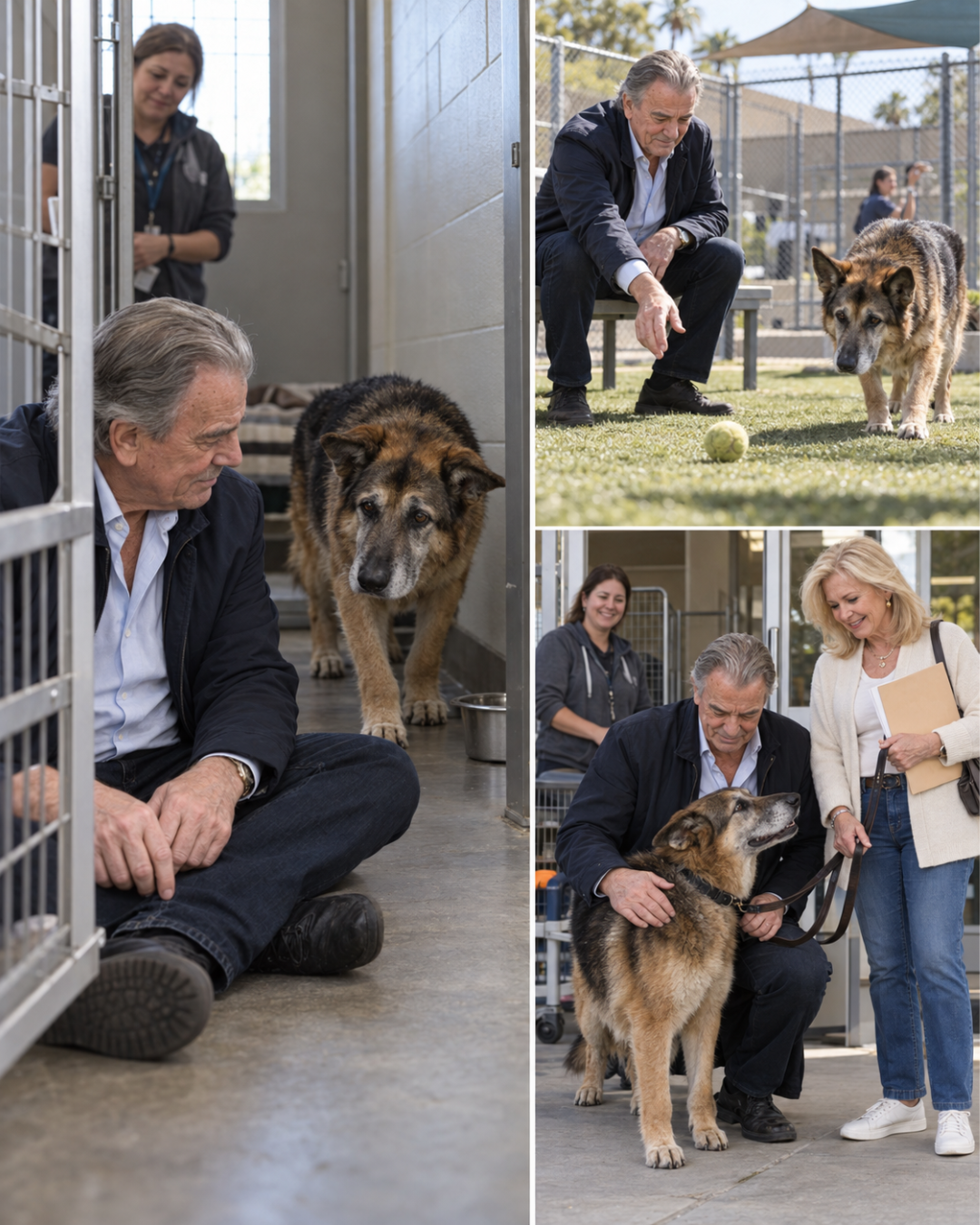
The German Shepherd was lying near the back wall of a kennel.

He was large, gray around the muzzle and noticeably thinner than he probably had been in younger years.
His name was Max.
When Eric approached, Max did not bark.
He did not rush toward the gate.
He simply lifted his head.
Then he lowered it again.
Eric stood there for several seconds.
“He doesn’t seem aggressive,” he said.
The worker shook her head.
“He isn’t.”
That made the story even harder to understand.
Why had three families returned him?
The worker explained.
The first family had adopted Max because they wanted a calm older dog.
But after bringing him home, they discovered he refused to enter certain rooms.

He became anxious around loud televisions.
At night, he paced.
After less than two weeks, they returned him.
The second family lasted longer.
They tried to give him time.
But Max rarely played.
He sometimes hid when visitors arrived.
And whenever someone raised their voice, even casually, he trembled.
They eventually decided he was not adjusting.
Back to the shelter he went.
The third family said Max was simply too distant.
They wanted a dog that would follow them everywhere.
Max preferred sitting alone near the door.
Three families interpreted his behavior differently.
But the shelter staff had begun to understand something else.

Max was not rejecting people.
He was waiting for someone.
His previous owner had died.
For nearly ten years, Max had lived with the same elderly man.
The two had apparently spent almost every day together.
After the man passed away, distant relatives brought Max to the shelter.
Nobody knew much about what his life had looked like before that.
But one detail seemed clear.
His entire world had disappeared overnight.
Eric listened carefully.
Then he asked whether he could sit inside the kennel.
The worker opened the gate.
Eric entered slowly and sat on the floor several feet away from the dog.
He did not call Max.
He did not reach toward him.
He simply sat.
For nearly five minutes, nothing happened.

Then Max looked at him.
Eric spoke quietly.
“Well, you’re not very interested in impressing anybody, are you?”
The dog blinked.
Eric smiled.
“That makes two of us.”
A few minutes later, Max stood.
He took two steps toward Eric.
Then stopped.
Eric remained still.
Max took another step.
Eventually, the old dog lowered himself onto the floor beside him.
Not touching.
Just close enough.
The shelter worker watched from outside.
She said later that Max usually stayed near the back of the kennel when strangers entered.
Eric did not seem particularly surprised.
He gently rested one hand on his knee.
After another minute, Max moved closer.
His shoulder touched Eric’s leg.
That was the moment Eric canceled his afternoon plans.
He took out his phone and made two calls.
The first was to reschedule a meeting.
The second was to his wife.
“I’m going to be late.”
She asked why.

Eric looked down at Max.
“I met someone stubborn.”
His wife laughed.
“That could describe half the people you know.”
“No,” Eric said. “This one has four legs.”
Eric stayed at the shelter for nearly three hours.
He took Max into a small outdoor yard.
At first, the dog walked slowly beside him.
Then something changed.
Eric found an old tennis ball near the fence and rolled it across the ground.
Max watched it.
He did not chase it.
Eric rolled it again.
Still nothing.
On the third attempt, Max followed.
Not quickly.

Just a few steps.
He sniffed the ball and looked back at Eric.
“That’s progress,” Eric said.
The rest of the afternoon passed quietly.
Eric asked about Max’s medical records.
He learned the dog had arthritis and needed regular medication.
His hearing was beginning to decline.
He would probably need additional veterinary care as he aged.
None of it surprised Eric.
Older dogs came with older problems.
So did older people.
What bothered him was how easily Max’s grief had been mistaken for bad behavior.
“He’s not difficult,” Eric said.
“He’s scared.”
The shelter worker agreed.
“He lost the only person he understood.”
That sentence stayed with Eric.
Before leaving, he asked the staff not to tell anyone what he was thinking.
They agreed.
Eric returned home that evening without the dog.

His wife immediately asked what had happened.
He told her about Max.
All of it.
The three adoptions.
The returns.
The old owner.
The fear.
Then his wife asked the obvious question.
“Are you thinking about adopting him?”
Eric shook his head.
“Not exactly.”
She looked suspicious.
She knew that expression.
Eric had already made a decision.
He simply had not explained it yet.
The following morning, he woke earlier than usual.
Before breakfast, he called the shelter.
Then a veterinarian.
Then someone he knew who worked with senior dogs.
By 10 a.m., he was back at the shelter.
His wife came with him.
She thought they were there to spend more time with Max.
Instead, Eric walked into the office carrying paperwork.
His wife looked at him.
“What did you do?”
Eric handed her the papers.
He had not adopted Max.
He had created something bigger.
Eric had agreed to cover Max’s medical expenses for life.
Then he paid the adoption fees for every senior dog currently housed at the shelter.
But there was one condition.

The shelter could not rush any of them into homes.
Instead, Eric wanted the money used to create a trial program for elderly animals.
Potential adopters would first spend several visits with the dog.
They would learn about its medical needs.
They would receive information about grief, anxiety and adjustment.
And during the first months, the shelter would provide additional support so families were less likely to give up when an older dog struggled.
His wife stared at him.
“You did all of this overnight?”
Eric shrugged.
“They keep getting returned because people expect them to behave like puppies.”
Then he looked toward Max’s kennel.
“They already lost one home. They shouldn’t have to keep losing another.”
His wife smiled.
Then she asked another question.
“What about him?”
Eric did not answer.
Instead, he walked toward Max.

The dog recognized him immediately.
For the first time, his tail moved.
Only slightly.
But it moved.
Eric opened the kennel.
Max came forward.
This time, he did not stop several feet away.
He walked directly to Eric and leaned against his leg.
Eric looked back at his wife.
She crossed her arms.
“You said you weren’t adopting him.”
“I said not exactly.”
A shelter worker brought out another set of papers.
His wife laughed.
“You already filled those out too?”
Eric smiled.
“I left one signature blank.”
“For me?”
“Yes.”
She looked at Max.
Then at Eric.
“Why?”
“Because he has to live with both of us.”
That was how Max finally left the shelter.
Not as part of a publicity event.
Not with cameras waiting outside.
Just Eric, his wife and an old German Shepherd climbing slowly into the back seat of their car.
The first few days were not easy.
Max paced at night.
He refused to enter the kitchen.
He became nervous when the doorbell rang.
Eric did not push him.
He simply stayed nearby.
When Max sat by the front door for hours, Eric sometimes brought a chair and sat beside him.
His wife once asked what they were doing.
Eric answered, “Waiting together.”
Over time, Max changed.
He began sleeping longer.
He started following Eric into his study.
Eventually, he discovered a favorite spot near the window.
The old tennis ball from the shelter came home with him.
For weeks, Max ignored it.
Then one morning, Eric rolled it gently across the floor.
Max walked after it.
He picked it up.
And brought it back.
Eric called his wife from the other room.
“You need to see this.”
She arrived just as Eric rolled the ball again.
Max followed.
Slowly.
Carefully.
But this time, there was no fear in him.
Only an old dog learning that maybe he had not lost every home he would ever know.
For Eric, that was enough.
He had gone to the shelter expecting to spend a few minutes understanding why one elderly German Shepherd kept being returned.
Instead, he learned something simpler.
Max had never needed someone to fix him.
He had needed someone willing to stay long enough for him to believe they would not leave.