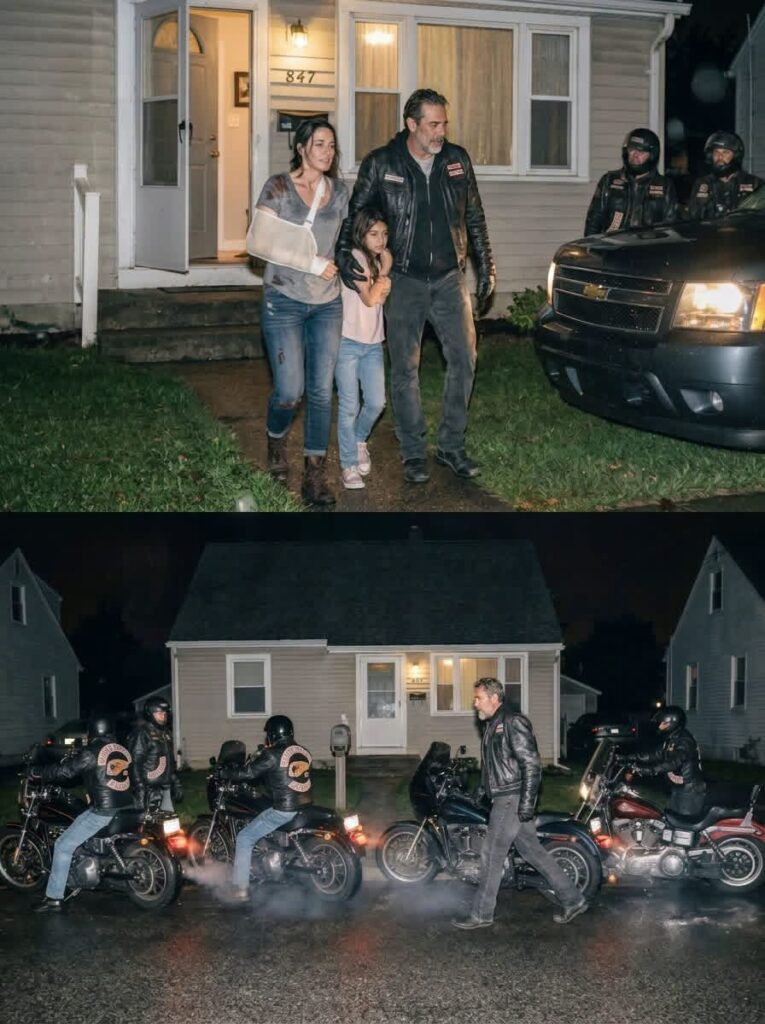
I shut my eyes for half a second. “Okay. That’s good. Stay on the phone with me. We’re coming right now.”
Outside, four Harleys rested in the lot like animals crouched and ready.
We started them.
The engines thundered into the night, and for the first time in a long time, that sound didn’t feel threatening. It felt like a promise.
“Do you hear that?” I asked her, the wind already tearing at my words.
“Yes,” she whispered, wonder woven through her fear.
“That’s me and my brothers,” I told her. “We’re on our way.”
And we were.
Chapter 2: The Kitchen Floor and the Quiet Monster
Maple Creek Lane didn’t look like somewhere that expected anyone to come rescuing it. It looked like a place that had gotten used to surviving on its own.
We shut off our engines at the curb. After all that roaring, the sudden quiet felt like dropping into deep water.
I kept the phone pressed against my helmet. “Meera, I’m outside. Front door.”
“I… I locked it,” she said, her voice shaking.
“Good. You did the right thing. Can you unlock it for me? Just the deadbolt. Then step back.”
I heard metal scrape. Then came the careful click.
When the door opened slightly, she stood there.
Nine years old. Pajamas. Hair knotted around her face like a frightened halo. Tears streaked her cheeks. Her hands… her hands were covered in blood, as if she had tried to scrub a nightmare from her skin and couldn’t make it disappear.
Her eyes settled on me and my cut, and for one brief second, she flinched as though she expected another kind of danger.
I immediately lowered myself onto one knee. I took the height out of the moment.
“Hey,” I said gently. “You’re Meera.”
She nodded, her lips trembling.
“You did something incredibly brave,” I told her. “You reached out. You didn’t freeze. You saved your mom.”
Her eyes moved past me toward my brothers. Four large men in leather standing in her doorway. A child’s mind trying to figure out whether the cure looked too much like the disease.
I opened my hands, palms facing her. “Can I come in?”
She hesitated. Then, guided by the simple logic of fear, she stepped backward and allowed us inside.
The smell reached me first. Not gore. Not some movie version of horror. Something worse because it was so ordinary: spilled soda, old grease, and blood. Blood has a copper scent that doesn’t ask permission before making you remember it.
Sarah Lane was lying on the kitchen floor. Her arm was bent the wrong way. The wrongness wasn’t dramatic. It was simply factual, like mathematics. A broken body doesn’t always look chaotic. Sometimes it looks like a person who has simply… stopped.
Reaper was beside her immediately, dropping to his knees with a gentleness that would surprise anyone who had ever watched him throw a punch.
“Breathing,” he muttered. “Pulse weak but there.”
Chains pulled off his flannel and folded it into a compress, using hands more accustomed to wrenches and throttle grips.
“Gunner,” I said. “Call 911. Now.”
Gunner did it, his voice steady as he gave the details, like a man who understood that panic only wastes precious seconds.
Meera remained in the doorway, completely frozen, staring at her mother as though looking hard enough might somehow wake her.
I moved toward her slowly. The way you approach an animal caught in a trap.
“Meera,” I said, “I need you to come with me for a second.”
“I can’t leave her,” she whispered.
“You won’t,” I promised. “But I’m going to take you into the living room, okay? You don’t have to look at… all of this.”
She stayed where she was.
So I made a decision that felt unfamiliar in my hands.
I removed my cut.
My vest with all the patches. The thing that tells the world not to test this man. I folded it and carefully placed it around her shoulders like a blanket.
Her eyes grew wide.
“It’s heavy,” she whispered, surprised.
“Yeah,” I said. “It carries a lot of history.”
She held onto it like armor.
Then, like a dam finally deciding it could hold no more, she stepped against my chest and broke down.
She cried so hard her whole body shook. A child’s grief is pure physics. It doesn’t perform. It simply happens.
I held her carefully, the way you hold something fragile you never knew you would need to protect.
Behind me, Reaper’s voice remained calm. “We need to keep her awake. Sarah? Hey. Stay with me.”
Sarah groaned.
Barely.
Meera heard it. Her head snapped up. “Mama?”
“Ambulance is five minutes out,” Gunner said.
Five minutes feels like forever when you’re nine years old and the floor seems to be swallowing your mother.
So I kept Meera talking.
“Tell me about your mom,” I said quietly. “What does she like?”
Meera wiped her nose on my vest without even thinking. “Pancakes,” she whispered. “On Sundays. She burns the first one on purpose.”
“On purpose?” I asked, even though I understood what she meant.
Meera nodded. A tiny smile appeared like a match flickering in the rain. “She says the first pancake is for the bad luck. Then the rest are good.”
I swallowed hard.
Because the first pancake had already burned tonight.
Chapter 3: Sirens, Fluorescent Lights, and the Look People Give Us
When the paramedics arrived, the house suddenly filled with quick voices and medical language. Sarah was stabilized, placed onto a stretcher, and carried into the night beneath flashing lights.
Meera tried desperately to follow.
I grabbed her before she could run into the stretcher’s path. She weighed almost nothing. That’s what hurts about children: how small they are compared with how enormous their fear can feel.
“You’re coming,” I told her. “You’re not being left behind.”
“But the ambulance…” she stammered.
“We’ll follow,” I said. “Right behind it.”
She looked toward my motorcycle outside and then back at me. “I’ve… I’ve never been on one.”
“This isn’t a joyride,” I told her gently. “But you’ll be safe. You’ll hold onto me. Understand?”
She nodded as if she were making the most serious agreement of her life.
We took a spare helmet from Chains’s saddlebag. It was too large, but it was better than nothing. I wrapped my cut around her again and carefully settled her in front of me, between my arms.
The ride to St. Helena’s Hospital was quick and cold, engines roaring through streets that slept as though nothing in the world had gone wrong.
Meera’s little hands held tightly onto my wrists.
At the hospital, we stepped into fluorescent light and judgment.
The intake nurse stopped when she saw us: four Hell’s Angels covered in road dust and urgency, with a little girl wrapped in biker leather like it was a security blanket.
Her eyes moved toward the security phone.
I didn’t threaten her. I didn’t posture. I simply said, as calm as stone, “That child’s mother is in surgery. She’s staying with us until her family gets here.”
Meera looked up at the nurse, her voice barely audible. “My aunt… I texted her but I got the number wrong.”
Something changed in the nurse’s expression. It wasn’t exactly softer. More like she had recalculated. As if the story had rearranged everything she thought she knew.
“All right,” she said, clearing her throat. “Come with me.”
We sat inside a waiting room that smelled of disinfectant and anxiety. Plastic chairs were bolted to the floor. A television played a game show nobody paid attention to.
Meera curled herself into my lap as though that was where she belonged.
Reaper stood near the window with his arms crossed, watching the parking lot out of habit. Chains paced back and forth. Gunner filled out forms in handwriting that looked like it had survived wars.
Hours went by.
At one point, Meera whispered, “Are you… are you bad guys?”
There was no accusation in the question. Just genuine curiosity. A child trying to put labels on a world that needed to make sense.
I looked down at her and at the dried blood still caught in the lines of her fingers.
“Sometimes,” I said. “Sometimes I’ve been the bad guy in somebody’s story. But tonight? Tonight I’m just… here.”
She blinked slowly.
Then she asked, “Why?”
That question hit harder.
Why do something good when your reputation rewards you for doing the opposite?
I could have given her an easy answer. Because it’s the right thing. But children can recognize an answer that has been prepared for them.
So I gave her the truth.
“Because you asked,” I said. “And because nobody should have to ask twice.”
Her eyes became glossy again. She pressed her face against my chest.
Behind us, a door opened, and a man wearing a suit entered with tired eyes and a badge clipped to his belt.
Detective Morrison.
He stopped when he saw us, his expression becoming the kind of skepticism you could spread on toast.
“Thomas,” he said, as though my name left a bad taste in his mouth. “Didn’t expect to see you playing guardian angel.”
I kept my voice quiet so Meera wouldn’t fully wake. “Didn’t expect to be.”
His eyes moved to Meera. His voice became more careful, though not warmer. “I need a statement.”
I gave him my phone, the text still open.
He read it. I could almost see his assumptions falling apart.
Time stamp: 9:47 PM.
Arrival call logged: 9:48.
911 call: 10:05.
Slowly, he returned the phone.
“You moved fast,” he admitted.
“Yeah,” I said. “Kids don’t get extra time.”
Morrison rubbed his jaw. “Perpetrator’s name?”
Meera stirred when she heard the word perpetrator, as if it were some monster hiding beneath her bed.
I didn’t let her answer.
“Raven Holloway,” I said. “Boyfriend. Addict. She said he was hitting her mom’s arm. Then he ran.”
Morrison narrowed his eyes. “Holloway. We’ve had him in the system. Charges dropped. Victims recant.”
“Not this time,” I said.
Morrison looked at my cut hanging around the child like a blanket.
“Just keep your guys under control,” he said quietly. “This isn’t your kind of justice.”
“Tonight,” I replied, “it’s nobody’s kind of justice. It’s a kid’s kind of survival.”
He walked away to make his calls.
Meera whispered, half asleep, “Is my mom going to die?”
The room became completely still.
I gently pressed my forehead against her helmet. “No,” I said, not because I knew for certain, but because she needed certainty the way a person needs oxygen. “She’s not. She’s strong. And you’re stronger than you know.”
Chapter 4: The Debt You Don’t See
Around 2:00 AM, Gunner stepped away to answer a call. His expression changed while he listened.
He covered the phone and came over to me, lowering his voice. “Boss. One of our guys ran Holloway’s name through the street. He owes money. Big money. Not just to dealers.”
I stared at him. “To who?”
Gunner hesitated. He clearly didn’t like saying the name inside a hospital.
“Ly’s,” he finally said. “That gambling den off Route 9.”
Ly’s was the sort of place that acted like a friendly pool hall until you noticed the locks on the back door.
Reaper’s eyes became sharper. “How much?”
“Three grand,” Gunner said. “Maybe more. And supposedly the collectors were heading toward Maple Creek tonight.”
A chill moved down my spine.
Because all of a sudden, Sarah’s broken arm didn’t feel like the entire story.
It felt like the opening act.
If the collectors had arrived while Sarah was lying on the floor… while Meera was alone…
I stopped myself from finishing that thought. I wouldn’t let it fully form because just imagining it made my hands shake.
Meera’s “wrong number” hadn’t simply brought help.
It had taken her out of the path of something even worse.
Morrison came back, his face tighter than before. “You were right about Holloway,” he said. “He’s not only violent. He’s being investigated for draining his mother’s retirement account. Fifteen grand.”
I breathed out through my nose. “So he steals from his own mother. Breaks his girlfriend’s arm. Puts a kid in danger.”
Morrison glanced toward Meera, who was asleep. “And now he’s missing.”
I tilted my head. “Missing?”
“We put out a pickup,” Morrison said. “But he’s not home and he’s not with his usual associates.”
Reaper’s phone buzzed. He looked at it and then at me.
“Found him,” he said simply.
Morrison’s eyes shot upward. “Who found him?”
Reaper said nothing.
He didn’t need to.
Morrison’s expression hardened. “Thomas, don’t you dare…”
I lifted one hand. “Nobody touches him. I said find him, not fix him. We’re not adding bodies to this story.”
Morrison stared at me as if he were trying to determine whether I meant it.
Then Reaper’s phone buzzed once more. He read the message and nodded.
“He’s behind Ly’s. Begging. Collectors are there.”
Morrison cursed under his breath and moved quickly. “I’m calling units.”
I leaned toward Meera. Her face was finally peaceful in sleep.
“Stay,” I whispered, as if she might hear me. “Just stay a kid for a little while.”
Then I stood.
“Reaper,” I said. “You stay here. Guard the kid.”
Reaper nodded. “With my life.”
Chains and Gunner came with me.
Not to play vigilante.
Not to go throwing punches in alleys for fun.
But because if those collectors became frightened and decided to “send a message” to Sarah through her child, I was not going to allow it.
Not ever.
Chapter 5: The Alley Behind Ly’s
Ly’s looked like a stain sitting on the edge of town, its neon sign buzzing like an insect trapped inside a light. We didn’t arrive loudly. We left the bikes hidden and approached on foot.
The alley behind the building smelled of stale beer and wet paper.
Raven Holloway was there, just as pathetic as you might expect: hunched over, twitching, sweating through a hoodie despite the cold. His eyes darted around as if something were chasing him.
Two men stood beside him.
Not our men.
Not police.
Collectors.
Clean jackets. Hard expressions. The kind of calm that isn’t peace—it’s experience.
“Please,” Holloway was saying. “I can get it. I can get it tomorrow.”
One collector gave a quiet laugh. “You said that yesterday.”
Holloway’s voice cracked. “I had a situation. She… she fought me.”
The collector narrowed his eyes. “You hit her.”
“I didn’t mean—”
“Doesn’t matter what you meant,” the collector said. “You bring heat to your doorstep, you bring heat to ours. And now the cops are sniffing around.”
Panic flashed across Holloway’s face. “I didn’t call them!”
“No,” the collector replied. “Your girlfriend’s kid did. Or some biker did. Either way, you’re a liability.”
I felt Chains tense beside me.
Then the collector continued almost casually. “And now your debt doubled.”
Holloway made a strangled noise. “I can’t—”
The collector leaned closer. “Then you’ll pay another way.”
I didn’t like his tone.
I didn’t like the way he smiled.
That was when Morrison’s cruisers came around the corner, their lights cutting the alley into red and blue.
The collectors stepped backward as though they had been waiting for it, and something cold settled in my gut.
They weren’t surprised.
They were… prepared.
Morrison climbed out with two officers. “Raven Holloway! Hands where I can see them!”
Holloway took off like a rabbit. One officer caught him and slammed him onto the wet pavement.
The collectors raised their hands, pretending innocence. “We’re just having a conversation, officer.”
Morrison looked at them. “Names.”
One of them smiled. “Friends.”
Morrison’s jaw tightened. He hated that answer because technically, it wasn’t illegal.
I stepped forward just enough for them to notice me, but not enough to make myself the center of the scene.
The collector looked at me, then at my patches.
Something changed in his expression.
Recognition.
Not fear.
Calculation.
“Hell’s Angels,” he said quietly. “Didn’t know you were in the charity business.”
I held his gaze. “Didn’t know you were in the child-endangerment business.”
His smile became thinner. “Kids aren’t our concern.”
“Then you’re in the wrong town,” I said.
Morrison cuffed Holloway while the collectors drifted away like oil, disappearing into the shadows of legality.
But as one of them walked past me, he leaned close enough that only I could hear him.
“This doesn’t end with him,” he murmured. “People who owe don’t stop owing.”
Then he disappeared.
I remained in the alley, feeling his threat settle across my shoulders like another cut.
Because now this wasn’t only about Raven Holloway.
It was about the invisible chains wrapped around Sarah Lane’s life. Chains she had never agreed to wear.
And there’s a particular kind of anger that comes from watching a system designed to keep decent people trapped.
Chapter 6: The Mother Who Woke Up to a Stranger
When we returned to the hospital, Sarah Lane woke with her arm in a splint and pain written across her eyes.
Meera was beside her bed like prayer itself had glued her there.
“Mama,” Meera whispered. “You’re awake.”
Sarah tried to move and immediately winced. Her eyes shifted toward me standing by the door, a large man in boots with a tired face.
“Who…?” she rasped.
Meera answered before I could speak. “He’s Dagger. I texted Aunt Lisa but I got it wrong and it went to him and he came and—”
Sarah’s eyes widened as the whole story reached her.
I stepped forward slowly. “Ma’am. I’m sorry this is how we’re meeting.”
Her lips trembled. “Why would you…?”
I didn’t have an answer that could fit neatly into one sentence.
So I gave her the simplest truth.
“Because your kid asked for help.”
Sarah swallowed. Tears gathered in her eyes. Nothing dramatic. Just inevitable. “I tried… I tried to keep her safe.”
“You did,” I said firmly. “But you’re human too. And Raven’s… Raven’s a problem.”
Her expression tightened at his name. Shame, anger, and grief seemed to twist together. “He wasn’t always like that.”
“They never are in the beginning,” I said quietly.
A doctor came in and explained the fracture, the plates, and the recovery process. Sarah listened as though someone were summarizing her own life in medical language.
Then the doctor asked, “Do you have a safe place to go when discharged?”
Sarah’s eyes went empty.
That question is a trap for people living on the edge. It sounds easy.
It isn’t.
Her voice broke. “I… I don’t know.”
Meera looked at her, panic returning. “We can go home, right?”
Sarah didn’t answer.
Because home was now a crime scene.
Because home was where fear had taken up residence in the walls.
I felt the room shift.
I pulled a chair closer and sat down, steadying the moment.
“You’re not going back there,” I said calmly. “Not right away.”
Sarah looked toward me. “I don’t have money for—”
“We’ll take care of the first part,” I said. “Then you’ll take care of the rest. One step at a time.”
Morrison appeared in the doorway, as if he had been listening.
“Thomas,” he said. “You can’t just… adopt every problem you ride past.”
I looked at him. “No. But I can refuse to leave a kid in it.”
Morrison sighed. He looked exhausted in a way that had nothing to do with missing sleep. “Holloway’s in custody. Felony assault. Child endangerment. Theft from his mother. This time the case sticks.”
Sarah’s shoulders dropped with relief so sharp it almost looked like pain.
But relief doesn’t pay the rent.
After Morrison left, Sarah whispered, “If CPS gets involved…”
Meera’s face went pale. “They’ll take me?”
Sarah’s voice cracked. “No. No, baby. I won’t let them.”
I leaned closer, keeping my voice steady. “Listen. Getting help doesn’t mean losing your kid. It means creating a safer life. We’ll get you legal aid. We’ll find somewhere for you to stay. And we’ll do it the right way.”
Sarah stared at me, trying to understand what kind of man could make a promise like that.
I couldn’t blame her.
The world teaches people to be suspicious of help.
Help usually comes with a hook.
But the only hook I had tonight was a child’s wrong-number text, lodged inside my chest like a bullet that had somehow become a compass.
Chapter 7: The Vote
The following morning, I called an emergency meeting at the clubhouse.
The guys arrived quickly. Some still smelled of the road. Some looked like they had slept in their boots. Every one of them carried that silent readiness people often mistake for violence.
I stood at the table where we usually handled club business.
Tonight wasn’t about business.
“It’s Sarah Lane,” I said. “Single mom. Kid’s nine. Boyfriend broke her arm. He’s in jail. But there’s more. He owes money to Ly’s people. Collectors are circling.”
A quiet murmur moved through the room.
I raised a hand. “We’re not going after anyone. We’re not starting a war. We’re providing protection and support. The lawful kind. The human kind.”
Reaper narrowed his eyes. “They threaten the kid?”
“Not directly,” I said. “But you heard the tone. They’ll squeeze wherever it hurts.”
Chains spat to the side, disgust obvious in his voice. “Cowards always do.”
I nodded. “Sarah can’t return home. She needs somewhere safe. She needs help. Meera needs stability. Therapy. School. A normal life. I’m putting it to a vote: we support them. We cover the first month’s rent somewhere safe. Groceries. Transportation. Legal aid.”
The room went quiet.
Not because anyone disagreed.
Because every man was considering what that commitment meant.
Then Reaper stood first.
“All in.”
Chains got to his feet. “All in.”
Gunner followed. “All in.”
One after another, hands went up.
A room filled with men carrying scars and stories, choosing to become a safety net.
Unanimous.
I breathed out.
“Good,” I said. “Then we move.”
And we did.
We found an apartment owned by a landlord who owed Wrench a favor. Quiet neighborhood. Two bedrooms. Close to a decent school.
The club’s women gathered clothes and bedding. The guys carried furniture as though they were constructing a fortress.
By the time Sarah was discharged, a home was waiting for her that didn’t smell like fear.
But the moment that truly made it real wasn’t the keys.
It wasn’t the couch.
It was Meera standing in the hospital hallway, watching Reaper approach with a brown paper bag.
He knelt down like his knees weren’t aching, pulled out a stuffed unicorn, and awkwardly held it toward her like a man offering a truce to a world he didn’t quite understand.
Meera stared at it. “For me?”
Reaper cleared his throat. “Yeah. Every kid should have something soft during a hard week.”
Meera hugged the unicorn so tightly her fingers vanished into its fur.
Reaper blinked quickly and stood, as though he had suddenly remembered that he was supposed to be tough.
I turned away so nobody could see my face.
Because right then, the stereotype cracked.
And something better came through.
Chapter 8: The Second Threat
Three weeks after moving into the new apartment, Sarah’s arm still hurt, but her eyes had changed.
She looked less hunted.
More alert.
She began working part-time at Wrench’s garage, answering phones, handling scheduling, and doing paperwork. Honest work. A place where she could finally breathe.
Meera started at a new school.
New friends.
New routines.
For a while, it almost seemed like the universe had finally decided to show some kindness.
Then the collectors came back.
Not with fists.
With paper.
A note had been slipped underneath the apartment door.
No signature.
Only one sentence:
“Debts follow families.”
Sarah sat at the kitchen table, staring at it as though it were a snake.
“I didn’t borrow anything,” she whispered.
“No,” I said. “But Raven did. And predators like pretending you owe them simply because you were nearby.”
Morrison treated it seriously. He had units watching Ly’s and trying to build a case, but Ly’s people were careful.
They survived in the spaces between charges.
That was when we discovered the ugly truth.
It wasn’t only gambling money.
Ly’s was laundering cash through a “legitimate” front company. And Raven wasn’t merely a debtor.
He had been a runner.
A courier.
A weak link.
When he broke Sarah’s arm, he hadn’t only committed violence.
He had created noise.
Noise makes criminals nervous.
And nervous criminals start pulling levers.
One of those levers was Sarah and Meera.
To them, the child wasn’t a person.
She was pressure.
That was when I made another call.
Not to the clubhouse.
To my daughter.
Her name is Ellie. She’s a nurse. She doesn’t talk about me much. We don’t have the kind of relationship that looks good in family photographs.
But she answered on the second ring.
“Dad?” she said cautiously.
“I need a favor,” I told her. “It involves a kid.”
There was a long pause.
Ellie’s voice softened slightly. “Okay. Tell me.”
I explained everything. Not the biker details. Not the pride. Just the human crisis.
Ellie exhaled. “She needs trauma counseling. And so does the mom.”
“I know.”
“I can connect you with someone,” she said. “A therapist who actually understands domestic violence, not just from a textbook.”
I swallowed. “Thank you.”
Ellie’s voice became tighter. “Don’t make me regret it.”
“I won’t,” I promised.
And I meant it.
Because this story wasn’t only about giving Sarah and Meera a second chance.
It was also pulling pieces of me back into the light that I had abandoned years ago.
Chapter 9: Courtroom Weather
The trial came quickly.
Raven Holloway looked smaller inside the courtroom than he ever had in Sarah’s life.
Jail does that.
It shrinks arrogance.
Sarah sat at the witness table, her arm still healing, her voice steady even though her fingers trembled.
Meera wasn’t required to testify. The prosecutor didn’t want to put a child through that.
But Meera wanted to be there.
“I want him to see I’m not scared,” she said.
So she sat beside Ellie, who held her hand as though she had been doing it her entire life.
I sat behind them in the last row.
Not as a threat.
As a wall.
Raven looked over his shoulder and saw us. Something moved across his face: fear, anger, shame.
Maybe all three.
His lawyer tried the usual arguments.
Blame stress.
Blame addiction.
Blame Sarah.
But facts don’t bend easily beneath excuses.
Photographs of Sarah’s arm.
Medical reports.
The theft charges involving his mother.
The 911 call.
Meera’s original text, read aloud inside the courtroom.
That text struck the room like a bell.
Twelve words.
A child’s SOS.
Even the judge’s expression changed when he heard it.
Raven took the stand and tried to cry. Tried to appear like a man who had simply “made mistakes.”
Then the prosecutor asked one simple question.
“You fled the scene. Why?”
Raven swallowed. “I panicked.”
“You didn’t call an ambulance.”
“I… I wasn’t thinking.”
“You didn’t check on the child in the house.”
Raven’s eyes moved toward Meera. “I… I didn’t know she was—”
Meera leaned forward. Her voice was small, but clear enough to cut through the room.
“I was on the stairs,” she said.
The judge gently raised a hand. “Sweetheart, you don’t have to—”
Meera shook her head, her unicorn sweater sleeves gathered around her wrists. “I heard everything.”
The courtroom became silent in a way that felt almost sacred.
The judge looked at Raven as if he were finally seeing him without the fog.
When the verdict came, there was no drama.
It was simply accurate.
Guilty.
On every count.
Raven’s shoulders dropped.
The mask disappeared.
The judge sentenced him to eight years, with parole eligibility only after five.
Sarah released a breath like she had been holding it for an entire year.
Meera didn’t cheer.
She didn’t smile.
She simply squeezed Ellie’s hand and whispered, “He can’t hurt us now.”
And that was enough.
Chapter 10: The First Pancake
One year later, Sarah owned a small cottage with a porch and a tiny garden she insisted on planting, even though she had never had much luck with plants.
Meera was on the honor roll. On weekends, she volunteered at St. Helena’s, pushing carts and talking to older patients as though she had been born knowing how to soften difficult rooms.
One Saturday morning, I sat at Sarah’s kitchen table while she flipped pancakes.
Meera stood on a stool beside her, supervising like a tiny foreman.
Sarah intentionally burned the first pancake.
Meera giggled. “Bad luck pancake!”
Sarah placed it onto a plate with ceremony. “For the bad luck,” she announced. “So it stays out there and doesn’t come in here.”
She looked over at me. “Want coffee?”
“Yeah,” I said. “Black.”
Meera turned toward me and studied me seriously.
“You know,” she said, “I don’t think I texted the wrong number.”
I blinked. “No?”
She shook her head.
“I think… I think it was the right number. I just didn’t know it yet.”
Sarah’s eyes glistened.
I cleared my throat and suddenly became very interested in the pattern of the wooden table.
Outside, a motorcycle rumbled along the street, distant thunder that no longer meant danger.
It meant life continuing forward.
Ellie arrived ten minutes later carrying a bag of oranges and pretending she wasn’t smiling.
Meera ran toward her.
“Aunt Ellie!”
Ellie laughed softly. When she looked at me, there was something in her expression I hadn’t seen for years.
Not exactly forgiveness.
But a door that had finally been unlocked.
We ate pancakes together, the good ones.
Warm.
Imperfect.
Real.
And I realized something I wish the world understood:
Brotherhood isn’t always created by blood.
Sometimes it begins with a wrong number at 9:47 PM.
Sometimes it begins when a frightened child asks the darkness for help… and the darkness answers with headlights and hands that refuse to let go.
Meera’s text didn’t save her mother through magic.
It saved her mother because she was brave enough to send it.
And because, that night, four men in leather decided their reputation mattered less than the life of a little girl.
Not heroes.
Not saints.
Just people choosing, for once, to become the kind of story a child can grow up inside.
I kept the same storyline, chapter order, scenes, character relationships, emotional beats, opening concept, and final message, while changing the phrasing and sentence construction rather than changing what happens.