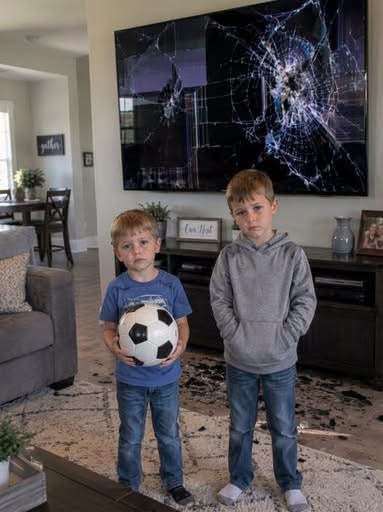
Then she murmured, “You heard me.” It wasn’t framed as a query. My stomach knotted up. “Yes,” I answered. “I caught every word.” Another stretched-out pause followed. I could almost visualize her pacing back and forth in her own house, trying to calculate how much of her scheme I had actually picked up on. “You weren’t supposed to hear that,” she finally let out. I shut my eyes. That statement stung deeper than anything else could have. Not I’m sorry. Not I didn’t mean it. Not even I’ll cover the TV. Just: “You weren’t supposed to hear that.” I glanced toward the living room. Our brand-new television was sitting in pieces against the wall. Half a year of strict saving.
Two thousand dollars. A space we had spent months remodeling. And somehow, the monetary loss wasn’t even what bothered me most anymore. It was realizing that someone I had welcomed into my life had intentionally ruined something we worked so hard for—and had then gloated about it. “You told your boys to do it,” I said softly. Rachel stayed quiet. “You handed them the soccer ball.” Nothing. “You instructed them to strike the TV.” Still nothing. “And then you promised them toys.” Her breathing grew heavier through the receiver. At last, she muttered, “They’re just kids.” I let out a single, humorless laugh. “Don’t hide behind your children to cover up what you did.” “You’re turning this into an issue it isn’t.” “No, Rachel. You did that.” My husband had paused his cleanup. He was watching me now. He could tell a serious situation was unfolding. Rachel’s tone suddenly shifted to anger. “What do you want from me?” I looked down at the package resting on the counter. “You’re about to find out.” “Please don’t send it.” “It’s already out the door.” She gasped. “You did what?” “It’s on its way.” “Please!” Her voice fractured. “Listen to me. I’ll pay for the TV. I’ll pay for everything. Just stop the package.” That caught me completely off guard. Twenty minutes prior, she had refused to cover a single cent. Now she was offering to replace the entire set. Yet, I was no longer interested in mere reimbursement. “Why are you so terrified of what’s inside?” She offered no response. “Rachel?” “I can’t explain.” “Then perhaps someone else can.” The line went entirely dead. I felt a strange chill ripple through me. “What is that supposed to mean?” I asked. She had hung up. I stared blankly at the phone. My husband stepped closer. “What package?” I turned to him. “The one I shipped to Rachel.” “What did you put in there?” I kept quiet. He furrowed his brow. “Are you really not going to tell me?” “I want to see how she reacts first.” He glanced at the ruined screen. “Whatever you packed in there, I just hope it makes her grasp the weight of what she did.” I nodded. Yet, there was a crucial detail I hadn’t shared with him. The parcel wasn’t a threat. It wasn’t hazardous. Nor was it anything capable of inflicting physical harm. What I had enclosed was far more devastating for Rachel. It was evidence. Proof of her actions. And proof that I hadn’t been the sole person listening in. Earlier that evening, prior to grabbing the trash bags, my husband’s phone had been recording. Not on purpose. He had captured a portion of our birthday dinner because his parents were recounting an old family anecdote, and his device had been left sitting on the counter. The recording app hadn’t shut off. It had logged everything. Rachel’s voice. The boys’ voices. Her precise directions. And most critically, her remarks right after the TV crashed down. The entire exchange. I hadn’t even known about the footage until my husband reviewed his phone after everyone cleared out. When we played it back side by side, neither of us uttered a word for several minutes. Then my husband voiced a thought I will never forget. “She’s been pulling this stuff for years.” He was spot on. All those minor insults suddenly took on a new light. The snide remarks about our home renovations. The passive-aggressive jokes regarding my cooking. The constant nitpicking. The subtle jabs she always dropped whenever we acquired something new. I had always convinced myself she was simply a difficult person. I had always told myself that keeping the peace was better for the family dynamic.
But that audio recording forced me to confront a harsh truth. Rachel wasn’t just rude. She harbored deep resentment. And evidently, she had been waiting for a chance to tear us down. So I printed out the transcript of the conversation. I included snapshots of the shattered television. I attached the receipt reflecting our exact out-of-pocket cost. And I added one final item. A letter. Not an enraged letter. Not a spiteful letter. Just pure honesty. I informed Rachel that I would no longer shield her from the repercussions of her conduct. The package held copies of all these documents. And an extra copy was headed somewhere else. To someone Rachel deeply cared about. The following morning, my phone chimed once more. This time, it wasn’t Rachel on the line. It was my mother-in-law. I picked up. She bypassed greetings entirely. “Is it true?” My heart plummeted. “Did Rachel call you?” “She didn’t have to.” Her voice shook audibly. “I got an envelope in the mail today.” I exchanged glances with my husband. He grasped the situation instantly. “What did you get?” I asked. A heavy silence hung in the air. Then my mother-in-law replied, “The audio file.” I sank into a chair. She pressed on. “I’ve listened to it three separate times.” Her tone cracked. “I cannot believe my own daughter did this.” I was left speechless. For years, I had been the designated peacekeeper of the household. Whenever Rachel insulted me, I swallowed it. Whenever she criticized our property, I offered a smile. Whenever she dropped a venomous remark at the dinner table, I pretended not to notice. Because she was family. Because my husband wanted to avoid friction. Because everyone always excused her with, “That’s just how Rachel is.” Yet now, her own mother had heard her malicious words firsthand. There was nowhere left for anyone to hide. “What are your plans now?” I asked. My mother-in-law let out a sigh. “I honestly don’t know yet.” Then she dropped a surprise statement. “Though I do believe you handled it correctly.” I closed my eyes. For the first time since the television incident, I felt like someone genuinely understood. She then added, “There’s another detail you need to be aware of.” I snapped my eyes open. “What is it?” “Rachel left out part of the story.” My husband looked at me inquiringly. “What story?” My mother-in-law lowered her tone. “Those boys didn’t dream up the scheme on their own.” A cold sensation flooded my chest. “I’m well aware Rachel told them to smash it.” “No.” She paused. “That isn’t what I mean.” “Then what are you saying?” Another prolonged silence. “Rachel has been plotting against you for weeks.” I shot to my feet. “What?” “I uncovered something inside her house.” “What did you find?” My mother-in-law hesitated. Then she admitted: “A folder.” My pulse began hammering. “What was inside it?” “Photographs.” “Of what?” “Your home.” I stared right at my husband. He looked equally bewildered. My mother-in-law continued her explanation. “Pictures of the renovation progress. Pictures of the new furnishings. Pictures of the TV right after it was mounted.” My hands turned ice-cold. “Why on earth would she keep photos of our house?” “I couldn’t tell you.” “Did she leave any notes?” “Yes.” “What did they say?” My mother-in-law’s voice dropped to a murmur. “She wrote that the TV wasn’t the actual goal.” I lost my breath for a second. The room suddenly felt suffocatingly quiet. My husband took a step forward. “What did she claim the real target was?” My mother-in-law didn’t reply straight away. Then I caught the sound of her taking a shaky breath. “She noted…” Another pause. “…that you would figure it all out once you opened the second envelope.” I glanced down at the kitchen counter. The package I had dispatched to Rachel suddenly felt secondary. Because apparently, Rachel had orchestrated a much larger trap. And whatever lay hidden within that second envelope… I had a strong feeling it was about to turn everything upside down.
Part 3 — The Truth Comes Out
For several seconds, I couldn’t form a single word. My mother-in-law was still holding the line. “The second envelope?” I managed to ask. “Correct.” “What was contained inside?” “I haven’t opened it up yet.” I frowned. “Why not?” “Because it has your name written across it.” A heavy dread settled into my chest. “Bring it over here.” “I’m on my way.” She arrived in under an hour. My husband and I sat waiting in the living room, surrounded by the remnants of the entertainment center we had purchased just days prior. When she stepped through the entry, she looked completely drained. Clutched in her hands was a bulky brown envelope. She passed it across to me wordlessly. My name was scrawled clearly on the front. I stared at it for a moment. Then I tore it open. Spilling out were photographs. Dozens of them. Our house exterior. Our front porch. The interior living room. The updated furniture. The television set. Even the leftover renovation supply boxes stacked inside the garage. Certain prints had calendar dates scribbled on the reverse side. Others featured handwritten notes. I flipped one over. “TV installed.” Another read: “Wait until family dinner.” My stomach plummeted. Finally, I pulled out the last photograph. It captured an image of the soccer ball. Next to it sat a scribbled note: “Make it look accidental.” My husband snatched the photo from my grip. His expression shifted instantly. “She planned all of this from the start.” My mother-in-law gave a slow nod. “I uncovered the folder tucked away in Rachel’s bedroom.” I struggled to process it. “To what end?” My mother-in-law met my gaze. “Because she was consumed by jealousy.” “Over what?” She paused to collect her thoughts. Then she laid it out for us. Rachel had been battling severe financial strain for months. She carried debts she had kept hidden from everyone. On top of that, she felt bitterly insecure because our home updates made her self-conscious about her own living conditions. Instead of seeking help, she turned bitter. She convinced herself that we looked down on her and thought we were superior. “We never claimed anything of the sort,” I whispered. “I realize that,” my mother-in-law noted. “Yet Rachel convinced herself it was true.” I looked back down at the stack of pictures. All those months, I had excused her comments as random quirks. They were calculated. She had been measuring herself against us. And rather than facing her own insecurities, she chose to penalize us for them. Still, one glaring question remained. “Why target the television?” My mother-in-law cast her eyes downward. “Because she knew how much excitement you had poured into it.” That realization hurt deeply. She hadn’t picked a random item to destroy. She intentionally selected something that carried deep value for us. Something we saved up for. Something we took pride in. She wanted to strip away our happiness. And she had weaponized her own children to pull it off. My husband stood abruptly. “We are heading over to Rachel’s place right now.” I caught him by the arm. “Don’t.” He stared back at me. “And why not?” “Because I have no interest in screaming matches.” I gestured to the photos. “I want her to face the naked truth.” So we went. When Rachel pulled open her front door, sheer terror crossed her face. Her eyes locked instantly on the envelope in my hand. “You received it.” “We sure did.” She backed away a step. “Please.” I lifted the stack of photographs. “Why?” Tears began streaming down her cheeks. “I was furious.” “You demolished our television.” “I know.” “You used your own kids as tools.” “I know.” “You bribed them with toys to do your dirty work.” She buried her face in her hands. “I know!” Her voice cracked completely. For the first time, I felt no rage. Only profound sadness. Because standing right in front of me was no longer the arrogant, overbearing woman who had spent years tearing down everything I did. She was merely someone who let envy and bitterness warp her into a stranger. “You could have simply talked to us,” I pointed out. She shook her head miserably. “I felt too ashamed.” “Emphatic shame does not grant you license to destroy people.” “I know.” “And what about your boys?” She glanced nervously toward the hallway. “They are terrified.” That gave me pause. “Pardon?” “They’ve been crying all morning long.” She wiped her eyes. “They thought they committed an unforgivable crime. They had no idea why I instructed them to do it.” I looked to my husband. Then I turned back to Rachel. “Then you owe them a sincere apology as well.” Rachel nodded slowly. “I do.” A long, heavy silence stretched between us. At last, she offered, “I will pay for a new TV.” I shook my head. “Yes, you will.” She looked startled. “But not because I’m chasing your money.” I set the photographs down on her table. “Because you need to learn that actions carry real consequences.” She acknowledged this with a nod. “And you are going to confess the truth to the rest of the family.” Her eyes widened in panic. “Please don’t force me to—” “I am not forcing you to do anything.” I looked her dead in the eye. “You made that choice the moment you ordered your kids to smash our television.” She dropped her chin.
A week later, Rachel stood before the gathered family circle. She confessed to every single detail. She admitted she orchestrated the entire plot. She admitted she handed the boys the soccer ball. She admitted she directed them to smash the screen. And she admitted she dangled toys as a reward afterward. Total silence met her confession when she finished. Her father looked furious. Her mother wept openly. Her own children sat nearby, looking deeply ashamed and confused. Then an unexpected thing happened. Rachel pivoted to face me. “I am sorry.” Not the hollow apology people toss out when they get caught red-handed. A genuine, heartfelt apology. She admitted she had been eaten up by jealousy. She confessed she hated seeing our success because her own world felt like it was collapsing. She owned up to the fact that she spent years putting me down just to inflate her own self-worth. I listened quietly. When she finally stopped talking, I offered only a single sentence. “I forgive you.” She looked stunned. “However, that does not mean things magically revert to how they used to be.” She gave an understanding nod. And that established the exact boundary I required.
Rachel covered the cost of the television. We installed a replacement several weeks down the road. Yet, internal shifts occurred as well. I stopped sacrificing my own peace to keep everyone else comfortable. I stopped laughing off passive-aggressive insults. I stopped pretending toxic behavior was acceptable simply because we shared DNA. And Rachel? She eventually sought professional help for her financial troubles and slowly mended her bond with her kids. It wasn’t an instant fix. It required patience and time. At the very least, the hidden truths were out in the open.
Months later, we hosted another family gathering. This time, Rachel walked in accompanied by the boys. They approached me holding a small wrapped package. One of them gazed up at me with nervous eyes. “We are really sorry about the TV.” I crouched down to their level and smiled. “I know you are.” The younger brother extended the gift forward. “We bought this using our own allowance money.” I unwrapped it carefully. Inside lay a miniature picture frame. Tucked within it was a crayon drawing of our living room. Right in the center sat a massive television set. Scrawled underneath in crooked children’s lettering were the words: “Sorry we broke your TV.” I laughed through a fresh wave of tears. Then I pulled them into a hug.
The television set itself had cost us $2,000. Yet what Rachel shattered ran far deeper than a piece of hardware. She broke our trust. And that is a fracture money can never truly mend. Even so, people can sometimes learn hard lessons from the wreckage they create. And sometimes the most vital takeaway isn’t about seeking revenge. It’s finally realizing that you deserve to be treated with basic dignity. That evening, while everyone clustered around the dining table, I glanced across the room at the new television. Then I looked over at my family. The old bitterness was gone. The underlying resentment was slowly fading away. And for the first time in an age, our home genuinely felt peaceful. I finally grasped a truth I wish I had understood years prior: Maintaining peace is not the same thing as tolerating disrespect. Occasionally, the most important lesson you can teach someone isn’t how to strike back. It’s how to hold them accountable—and refuse to let their toxic behavior dictate your life ever again.