My brother was still holding the photograph.
His fingers were trembling.
“Where did you find this?” I asked.
“It was inside the envelope.”
He turned it toward me.
The photograph showed our mother standingbeside a young woman I’d never seen before.They were outside a small white house, holding ababy wrapped in a yellow blanket.
Mom looked about thirty years younger.
She was smiling, but there was something aboutthe way she held the baby that made my chesttighten.
I turned the photograph over.
There was a date written on the back.
October 14, 1981.
And beneath it, in Mom’s handwriting:
The day everything changed.
“Who is that woman?” I whispered.
My brother shook his head.
“I have no idea.”
I picked up the envelope.
It was sealed with a piece of yellowed tape. Insidewere several documents, a handwritten letter, anda small folded sheet of paper.
The letter began:
My dear children,
There are things I wanted to tell you when youwere younger, but I was afraid the truth wouldhurt you. Then you grew up, built your own lives,and I kept telling myself there would be a bettertime.
Unfortunately, life doesn’t always give us the timewe expect.
I stopped reading.
My brother pulled a chair closer.
“Keep going.”
I continued.
The woman in the photograph is Margaret. Shewas my closest friend when I was young. We metbefore either of you were born.
She had a little girl. Her name was Emily.
I looked at my brother.
“Emily?”
He shook his head.
The letter continued.
When Emily was four years old, Margaret becameseriously ill. She had no family nearby, and Ipromised her I would look after her daughter ifanything happened.
I kept that promise.
My hands began to shake.
Mom had never mentioned a Margaret.
She had never mentioned an Emily.
Not once in eighteen years of living in thatapartment.
I read the next paragraph.
What I never told you is that Emily became part ofour family in ways neither of you understood. Ihelped raise her. I paid for her schooling. I stoodbeside her at important moments in her life.
And when she eventually had children of her own,I became their grandmother in everything thatmattered.
My brother leaned forward.
“Are you saying we have a sister?”
I couldn’t answer.
Then I noticed a document beneath the letter.
It was a copy of a birth certificate.
The mother’s name was Margaret.
The child’s name was Emily Margaret Collins.
But there was something else.
A second document was attached.
It was an adoption record.
I read the names carefully.
Then I looked up.
“She wasn’t our biological sister.”
My brother frowned.
“What?”
“Emily was adopted by Margaret’s sister afterMargaret died. Mom helped raise her, but shewasn’t legally part of our family.”
He took the papers from me.
“Then why is Mom telling us this now?”
I looked back at the letter.
There was another page.
I am telling you because Emily has spent most ofher life believing she was a burden. She neverwanted to interfere with your family. She knewabout both of you, but I asked her to give me timeto explain everything.
I don’t want her to spend the rest of her lifebelieving she has no family left.
My eyes filled with tears.
Then came the sentence that changedeverything.
I have arranged for each of you to receivesomething from me. But the most important giftisn’t inside any of those boxes.
My brother looked toward the living room.
“Then what’s inside them?”
I folded the letter carefully.
“I think we’re supposed to find out.”
We returned to the dining table.
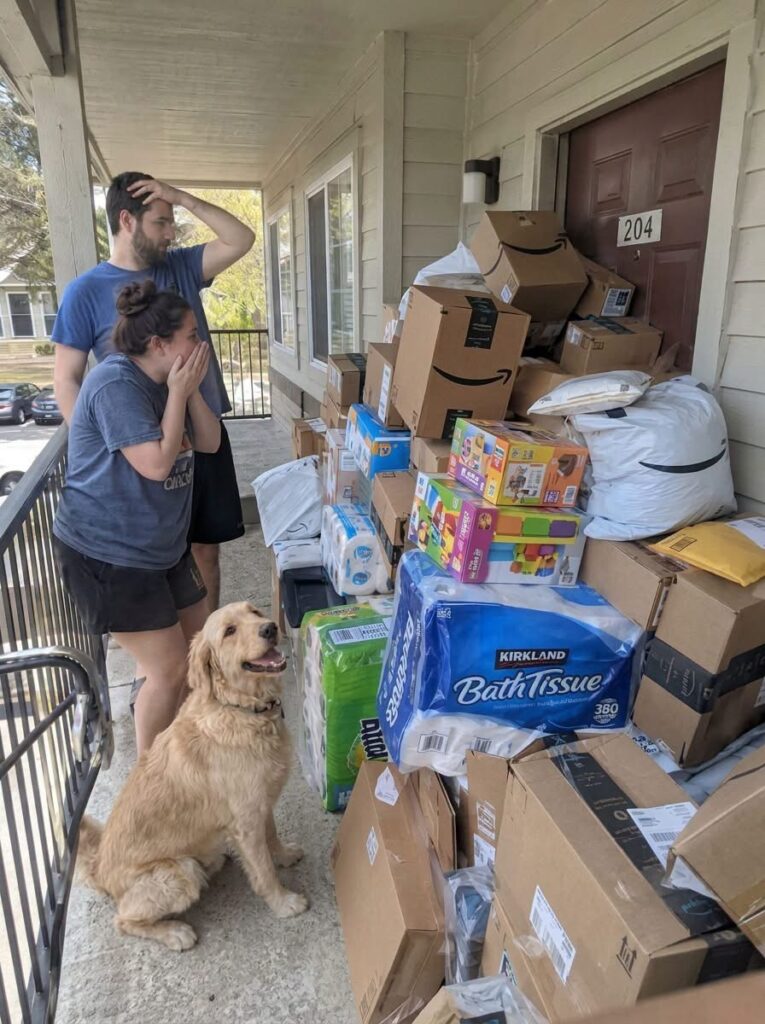
There were still more than twenty packageswaiting.
My brother picked up the box with his name.
Inside was a beautiful leather-bound journal.
The first page contained a handwritten message.
For my son. I know you’ve spent your lifebelieving you have to be strong for everyone. Ihope these pages remind you that you areallowed to be loved, too.
He ran his fingers over the writing.
Then he sat down and cried.
I’d rarely seen my brother cry.
He was the practical one. The person whohandled hospital paperwork, insurance calls, anddifficult conversations.
But now he was holding a journal our mother hadprepared while she was dying.
I opened another package.
Inside was a framed photograph of me and Momat my college graduation.
Behind the frame was a small envelope containinga letter.
For my daughter. You always thought I didn’tnotice how much you sacrificed to make sureeveryone else was happy. I noticed. I was proudof you long before you ever became successful.
I pressed the letter against my chest.
For the next hour, we opened packages slowly.
There were handmade quilts.
Photograph albums.
Small jewelry boxes.
Books Mom had selected for each of us.
And several envelopes containing lettersaddressed to people she loved.
Every package had a purpose.
Every label was written in her familiarhandwriting.
Then we reached the largest box.
It was addressed to both of us.
My brother cut the tape.
Inside was a thick folder, a small wooden key box,and another letter.
This one was shorter.
My children,
You have always believed that everything I ownedwas inside this apartment.
It wasn’t.
Years ago, your father and I purchased a smallproperty together. After he passed away, I kept itbecause it reminded me of the life we built.
I never told you what happened to it because Iwanted to make sure you both had a chance tobuild lives of your own.
The property is paid off.
My brother stopped reading.
“Mom owned another property?”
I nodded slowly.
We opened the folder.
Inside was a deed.
And the address was in a town about fortyminutes away.
I recognized it immediately.
It was the little house from the photograph.
The same white house where Mom had beenstanding beside Margaret and the baby.
But the next document made us both stare ateach other.
It wasn’t just a deed.
It was a trust agreement.
And the beneficiaries were listed as:
- My brother.
- Me.
- Emily Margaret Collins.
My brother sat back.
“Mom left the house to all three of us?”
I nodded.
Then I noticed a handwritten note attached to theagreement.
Please don’t sell this house before youunderstand why I kept it.
My brother picked up the small key box.
The key from the dresser fit perfectly.
Inside was a second photograph.
This time, it showed our mother sitting on a porchwith three children.
My brother.
Me.
And a little girl with dark curly hair.
I recognized myself immediately.
The little girl was standing beside me, holding myhand.
On the back, Mom had written:
The first day you met Emily.
I looked at my brother.
“How could we not remember her?”
He stared at the photograph.
Then suddenly he shook his head.
“Wait.”
“What?”
“I remember a little girl coming to our house whenwe were children. I thought she was one of Mom’sfriends’ kids.”
My mind began racing.
A memory surfaced.
A birthday party.
A little girl sitting beside me.
Mom cutting an extra slice of cake.
A woman standing near the kitchen doorway.
I had forgotten all of it.
But Mom hadn’t.
She had remembered every detail.
Then my phone rang.
Unknown number.
I answered cautiously.
“Hello?”
A woman’s voice came through.
“Is this Anna?”
“Yes. Who is this?”
There was a long pause.
Then she said:
“My name is Emily. Your mother gave me yournumber a few months ago. She told me that ifanything happened to her, I should call you.”
I looked at my brother.
He had gone completely still.
Emily continued.
“I heard she passed away. I’m so sorry. I wantedto give you both some time, but there’s somethingyour mother asked me to tell you.”
My throat tightened.
“What?”
Her voice broke.
“She didn’t just leave you that house. She leftsomething there that belongs to all three of us.”
I glanced at the photograph.
“What is it?”
Emily took a shaky breath.
“Your mother’s letters. All of them. And there’sone addressed to me that she said I must readwith you both present.”
I looked at my brother.
He slowly stood up.
“Can you meet us tomorrow?” I asked.
“Yes,” Emily whispered.
Then she added something that made my heartache.
“There’s one more thing. Your mother called methe night before she went into the hospital for thelast time.”
I held my breath.
“She told me she was worried you and yourbrother would never forgive her for keeping thissecret.”
I closed my eyes.
Emily’s voice became softer.
“She said she wanted us to be a family before itwas too late.”
The call ended.
For several minutes, neither my brother nor Imoved.
Then he picked up the photograph again.
“She was planning all of this,” he whispered.
I looked around the apartment.
The slippers.
The blanket.
The little bowl of candies.
The packages stacked beside the dining table.
And suddenly I understood something.
Our mother hadn’t been shopping.
She had been saying goodbye.
One letter at a time.
One gift at a time.
Making sure that even after she was gone, thepeople she loved would find one another.
But there was still one mystery we hadn’t solved.
Why had she insisted that we visit the little whitehouse before opening the final package?
Because when Emily arrived the followingmorning, she brought a photograph of our fatherthat neither of us had ever seen.
And on the back was a message written in hishandwriting:
“If my children ever discover the truth, tell themwhat really happened in October 1981.”
Emily looked at us through tears.
“Your mother wasn’t the only person who keptthis secret.”
And then she opened the final letter.
What she read next would change everything wethought we knew about our parents.