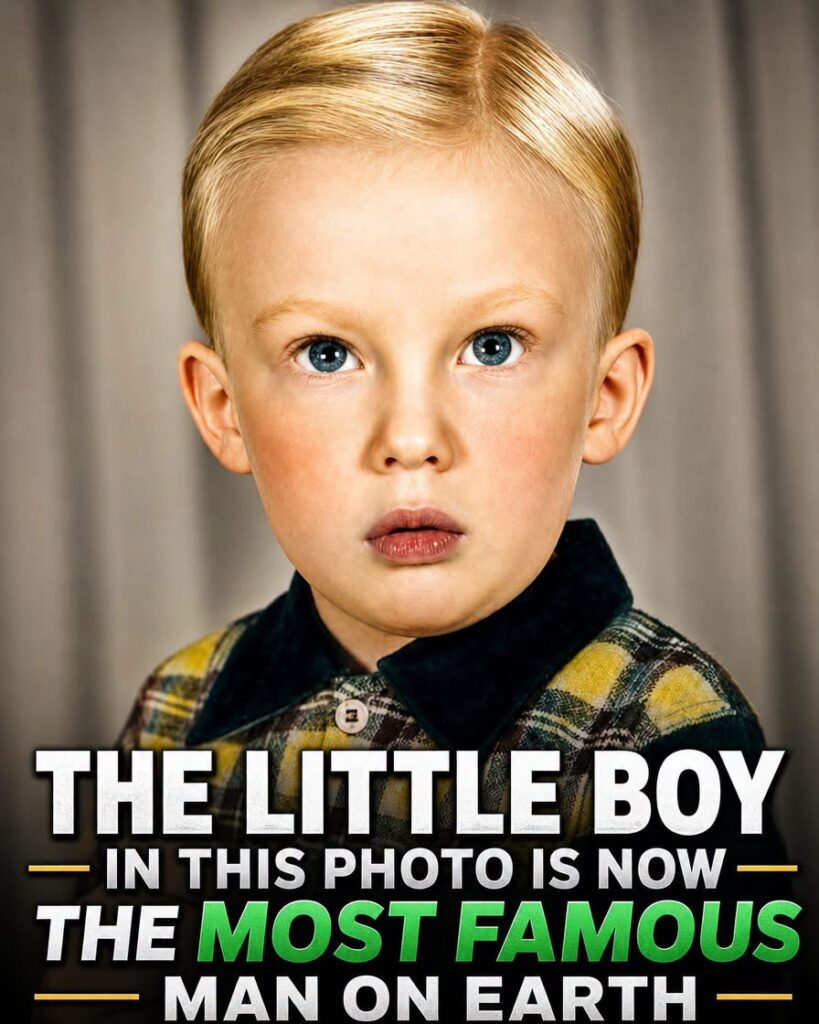
A childhood photograph can sometimes feel strangely powerful.
There is something about looking at a famous person before the world knew who they would become. The expression is often ordinary. The clothes are ordinary. The setting may be completely unremarkable. Yet the viewer already knows what happened later, and that knowledge changes the way the photograph feels.
That is the reaction many people have had to an old photograph showing Donald J. Trump as a young child.
The picture captures a very early moment in the life of a person who would eventually become a businessman, television personality, political figure, and president of the United States. By itself, however, the photograph tells us very little about the adult who would eventually become one of the most recognizable figures in American public life.
It simply shows a little boy.
Everything else comes later.
Before the Name Became Famous
Donald Trump was born in Queens, New York, in 1946. He was the fourth of five children born to Fred and Mary Trump.
His childhood took place in a family that was already connected to the world of real estate. His father, Fred Trump, had built a substantial business developing residential properties, particularly in New York City.
That family background would become an important part of Donald Trump’s eventual career.
But looking backward from adulthood can make childhood seem more predictable than it really was.
A young child does not know what kind of career he will eventually have. He does not know whether millions of people will recognize his name. He does not know that photographs taken during ordinary family moments might one day circulate around the world.
At the time, the photograph was simply a record of childhood.
There was no presidential campaign attached to it. No political movement. No television audience waiting to hear what the child would say.
There was only a young boy growing up in New York.
Growing Up in a Structured Environment
As Trump grew older, his education became increasingly structured.
At thirteen, he was enrolled at the New York Military Academy. The school emphasized discipline, organization, competition, leadership, and responsibility.
The experience became one of the notable parts of accounts of Trump’s youth.
Military schools can provide a very different environment from a conventional school. Students live according to schedules and expectations. There is an emphasis on rules and personal responsibility, along with competition and leadership.
For Trump, those years became part of the foundation of his later life.
After graduating, he attended Fordham University before transferring to the University of Pennsylvania’s Wharton School. He graduated in 1968.
By that point, his connection to the family real-estate business was already significant.
The path from childhood to adulthood was becoming clearer.
Yet even then, there was no guarantee that he would become the figure known around the world decades later.
The Family Business
Donald Trump’s professional life began in real estate.
His father had already established a successful development business, and Donald eventually became increasingly involved in it.
The New York real-estate market provided an environment where buildings, property values, financing, branding, and public image could all become part of the same business strategy.
Trump eventually expanded beyond residential development.
His name became attached to buildings, hotels, casinos, entertainment projects, and other ventures. The name itself increasingly became a brand.
That development is important when considering the old childhood photograph.
The photograph shows a person before his name had become a recognizable commercial identity.
There is no famous signature attached to the child. No towering skyscraper in the background. No television cameras. No political rallies.
There is simply a young Donald Trump.
The contrast is part of what makes such photographs fascinating.
From Businessman to Television Personality
Trump’s public identity eventually extended beyond real estate.
He became a familiar figure in American popular culture and appeared frequently in television interviews and entertainment coverage.
One of the most important developments came with his role on the reality television program The Apprentice.
The program introduced Trump to a much broader television audience. His catchphrases, personality, and on-screen presentation became familiar to millions of viewers.
For people who had never followed New York real estate, the television program provided an introduction to him.
He was no longer known primarily as a businessman associated with buildings and property.
He had become a national television personality.
That visibility would later become significant when he entered politics.
Entering American Politics
Trump had discussed political issues publicly for years before his presidential campaign, but his political career changed dramatically in 2015.
He announced his campaign for the Republican nomination for president.
The campaign immediately attracted enormous attention.
His style was different from that of many traditional politicians. He spoke directly to audiences, used simple and forceful language, and frequently focused on subjects such as immigration, trade, economic policy, national security, and dissatisfaction with established political institutions.
His campaign generated intense enthusiasm among supporters and equally intense criticism from opponents.
In 2016, Trump won the Republican nomination.
He then faced Democratic nominee Hillary Clinton in the general election.
The campaign became one of the most closely watched and contentious presidential contests in modern American politics.
Trump ultimately won the Electoral College and became the 45th president of the United States.
The little boy in the photograph had become the president of the United States.
The White House Years
Trump’s presidency was marked by major political disagreements and significant policy changes.
His administration pursued changes involving immigration, taxation, regulation, trade, foreign policy, and the federal judiciary.
Supporters viewed his administration as a challenge to established political practices and credited him with pursuing policies they believed reflected their priorities.
Critics strongly opposed many of those same policies and actions.
His presidency also produced an unusually high level of public controversy.
His communication style, particularly his frequent use of social media, became a major part of political discussion. Statements made by Trump could quickly become national news stories, often followed by arguments between supporters and critics.
The result was a political environment in which Trump became a highly polarizing public figure.
For some Americans, he represented a political outsider who challenged the established system.
For others, he represented a dangerous departure from traditional political norms.
Those interpretations remain deeply contested.
Why Childhood Photographs Feel Different
This is where the old photograph becomes interesting.
A photograph of a political figure during adulthood comes with context.
People know the person’s political party. They know their positions. They know their controversies. They know their accomplishments or failures. They have formed opinions.
A childhood photograph removes almost all of that context.
The person is no longer standing behind a podium.
There is no campaign slogan.
There is no presidential seal.
There is no television audience.
There is simply a child.
That can create an unusual emotional reaction.
People may look at the photograph and imagine an ordinary childhood: family gatherings, school, birthdays, vacations, friendships, and the countless small experiences that shape a person’s early years.
At the same time, viewers know what comes later.
They know that the child eventually becomes a famous businessman.
They know he becomes a television personality.
They know he enters politics.
They know he eventually reaches the White House.
That knowledge creates a kind of historical distance between the photograph and the person we know today.
The Difference Between a Photograph and a Biography
It is also important not to ask too much of a single photograph.
A photograph can show us what someone looked like at a particular moment.
It cannot tell us everything about their personality.
It cannot explain their childhood.
It cannot reveal their private thoughts.
And it certainly cannot predict the person they will become decades later.
That distinction matters whenever old photographs of famous people become popular online.
People naturally want to find clues.
Was the future personality already visible?
Did the child look confident?
Did the expression somehow reveal ambition?
Was there something unusual about the way the child stood or looked at the camera?
Usually, those questions say more about the viewer than the photograph.
Human beings are very good at finding meaning after we already know the ending.
Once we know what happened to someone, ordinary childhood details can suddenly seem significant.
But childhood is not a prophecy.
A photograph captures a moment, not a destiny.
A Life That Became Part of History
Donald Trump’s life eventually became inseparable from American political history.
His 2016 election transformed the Republican Party and changed the country’s political conversation.
His presidency generated major debates over executive power, immigration, trade, foreign relations, judicial appointments, and the role of the media.
After leaving office, Trump remained a central figure in American politics.
His continued influence ensured that photographs from his childhood would be viewed through the lens of his later public career.
An image that might once have been nothing more than a family photograph can now become part of a much larger story.
That is one of the strange things about history.
We often don’t know which ordinary moments will become historically interesting.
A school photograph.
A family vacation.
A picture taken at a birthday party.
A photograph of a child sitting beside his parents.
At the time, nobody knows whether the person in the photograph will eventually become famous.
The Child Before the Public Figure
There is also something valuable about remembering that public figures were once children.
Political disagreements can become so intense that people begin thinking of politicians almost entirely as symbols.
A president becomes a political party.
A candidate becomes a campaign.
A public figure becomes a collection of headlines.
But before all of that, there was a childhood.
There were parents.
There were teachers.
There were siblings.
There were ordinary days that never made the news.
For Trump, that childhood took place in Queens during the postwar era. The United States was undergoing enormous changes during those years, and New York was itself transforming.
The boy growing up there could not have known how dramatically the world would change during his lifetime.
He could not have known that technology would eventually allow millions of people to see photographs instantly on computers and phones.
He could not have known that his own image would become part of global political discussion.
And he certainly could not have known that decades later, people would look at an old photograph and ask who the little boy was.
Looking at the Photograph Today
The strongest reaction to a childhood photograph of a famous person often comes from contrast.
The person in the picture appears small.
The historical figure we know appears enormous.
One exists in an intimate family setting.
The other exists on a global stage.
One is unknown to the public.
The other has spent decades under constant attention.
That contrast can make a simple photograph surprisingly compelling.
But perhaps the most interesting thing about it is not what the photograph tells us about Donald Trump.
It is what the photograph reminds us about time.
Every famous adult was once a child.
Every political leader once attended school.
Every public figure once had a family life that existed outside the public eye.
The distance between those two versions of a person can be enormous.
More Than Just an Old Picture
The childhood photograph of Donald Trump is ultimately only a small piece of a much larger story.
It does not explain his political beliefs.
It does not settle debates about his presidency.
It does not prove anything about his personality.
It simply captures a young child at one point in time.
The significance comes from everything that happened afterward.
That child grew up in Queens, entered the family real-estate business, developed a highly recognizable public brand, became a television personality, entered national politics, won the presidency in 2016, and became one of the most discussed political figures in the United States.
Millions of people have supported him.
Millions of others have strongly disagreed with him.
Those political arguments are part of his adult history.
The photograph belongs to an earlier chapter.
And perhaps that is why people find it so fascinating.
For a brief moment, before the buildings, before the television cameras, before the campaign rallies and presidential speeches, there was simply a little boy.
An old photograph cannot tell us exactly who that child would become.
But decades later, knowing the story that followed makes the image feel like a tiny window into the beginning of a life that would eventually become part of American history.