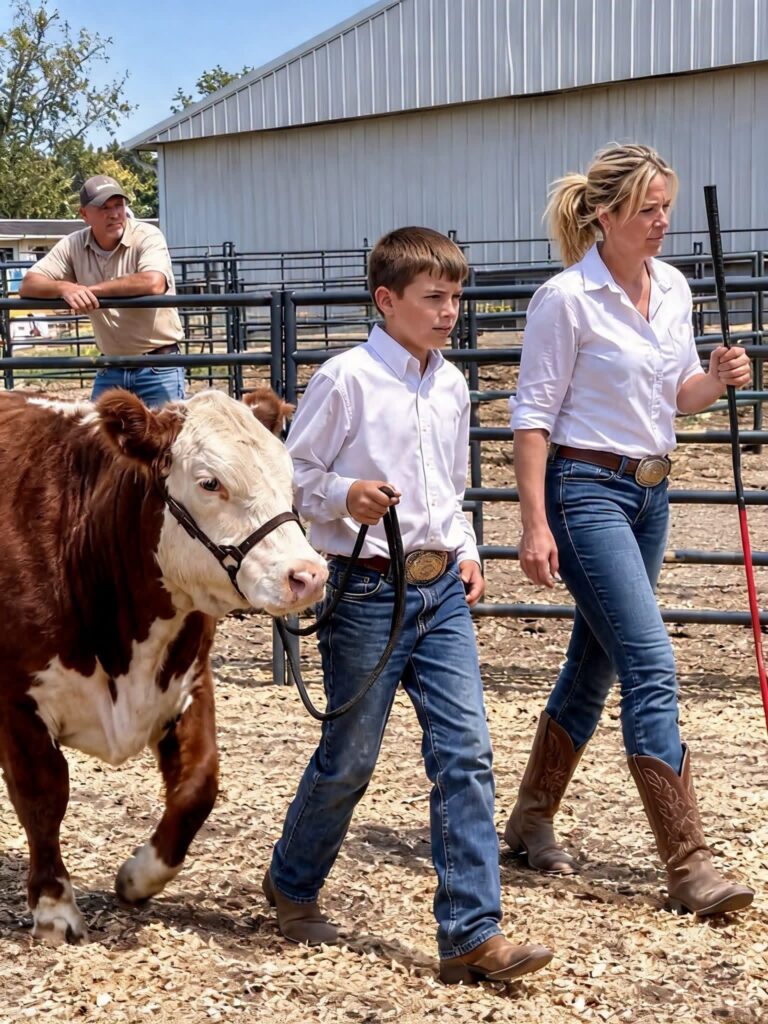
The judge looked down the line at my son beforebringing the microphone closer.
“Folks, before I announce anything about thisclass, I want everyone to understand what we’relooking at today.”
Cooper stood beside Moose, holding the showstick in one hand. His white shirt was alreadydamp with sweat, and his face was red from theafternoon heat.
The judge continued.
“I’ve judged livestock shows for more thantwenty-five years. I’ve seen young people workhard, and I’ve seen families make sacrifices to getan animal ready for this ring. But every once in awhile, an animal comes along with a story thatreminds us why these young people do what theydo.”
He looked toward Cooper.
“This young man lost his father during the veryseason he was supposed to be preparing for thisshow. Instead of giving up, he kept working.Every morning, he came out to feed this steer.Every evening, he made sure the animal wascomfortable. And from what I’ve heard, he didmuch of that work without the person who taughthim how.”
My throat tightened.
Cooper lowered his eyes.
The judge paused before continuing.
“Now, I want you to look carefully at this steer.Look at his condition, his balance, his muscledevelopment, and the way he responds to hishandler. Those things don’t happen by accident.”
He turned toward the other contestants.
“Whatever happens with the placing today, I hopeevery young person here understands that thework matters just as much as the ribbon.”
The crowd remained quiet.
Then the judge motioned for Cooper to bringMoose forward.
I gripped the metal railing.
I knew my son was nervous. I could see it in theway he adjusted his fingers around the showstick.
But he didn’t rush.
He guided Moose forward exactly as Brent hadtaught him.
The judge examined the steer again, walkingslowly around him. He checked his feet, lookedalong his back, and stepped away to study hisoverall appearance.
Finally, he returned to the microphone.
“First place in this class goes to Cooper andMoose.”
For a moment, I didn’t move.
I heard applause, but it seemed to come fromsomewhere far away.
Then Cooper looked toward me.
His face changed.
He smiled, and suddenly he was thirteen yearsold again, standing in the driveway beside hisfather, proudly announcing that Moose had finallylearned to walk without pulling.
I started crying.
Not quietly, either.
The woman standing next to me reached over andsqueezed my shoulder.
Cooper accepted the blue ribbon and placed itcarefully around Moose’s halter.
Then he turned toward the stands.
“Mom!”
I raised both hands.
He pointed toward me.
“That’s for Dad!”
The applause grew louder.
I covered my mouth with one hand.
And across the ring, I saw Mike.
My brother-in-law had removed his seed-company cap. He was holding it against his chest,staring at Cooper.
For the first time that afternoon, his expressionhad changed.
After the class ended, Cooper brought Moosetoward the gate.
I stepped forward, still wearing Brent’s oversizedboots.
My son reached me and threw his arms aroundmy waist.
“We did it, Mom.”
I held him tightly.
“You did it, sweetheart.”
“No. We did it.”
I looked at his face.
He was sweating, his hair was sticking to hisforehead, and the blue ribbon was hangingslightly crooked.
He looked exactly like his father.
And I knew Brent would have been proud.
The journey to that moment hadn’t been easy.
In the months after Brent died, I discovered justhow many things he had quietly taken care of.
There were feed orders to place, equipment tomaintain, veterinary appointments to schedule,and countless little decisions that had alwaysseemed effortless when he was around.
Before his death, I had never needed to thinkabout most of those things.
Brent would simply handle them.
He knew how much feed Moose needed. Heknew when the steer was growing too quickly andwhen his coat needed extra attention.
He could tell from the animal’s behavior whensomething wasn’t right.
I had watched him do these things for yearswithout understanding how much knowledge wasinvolved.
After the funeral, I found myself standing in thebarn one morning, staring at Moose’s feedbucket.
I had Brent’s notebook in one hand.
The other hand was holding a pencil.
I read the same feeding instructions three times.
Then I called Cooper.
“Can you come out here for a minute?”
He appeared in the doorway wearing his father’sold sweatshirt.
“What happened?”
“Nothing. I just want to make sure I’m doing thisright.”
He looked at the notebook.
Then he pointed to one of the measurements.
“That’s the amount for the morning.”
“What about the supplements?”
He showed me the next line.
I nodded and wrote it down.
“Okay. I think I understand.”
Cooper looked at me for a moment.
“Mom, Dad showed me all this.”
“I know, sweetheart.”
“I can help.”
I put the notebook down.
“I know you can.”
And that became our routine.
We learned together.
Some days went smoothly.
Other days seemed determined to test us.
There were mornings when Moose refused tocooperate, afternoons when the water hosedeveloped leaks, and evenings when I was soexhausted that I wondered how we would keepeverything going.
I still had my job at the school cafeteria.
I still had lunches to prepare, groceries to buy,laundry to wash, and a household to manage.
But every morning, before leaving for work, I wentto the barn.
And every evening, after dinner, Cooper and Ireturned to Moose.
We weren’t going to let him down.
The hardest part came in late May.
Moose developed a problem with one of his feet.
Cooper noticed it first.
“Mom, look.”
I watched the steer walk across the pen.
He was favoring one side slightly.
My stomach tightened.
“Do you think he hurt himself?”
“I don’t know.”
Cooper crouched beside the fence.
“He wasn’t doing that yesterday.”
I called our veterinarian immediately.
He arrived that afternoon and examined Moosecarefully.
Fortunately, the problem wasn’t as serious as wefeared, but he recommended some treatment anda few adjustments to the animal’s routine.
I wrote down everything he said.
Cooper stood beside me, listening carefully.
When the veterinarian left, my son lookedworried.
“Will he be okay for the fair?”
I put my hand on his shoulder.
“We’ll follow the instructions and give him time.That’s all we can do.”
For the next several days, we watched Mooseclosely.
I checked on him before breakfast and again afterwork.
Cooper kept his notebook nearby and recordedthe changes.
Eventually, Moose began moving normally again.
The first morning Cooper noticed it, he camerunning into the kitchen.
“Mom! He’s walking fine!”
I was making coffee.
I put the spoon down and smiled.
“That’s wonderful.”
Cooper grinned.
“Dad would’ve known exactly what to do.”
I looked at him.
“Your dad would have been proud that younoticed something was wrong.”
He didn’t answer.
But I saw his smile return.
As summer approached, the county fair becamethe biggest event in our lives.
Cooper practiced with Moose almost every day.
Sometimes I helped him prepare the steer.
Other times, I simply stood nearby, watching.
Our elderly neighbor, Mr. Peterson, became aregular visitor.
He had raised cattle for most of his life and hadknown Brent since they were young men.
One afternoon, he stopped by while Cooper wasbrushing Moose.
“How’s the boy doing?” he asked.
“Pretty well,” I answered.
He watched Cooper for a moment.
Then he looked at me.
“Brent would be proud.”
I smiled.
“I hope so.”
Mr. Peterson leaned against the fence.
“You know, Jamie, your husband was one of themost stubborn men I’ve ever known.”
I laughed.
“That’s certainly true.”
“But he was also one of the hardest workers.”
He nodded toward Cooper.
“That boy has the same determination.”
I looked at my son.
He was carefully brushing Moose’s shoulder,completely focused on the task.
“I hope he has his father’s patience too.”
Mr. Peterson chuckled.
“Let’s not get carried away. Nobody’s perfect.”
We both laughed.
It was the first time in weeks that I had laughedwithout feeling guilty afterward.
Then came the morning Mike offered us the ninehundred dollars.
He arrived in his pickup truck just after breakfast.
I was carrying a bucket of water toward the penwhen I noticed him standing beside Cooper.
The money was already in his hand.
“Nine hundred dollars,” he repeated.
Cooper stared at the bills.
Mike continued explaining that Logan, his ownson, could finish raising Moose.
He claimed it would be easier for everyone.
He said Cooper was too young to handle theresponsibility.
He even suggested that I didn’t understand howmuch work was involved.
I listened until he finished.
Then I refused.
“We’re keeping him.”
Mike looked at me as if I had said somethingunreasonable.
“Jamie, be practical. You have a job. You have ahouse. You don’t have time to manage cattle.”
“I’ll find the time.”
“There’s no man here to do the work.”
I glanced at Cooper.
He was standing perfectly still.
Then I looked back at Mike.
“Cooper doesn’t need someone to replace hisfather. He needs people who believe he can finishwhat he started.”
Mike’s expression hardened.
He folded the money and put it away.
“You’re making a mistake.”
“Maybe. But it’s our decision.”
He walked away without another word.
That evening, Cooper asked me whether I thoughthis uncle was right.
I sat beside him on the back steps.
“About what?”
“That we can’t do it without Dad.”
I looked at him.
“Your dad taught you more than you realize. AndI’m learning the rest.”
Cooper looked down at his hands.
“Sometimes I wish he was still here.”
I put my arm around him.
“So do I.”
We sat there for a long time.
Then he said something I would never forget.
“I just wanted Dad to see Moose at the fair.”
I kissed the top of his head.
“I know, sweetheart.”
The morning of the county fair was unusually hot.
I woke before five and made breakfast.
Cooper barely touched his eggs because he wastoo excited.
We loaded the supplies into the truck andchecked Moose one final time before leaving.
I wore a simple blue blouse and jeans.
But before we left, I stopped beside the backdoor.
Brent’s boots were still sitting where he had leftthem.
I picked them up.
They were worn around the edges, with dirt stillcaught in the seams.
I had cleaned them several times, but I had neverbeen able to put them away.
I slipped them on.
They were still too big.
I added the folded pieces of fabric Cooper hadhelped me prepare and tightened the laces.
When I walked into the kitchen, my son looked atmy feet.
He smiled.
“You’re wearing Dad’s boots again.”
“I thought they should come to the fair.”
He nodded.
“Good.”
We drove to the fairgrounds together.
The barns were already busy.
Families were unloading trailers, children werecarrying equipment, and volunteers werepreparing the show ring.
The smell of hay and livestock filled the air.
Cooper checked Moose carefully.
I helped him arrange his supplies.
Then I noticed Mike standing near the entrance.
He was talking to another man.
When he saw us, he stopped.
For a moment, neither of us moved.
Then he looked down at my boots.
He recognized them.
I could tell.
He looked away and returned to his conversation.
I didn’t approach him.
There was no reason to.
We had come for Cooper.
Now, standing beside the ring after the judgeannounced the results, I realized how much hadchanged.
Cooper had finished something his father hadstarted.
He had cared for Moose through the difficultmonths after Brent’s death.
He had learned to make decisions, ask questions,and accept help when he needed it.
And he had done all of it while dealing with a lossno thirteen-year-old should have to experience.
After the judging, the superintendent approachedus.
“Jamie, would you mind coming over for amoment?”
I looked at him.
“Of course.”
He smiled.
“We’d like to get a photograph of Cooper withMoose and his family.”
I glanced around.
“His family?”
The superintendent nodded.
“If you’d like, we’d also like to include Mike.”
I wasn’t sure how I felt about that.
But Cooper had already noticed his unclestanding near the rail.
He looked at me.
“Can Uncle Mike come?”
I nodded.
“Of course.”
The superintendent waved him over.
Mike approached slowly.
He looked at Cooper’s blue ribbon.
“Congratulations, son.”
“Thanks, Uncle Mike.”
Mike stood beside him.
For a moment, he seemed unsure what to say.
Then he looked at Moose.
“Your dad would’ve loved seeing this.”
Cooper nodded.
“I know.”
Mike swallowed.
“I was wrong about something.”
I remained quiet.
He looked at me.
“I shouldn’t have assumed you couldn’t handle it.”
I didn’t immediately answer.
Mike continued.
“I thought I was helping. I thought selling Moosewould make things easier for everyone.”
I looked toward Cooper.
He was gently rubbing Moose’s neck.
“Sometimes helping means letting someone finishwhat they started,” I said.
Mike nodded.
“I understand that now.”
He reached into his pocket and pulled out afolded envelope.
“There’s something else.”
I frowned.
“What is it?”
He handed it to Cooper.
Inside was a small handwritten card.
It said:
For Moose’s next year of feed and care. Noconditions. Just from your uncle.
Cooper looked up.
“Uncle Mike, you don’t have to.”
“I know. I want to.”
Cooper glanced at me.
I nodded.
“Thank him, sweetheart.”
“Thank you.”
Mike smiled faintly.
Then the photographer called everyone intoposition.
Cooper stood beside Moose.
I stood on one side, still wearing Brent’s boots.
Mike stood on the other.
The photographer raised his camera.
“Everybody look this way!”
Cooper smiled.
I did too.
And just before the photograph was taken, myson reached down and touched the side ofMoose’s neck.
It was a small gesture.
But I knew exactly what he was thinking.
That evening, after we returned home, Coopercarried the blue ribbon into the kitchen.
He placed it on the table beside Brent’s oldnotebook.
Then he sat down.
I brought him a glass of lemonade.
He looked at the ribbon for a long time.
“Mom?”
“Yes?”
“Do you think Dad knew we could do it?”
I pulled out the chair beside him.
“I think your dad knew you were capable of morethan you realized.”
Cooper nodded.
Then he opened the notebook.
He turned to the page where Brent had written thefeeding schedule.
At the bottom, beneath the measurements andnotes, was a sentence written in his father’shandwriting.
Take care of the animal, and the animal will takecare of you.
Cooper ran his finger across the words.
“He wrote that before he died.”
I nodded.
“He always said it.”
Cooper looked up.
“Can we keep this notebook?”
“Of course.”
He closed it carefully.
Then he carried the blue ribbon upstairs andplaced it on his bedroom shelf.
Later that night, after he had gone to bed, Ireturned to the barn.
Moose was resting quietly.
I leaned against the gate and looked at him.
For months, I had been afraid that I would fail.
I had worried about the feeding schedule, theequipment, the veterinary bills, and everythingelse Brent had once handled.
I had been afraid that Cooper would lose anotherimportant part of his father.
But standing there, I finally understoodsomething.
We hadn’t replaced Brent.
We hadn’t needed to.
We had simply continued the work he had started.
And in doing so, we had kept a little piece of himalive.
I looked down at the oversized boots.
They were dusty again.
I smiled.
“Well, Brent,” I whispered, “your boy did it.”
The barn remained quiet.
Moose shifted his weight and returned to his hay.
I turned off the light and walked toward thehouse.
The next morning, Cooper would still have choresto do.
He would still have school to attend.
And life would continue to ask things of us.
But now there was a blue ribbon on his shelf, ahandwritten notebook on our kitchen table, and amemory from the fair that neither of us wouldever forget.
Nine hundred dollars had been offered for thesteer.
But what Cooper had earned that afternoon wassomething no amount of money could buy.
He had finished raising the animal he and hisfather had chosen together.
And when he walked into that show ring, hewasn’t alone.
He carried his father’s lessons, his father’sdetermination, and the love of a family thatrefused to let grief decide what was possible.
The blue ribbon belonged to Cooper. The victory belonged to both of us. And the boots belonged to a man whose presence we would feel for the rest of our lives.