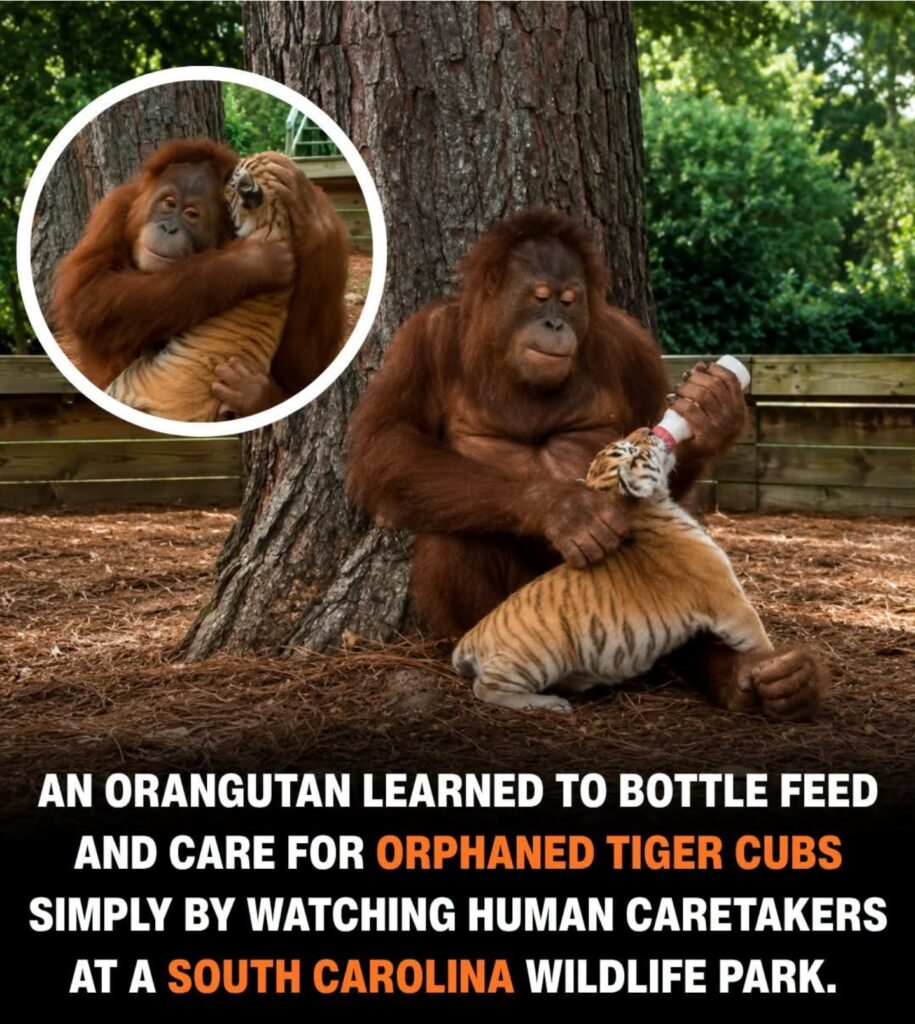
Suryia the Orangutan: A Lesson in Observational Caregiving
At the Myrtle Beach Safari in South Carolina, a male orangutan named Suryia demonstrated an extraordinary capacity for learning through observation. After watching caretakers bottle-feed and nurture a group of one-to-one-month-old tiger cubs, Suryia began mimicking their actions. He handled the feeding bottles gently, cuddled the young predators, and remained by their side with remarkable patience.
While researchers hesitate to label this behavior as a natural paternal instinct, it highlights the powerful role of observational learning in orangutans. Intelligence encompasses much more than analytical problem-solving; it also involves watching others, retaining those memories, and acting with empathy and care.
Additional Insights on Animal Cognition and Social Learning
The remarkable bond between Suryia and the tiger cubs opens a broader conversation about animal sentience, cross-species empathy, and cognitive flexibility.

- Observational Learning in Primates: Primates like orangutans possess sophisticated mirror neurons and advanced cognitive mapping skills, allowing them to absorb complex procedural behaviors simply by watching human or peer actions without direct training.
- Cross-Species Symbiosis: Instances where animals care for other species—often referred to as interspecies adoption—demonstrate that social bonds can transcend biological boundaries, driven by shared emotional cues, warmth, and the fundamental desire for companionship.
- The Evolution of Empathy: Behaviors once thought exclusive to humans, such as nurturing vulnerable infants of entirely different species, suggest that emotional intelligence and altruistic tendencies are deeply rooted in our evolutionary history, appearing in varying degrees across the animal kingdom.